The trial was to determine the fate of the Warner Bros. empire, with the opposing sides presenting vastly different arguments. The government embraced the market as it has been, and the merging companies pointed to a future marked by disruption.
Studio veterans were anxious to get the deal done and cash out, while plenty more who stayed were wary of a culture clash with the new owners. Inside and outside of the company, suspicions abounded about the role of Donald Trump and his animus toward CNN driving the court challenge.
That was the picture eight years ago when the government sued to block the $85 billion merger of AT&T and Time Warner. In 2026, as Paramount jousts with state attorneys general suing on antitrust grounds to stop the $110 billion acquisition of Warner Bros. Discovery, the parallels are striking.
The six-week 2018 trial of U.S. vs. AT&T was a showdown billed as a momentous battle between the government and a corporate powerhouse.
Watch on Deadline
There are, at the same time, some substantial differences between the Justice Department’s AT&T-Time Warner litigation and the state attorney generals’ lawsuit against the Paramount-WBD deal. AT&T-Time Warner was a vertical transaction and Paramount-WBD is a horizontal one, for starters. A vertical deal, which hasn’t been blocked in the media business for decades, is more difficult to prove as anticompetitive than a horizontal one.
Both cases, though, highlight just how important one asset is in a fast-changing media environment: time.
AT&T and Time Warner won their case resoundingly, as the judge concluded that the government had just not shown that the transaction would substantially lessen competition. But the litigation cost the two companies precious time as rivals were building out their streaming platforms. In the end, AT&T cited its deal-related debt burden, at a time of soaring production costs, in opting to exit the entertainment business. (A similarly disastrous takeover of DirecTV cemented the decision, after both mergers cost AT&T shareholders tens of billions of dollars.) In April 2022, a bit less than four years after the Time Warner merger’s close, AT&T spun off the newly named WarnerMedia into a venture with Discovery.
Blair Levin, policy analyst at New Street Research, told Deadline via email that the time AT&T lost during the legal quagmire ultimately turned out to be a devastating blow. “While the Trump DOJ had a weak case against AT&T’s purchase (the real cause of which was not traditional Republican antitrust metrics but rather Trump’s anger at CNN), the government was able to delay the deal which was costly to AT&T and diminished the value of the asset,” he said. In the Paramount-WBD case, the states “have a stronger case thank the DOJ against AT&T as it is a horizontal, not a vertical case,” he added. Plus, “the litigation is costly to Paramount both because of the ticking fee and the ability of the studios and other assets to engage in deal making while no one is certain who will be in charge when the deals go into production.”
One of the key figures from the AT&T-Time Warner trial is also a prominent player in the Paramount case: Makan Delrahim, the company’s chief legal officer. In 2018, he was the antitrust chief in the Justice Department, and he pushed back at the time on repeated claims of Trump administration influence.
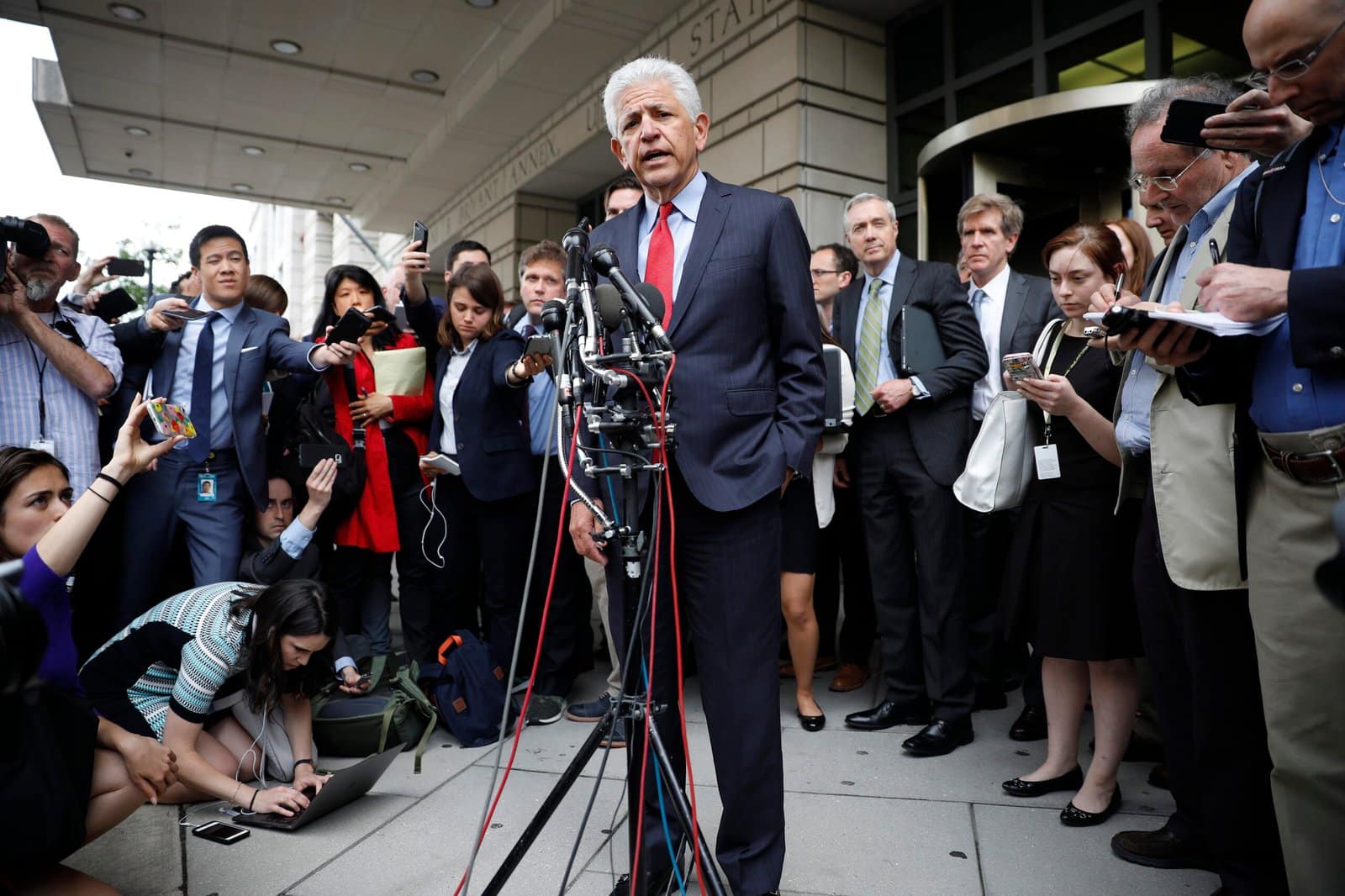
Another familiar face is AT&T’s lead attorney, Dan Petrocelli. He is now representing Warner Bros. Discovery and is expected to play a supporting role in any trial.
The judge in the 2018 case, Richard Leon, was a colorful figure with a penchant for exclamation points, strict rules for gallery decorum (no crossed legs, as all spectators were warned to keep two feet on the floor). He also demonstrated an apparently affinity for Turner Classic Movies, as he more than once asked about its post-merger future. “If there ever were an antitrust case where the parties had a dramatically different assessment of the current state of the relevant market and a fundamentally different vision of its future development, this is the one,” he wrote in one early ruling. “Small wonder it had to go to trial!”
Here are some lessons from U.S. vs. AT&T, and why the case matters for Paramount-WBD:
In his opinion, Judge Leon called the trial an “epic battle,” and it certainly seemed so at the time.
A Paramount-WBD trial may inspire visions of dramatic showdowns with CEOs on the stand, but journalists’ hopes of such moments quickly come crashing down in the reality of what is at hand: Antitrust trials are dominated by arguments about relevant markets, economic models and their inputs and dueling expert witnesses. They are almost always bench trials, decided by a single judge without the involvement of a jury. Yes, there can be moments where top executives are confronted with embarrassing emails, but most of the time they are very, very wonkish and full of arcane details.
That said, Leon did inject some moments of drama, primarily in the way that he announced his decision. Rather than just drop it in the docket, he scheduled a date and time for the announcement, gathered all the parties and the press in the courtroom, and forbid anyone from leaving until he was finished reading portions of his opinion. The 100 or so people packed into the courtroom and dozens more waiting just outside reacted with a frenzy to the news that the deal would close, reshaping Hollywood a bit less than two decades after Time Warner’s ill-fated marriage with AOL.
Judge Leon concluded that the government had just failed to show that the AT&T-Time Warner merger would substantially lessen competition. And he devoted considerable portions of his opinion to taking down the government’s chief expert witness and his economic models – which perhaps stands as a warning to the state AGs as they prepare to make their case against Paramount.
The judge also acknowledged the fast-changing landscape, noting that in the face of declining video subscriptions and TV ad revenues, in the midst of streaming and social media. In seeking to combine, AT&T and Time Warner “concluded that both companies could stop ‘chasing taillights’ and catch up with the competition,” he wrote.
One of Paramount’s big arguments is that a bulked-up combined entity would create a more robust competitor to Netflix, Amazon and Disney, especially in the streaming world.
Among other things, Paramount argues that streaming and theatrical can’t be completely separated from theatrical, and that the merger will create a “virtuous cycle: more theatrical content will drive engagement on the combined streaming platform, a larger subscriber base will generate revenue to fund more theatrical content, and the merged firm will become a stronger competitor to the technology companies atop the streaming market.”
The states’ lawsuit doesn’t challenge the merger’s impact on the recently established market of streaming. At the same time, it alleges competitive harm in three traditional markets: wide-release theatrical film distribution; anticipated big-budget blockbusters; and cable television channel licensing.
The cable market is where there is some overlap between the cases against AT&T and Paramount. Back in 2018, the government argued that the combination of AT&T’s distribution and Time Warner’s content would give them more leverage, forcing rivals like Comcast and Charter to pay more in distribution fees for “must have” channels like CNN, TNT and HBO – or even withholding them altogether. In a nod to the future, the government also argued that the combined company would have the power to slow the transition to streaming.
The state AGs argue that Paramount will control more than 50 channels, including the most “in-demand” programming, like March Madness and Major League Baseball, giving it “enormous bargaining power” that will leave distributors with “little choice but to accept onerous terms.”
Paramount maintains that the channels are complementary of each another, not competitive, and argues that cord cutting is reducing demand. “In this environment, every programmer’s bargaining position is diminishing because the underlying asset (pay television subscribers) on which affiliate fees are calculated is eroding annually,” the company’s legal team wrote in a filing earlier this summer.
“Much like in AT&T-Time Warner, defendants are likely to make sweeping arguments about how rapid changes in content business models create benefits across entertainment ecosystems,” said Diana Moss, vice president and director of competition policy at the Progressive Policy Institute. “If a judge gives credence to these arguments, as occurred in AT&T-Time Warner, the states might have a uphill battle defending the claim that the merger is anticompetitive, say, specifically in film markets. Even the unwinding of AT&T-Time Warner to revert to separate ownership and focus on content could be invoked to support the ‘efficiencies’ argument.”
Companies often point to efficiencies like streamlined operations and lower expenses in their defense of mergers. In his decision in AT&T, Leon took that into account.
Yet in the one ruling in the Paramount case so far, U.S. District Judge Araceli Martinez-Olguin splashed some cold water on Paramount’s invocation of the streaming landscape. She wrote in a footnote that she “cannot accept” that Paramount argument that the transaction will produce efficiencies in streaming. She wrote that courts “have expressly and repeatedly rejected the defense that a challenged merger will result in economic efficiencies ancillary to competition in the relevant market.”
As the AT&T-Time Warner trial was playing out, the Justice Department was reviewing another massive merger: The Walt Disney Co.’s $71.3 billion acquisition of most of 21st Century Fox, including its film and TV studio along with several cable networks and a large stake in Hulu.
Just weeks after the judge’s AT&T decision, the DOJ approved the deal. Unlike the Time Warner transaction, Disney-Fox was a horizontal merger that put one of the remaining legacy film studios, 20th Century Fox, under Disney control and effectively off the industry map. The state AGs call Disney-Fox a cautionary tale, noting that it resulted in the loss of 4,000 Fox employees, reducing production and film output.
Paramount dismisses the Disney-Fox merger impact as “irrelevant” in light of “a broader market trend that existing firms can, do, and likely would expand output in response to another competitor’s output reduction.” Paramount has pointed to the near doubling of its release count since the 2025 merger with Skydance, while also heralding its commitment for Paramount-WBD to distribute at least 30 theatrical films per year.
Paramount likely will challenge the state AGs market definitions as well as their claims that the combined market shares of the combined company in key markets – in this case around 30% – make it presumptively illegal. In this case, courts have considered other factors, such as low barriers to entry, Paramount contends. That’s why, when it comes to theatrical, Paramount’s legal team has emphasized the unexpected success of movies in the marketplace, including Focus Features’ Obsession.
They wrote that “the indisputable evidence shows that rival film production and distribution companies can and would expand their theatrical film slates if the merged firm were – contrary to its own economic incentives, to reduce output or try to increase prices for theatrical films. These low barriers to expansion would leave the merged firm with nothing to gain from reducing theatrical output or trying to increase prices to theaters.”
The judge, though, wrote in her opinion granting a temporary restraining order that Paramount still had not shown that the merger “would not substantially lessen competition.” That does not mean that she was convinced the merger was illegal — only that there were disputes over the facts of the market effects and that the lawsuit “at least demonstrates that serious questions going to the merits remain.”
From the moment that the Justice Department sued to block the AT&T-Time Warner merger, there was suspicion that the motive was CNN, which critics said was being targeted for its unfavorable coverage of the Trump administration.
The DOJ denied this, but that didn’t stop AT&T from seeking a court order to compel the DOJ to produce information on potential White House influence. Judge Leon, though, refused to go down that route before the trial even started.
This time around, Paramount’s David Ellison has claimed that CNN is also behind the opposition, writing in a New York Times op ed that the “issue is whether I can be trusted as a steward” of the network. Particularly among Democrats, there are concerns that Ellison will move the network to the right, and his repeated overtures to the GOP and Trump (dinners in his honor in Washington, trips to Mara Lago, seats at UFC matches, which stream exclusively on Paramount+) have only increased suspicion. In contrast to AT&T-Time Warner, a merger proposed before he had even won a first term, Trump has been more overt this time in his desire for changes at CNN.
One idea floated by backers of the Paramount-WBD deal, among them TKO Group CEO Ari Emanuel: an independent committee set up to oversee the network to ensure the independence of its news operations. The setup has been implemented before. A special committee was set up in 2007 to oversee editorial integrity at The Wall Street Journal, as Rupert Murdoch’s News Corp was looking to acquire the news outlet from the Bancroft family trust. The committee to this day has to grant approval for the appointments of an editor-in-chief and editorial page editor.
Despite that precedent, California Attorney General Rob Bonta, who is leading the state AG lawsuit, signaled that such a condition would not be sufficient with Paramount-WBD. He denies that the plaintiffs’ complaint is rooted in concerns about CNN, and he insists that any settlement will require robust “structural” remedies, like the sale of assets to alleviate the impact on competition concerns.
When it comes to antitrust trials, the real drama can often be the ticking of the clock.
The fact that the AT&T-Time Warner merger was waylaid for 20 months due to the antitrust trial may not have been the only reason for its ultimate failure, but the protracted limbo state certainly didn’t help.
The delay hampered the launch of streaming flagship HBO Max. Like NBCUniversal and Disney, WarnerMedia had finally decided to enter the costly direct-to-consumer streaming market after a decade of ceding it to Netflix, Amazon and Hulu. In part due to the lawsuit, HBO Max was the only major new service to have to postpone its debut. It finally hit app stores in the spring of Covid-marred 2020, becoming the last in a multi-billion-dollar burst of new entrants like Apple TV, Disney+ and Peacock coming to market over a seven-month span.
As mired as AT&T-Time Warner got in litigation, Judge Leon’s decision that the trial should start in March 2018, just four months after the suit was filed, was a light-speed pace compared with the Paramount case. He was mindful of the June 21 expiration of the merger agreement, which carried a $500 million breakup fee.
Judge Araceli Martinez-Olguin, on the other hand, was not swayed by Paramount’s call for a trial on a similarly accelerated timeline, but her trial start date of March 2, with a shorter projected length of 12 days, still leaves some room to render an opinion before the June 4 merger expiration date. The stakes, though, are much higher. Paramount would face a $7 billion breakup fee and has agreed to pay WBD shareholders a ticking fee of roughly $7 million for every day the deal is not closed after Sept. 30.
