The Sun sure shone for me.
“Get on the bloody Concorde with Jerry!” The Sun’s news editor barked when I rang in the old-fashioned way from a call box at JFK. It was 1982.
When I queried how to pay for the hefty cost of a seat on an Air France supersonic jet to Charles de Gaulle airport in Paris, I was told, “Pick up the pre-paid ticket from the desk and get on the bloody plane.”
The ‘Jerry’ in question was Jerry Hall. She was dating Mick Jagger but had entered into a brief fling with racing tycoon Robert Sangster, who was a big noise back then.
My Sun colleagues back at the paper’s Fleet Street office had just discovered that Jagger was planning to reunite with Hall, the glamorous cover girl and catwalk star, in Paris. My task was to accompany her on the flight and get her to talk. Even a simple “hello” or “piss off” from her was worth a thousand words to the paper.
Watch on Deadline
John Kay, The Sun’s then-chief reporter, used to say that whatever words a subject uttered was copy. You could, in theory, write, ”Jerry Hall spoke for the first time today, amid her reunion with Rolling Stones front man Mick Jagger, following her brief liaison with millionaire playboy Robert Sangster…”
And that’s how it went down. Legendary photographer Arthur Edwards was waiting to snap a photo as Jerry exited customs. She ran into Jagger’s arms as he cooed, ”Hello babe.”
It was all so easy-peasy. I was The Sun’s U.S. correspondent based in Manhattan. After that perfect airport rapprochement, Edwards and I tailed them to Jagger’s chateau near Amboise in the Loire Valley. I had a travel bag with a change of clothes but it was freezing. I swiftly purchased a double-breasted wool and camel hair Burberry overcoat (on expenses — thank you, Rupert Murdoch) which, amazingly, I still have. It’s not in bad nick and it’s perfect for walking the dogs on winter weekends.
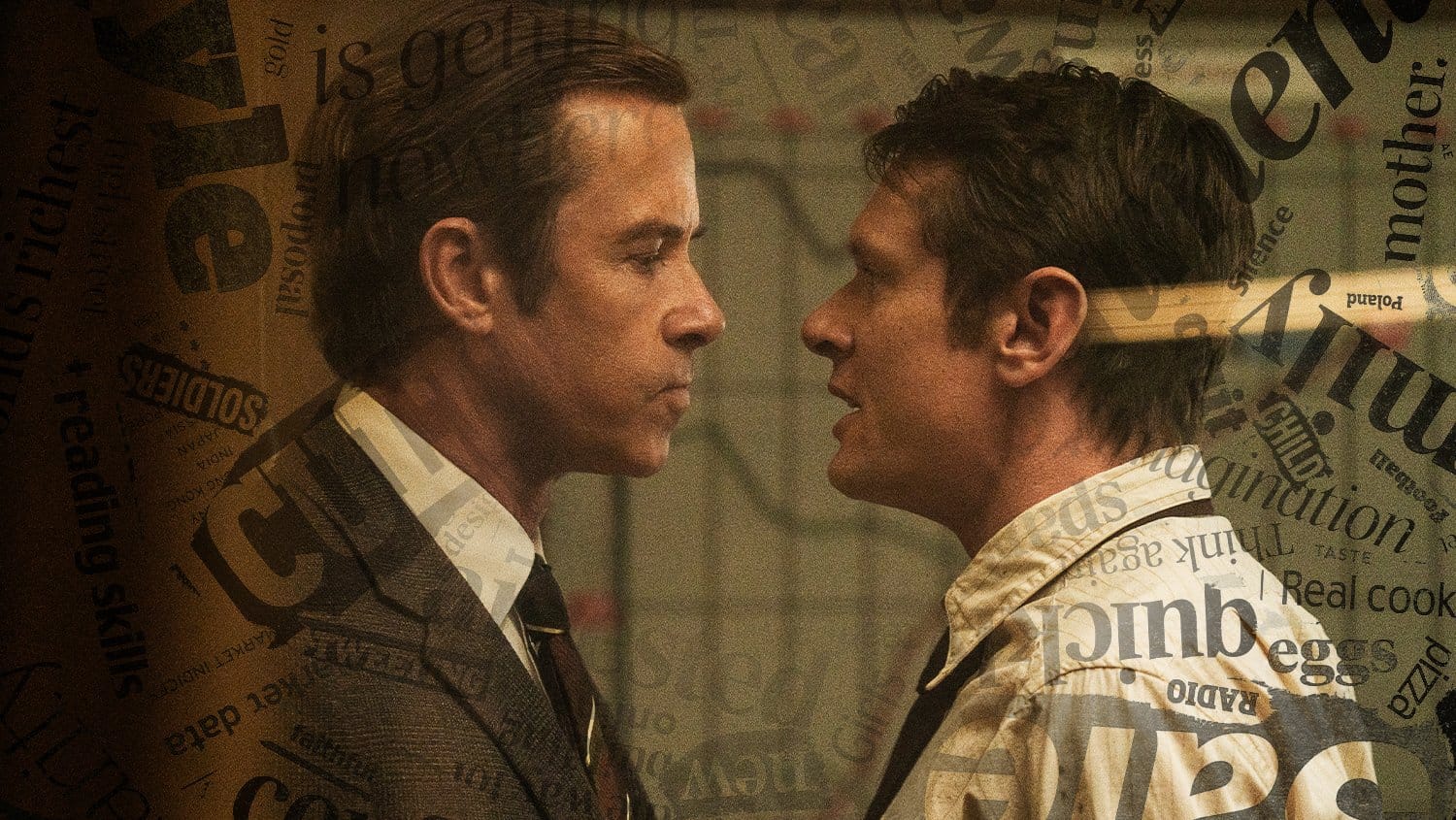
The aforementioned tale and other crazy memories came flooding back as I watched Danny Boyle’s scorching new movie Ink, which opens the Venice Film Festival on the Lido on Wednesday.

Anthony Dickenson
The film is a sort of origin story for the tabloid papers as we know them today.
Jack O’Connell (Sinners, 28 Years Later) stars as Larry Lamb, a then-little-known, Yorkshire-born news executive on the U.K.’s biggest selling daily paper, the Daily Mirror. The business-savvy Murdoch approaches Lamb with a plan to relaunch a rival to the Mirror: The Sun newspaper, a middling broadsheet he’s bought for a pittance from Hugh Cudlipp’s IPC publishing group. And this mission suits Lamb just fine, because IPC also owns the Daily Mirror, and Lamb is out for revenge against his employers for not promoting him. Lamb gamely assembles a team of brilliant misfits and The Sun relaunches as a tabloid in November, 1969.
O’Connell is superb as the brilliant newspaper tactician Lamb. It’s a huge performance, even Shakespearean in stature, as glory turns to tragedy.
In the stage version of Ink, written by James Graham, which premiered in London in 2017, the role of Murdoch was played by Bertie Carvel (Dalgiesh, Doctor Foster) and he was magnificent. But for this film incarnation of Graham’s story, Boyle wanted an Australian to portray the man labelled the ‘Dirty Digger’. And Guy Pearce cracks it as the Aussie who beat the Brits at their own game of publishing. Doyle’s ‘big three’ cast is rounded out by Claire Foy (The Crown, Women Talking), who is ferociously good as Jules, an amalgam of the group of women Lamb gathered for plumb posts on the Sun.

Anthony Dickenson
Boyle introduced Foy to former newspaper editor and columnist Eve Pollard (who happens to be the mother of The Traitors host Claudia Winkleman). “Claire loved her biting wit and modeled herself primarily on Eve and other pioneering Sun women, such as Joyce Hopkirk, who went from being the paper’s first women’s editor to editor of the U.K. Cosmopolitan,” Boyle tells me when we get on the phone to discuss the film.
He took Graham’s award-winning play of the same name and spun it into cinema art. “It’s cracking the Magnificent Seven of it. Assembling a bunch of people. They were the underdogs, and Larry and Rupert turned them into all-stars,” Boyle says.
The Sun soared. Within months, it was outselling the Mirror and in its heyday, the paper sold four million copies a day.
The runaway hit paper was laced with stories about the shenanigans of stars, politicians, footballers, Page 3 girls (back then, topless female models were on every issue’s opening spread), horoscopes, sport, female-aimed features and serializations of books about matters of sex — all with pithy, attention-grabbing headlines, saucy graphics and photos. The paper absolutely revolutionized daily newspaper habits. “It’s taken us to where we are now with the internet,” Boyle says, adding, “we can’t complain about it because we bought it. No one forced us to.”

Anthony Dickenson
In Darkest Hour, for which Gary Oldman won a Best Actor Oscar for his portrayal of wartime leader Winston Churchill, the great statesman is seen riding on the London Underground — a bit of poetic license. But Murdoch actually did ride around on the tube, checking out which newspapers were being read. “It’s true,” Boyle says. “Back then, he wasn’t the household name he is now. He blended in.” And it was such scenes as this that allowed Boyle and Graham to turn a stage-bound story into a big-screen tale.
Boyle studied film adaptations of Peter Shaffer’s Amadeus, which was turned into an Oscar-winning Best Picture by Miloš Forman, and Christopher Hampton’s Les liaisons dangereuses, from which filmmaker Stephen Frears created Dangerous Liaisons, which won three Oscar trophies and was nominated for Best Film. “I looked at them because these two films were based on stage plays but in the hands of Forman and Frears they became pure cinema,” Boyle says.
Boyle says he’s in such awe of Frears (The Queen, The Grifters, Philomena) that he and others are encouraging the British Film Institute to honor Frears with a “big BFI season” of his movies.

Anthony Dickenson
When Kelvin MacKenzie took over as The Sun’s editor in 1981, he hired me away from the Evening Standard to become The Sun’s show business and general reporter in London. I covered riots in Brixton, South London, and when there was unrest in Liverpool, MacKenzie ordered teams of reporters to cover the mayhem. But covering movie and rock stars was my main beat.
One time, I showed up at Elizabeth Taylor’s pad in Chelsea and handed her a bouquet of flowers. She was huge news in those days. By then, Richard Burton was divorced from Taylor and married to Sally Burton, but still, he turned up for Taylor’s 50th birthday celebrations. So, of course, I followed him. It turned out he was staying at the Dorchester Hotel, where I somehow managed to persuade him to let me inside his suite. As he poured out his heart about “darling Elizabeth” (and poured booze down his throat), I would excuse myself to the bathroom every fifteen minutes to write up notes on the crinkly, hard loo paper. Not to boast (OK, I will), but the resulting spread brought me job offers from rival papers. So, Murdoch and MacKenzie dispatched me to New York to keep the poachers at bay.
Talk about fun on the Sun! I had the time of my life!
“Joan Collins has a cold. She’s in Los Angeles. Take her flowers and get an interview.”

Nick Wall
“Rod Stewart’s living it up in Hollywood. Go see him.”
One day, the instruction came: “Randy Andy (the former Prince Andrew) is on a plane with model Koo Stark bound for Barbados. They’re headed for Mustique, and the Daily Express is with them. Go and join them.”
“The local authorities won’t let me stay on the island,” I wailed.
“Charter a yacht!” came the reply. But I was also told to share said yacht with rival journalists to cover the costs, mind you. Every morning, we’d row or swim to Basil’s Bar, where we were allowed to avail ourselves of his food and drink, for a price. Island security would corral us at Basil’s. However, a few of us would slope off to try and interact with the prince and his starlet.
My photographer Matthew Ford and the Daily Mail’s snapper Peter Carrette were arrested. When we tried to bail them out of jail, Carrette managed to covertly pass me his roll of film. By rights it belonged to the Mail. But I had it, so they had to share. The resulting photo that ran in The Sun of a bare-chested Andrew was headlined Me Tarzan, You Koo.
The escapade cost thousands of dollars. The Sun’s managing editor was livid. He still approved my expenses.
There were many other such jolly outings in the Caribbean, South America and across the U.S., all with the aim of filling column inches with showbiz and a few actual hard news stories. The thing about The Sun was, they had a crack team of reporters and editing staff who would turn your turn your copy into gold. People used to ask if I was ever embarrassed about working on The Sun. I wasn’t.
When I accompanied Andrew from Barbados back to London, a TV newsman interviewed me after I landed at Heathrow and asked me to justify the time and money spent chasing the prince and the showgirl. I simply replied that “I was enjoying myself.”
A year or so later, the Daily Mail’s editor David English was in Manhattan. He came a-courting and I switched papers. My days in The Sun were over.

Anthony Dickenson
The best movies set in the newspaper world are mostly American ones. Boyle cites Billy Wilder’s Ace in the Hole. And, of course, there’s Alexander Mackendrick’s Sweet Smell of Success, Howard Hawks’ His Girl Friday, Alan J. Pakula’s All the President’s Men and Tom McCarthy’s Spotlight. The only British movie that springs to mind is Val Guest’s The Day the Earth Caught Fire — and now there’s Boyle’s Ink. It joins that list because it’s a portrait of Britain that also reflects aspects of our society now, for good and bad.
In Graham’s play Ink, it was Carvel’s larger than life portrayal of Murdoch that seemed to dominate the piece. Graham tells me that Boyle “wanted to slightly tilt the balance” towards what “I think was the surprise in the play — that everyone assumed they were coming to watch a biography of Murdoch, and that Murdoch is the agent of all this change. I think what delighted Danny was the idea that actually no, it’s Larry Lamb, this guy you’ve never heard of, who who drove a lot of those most radical changes and built a lot of what would become the template for modern day populist sensational news. Danny really delights in that.”
Boyle says that he was initially apprehensive about seeking out Carvel to play the Mirror’s owner Hugh Cudlipp. “I loved the play and I remembered when I saw Bertie do it, that theater is a celebration of live performance. But for the film, I wanted Bertie to flex different muscles as Cudlipp. I thought he’d kill me when I approached him about Cudlipp. And he did go, ‘Oh, f–k, really?’ But when I explained that I wanted an Australian for Murdoch he understood what I was saying and took Cudlipp and captures him.”
But it’s O’Connell’s Lamb that’s at the heart of the film.
Boyle thought of Al Pacino in The Godfather Part II when he was working on the script with Graham. “You see Pacino’s Michael Corleone shut out the people closest to him and Lamb does that in Ink. Jack does that. His desire to create this newspaper makes him lose his soul,” Boyle says.
Graham notes that what’s liberating for him is “you know everybody has strong feelings about The Sun in particular, and Murdoch’s empire more generally. What’s liberating for us, I guess, is by going back to the beginning, you don’t have to worry about the politics of the now in painting too much on that. You’re basically going, this is how the newspaper was built. This is how it started. Isn’t it quite surprising, actually, that a lot of the people who built it were working class outsiders, often from the north and around the country — a group of people trying to make the news less pompous and less earnest, and make it fun.”
But of course, now we’re in an era where everything has changed. 24 hour news and commentary taking over from the facts has only escalated, but also, social media and AI and the platforms in which we share information now are all about engagement. It’s all about distraction and engagement and activation rather than what people might need to hear, or what the boring truth is. And that is worrying. “I think I’m terrified and worried about all those things,” Graham says. And going back to the surprising origins of in The Sun in the 1960s has made him see that the state of how we get our news now is “more urgent than ever.”
Ink has its U.S. theatrical release on December 11, U.K. theatrical through StudioCanal is January 8 and it’s on Netflix in the U.S. from January 8.
