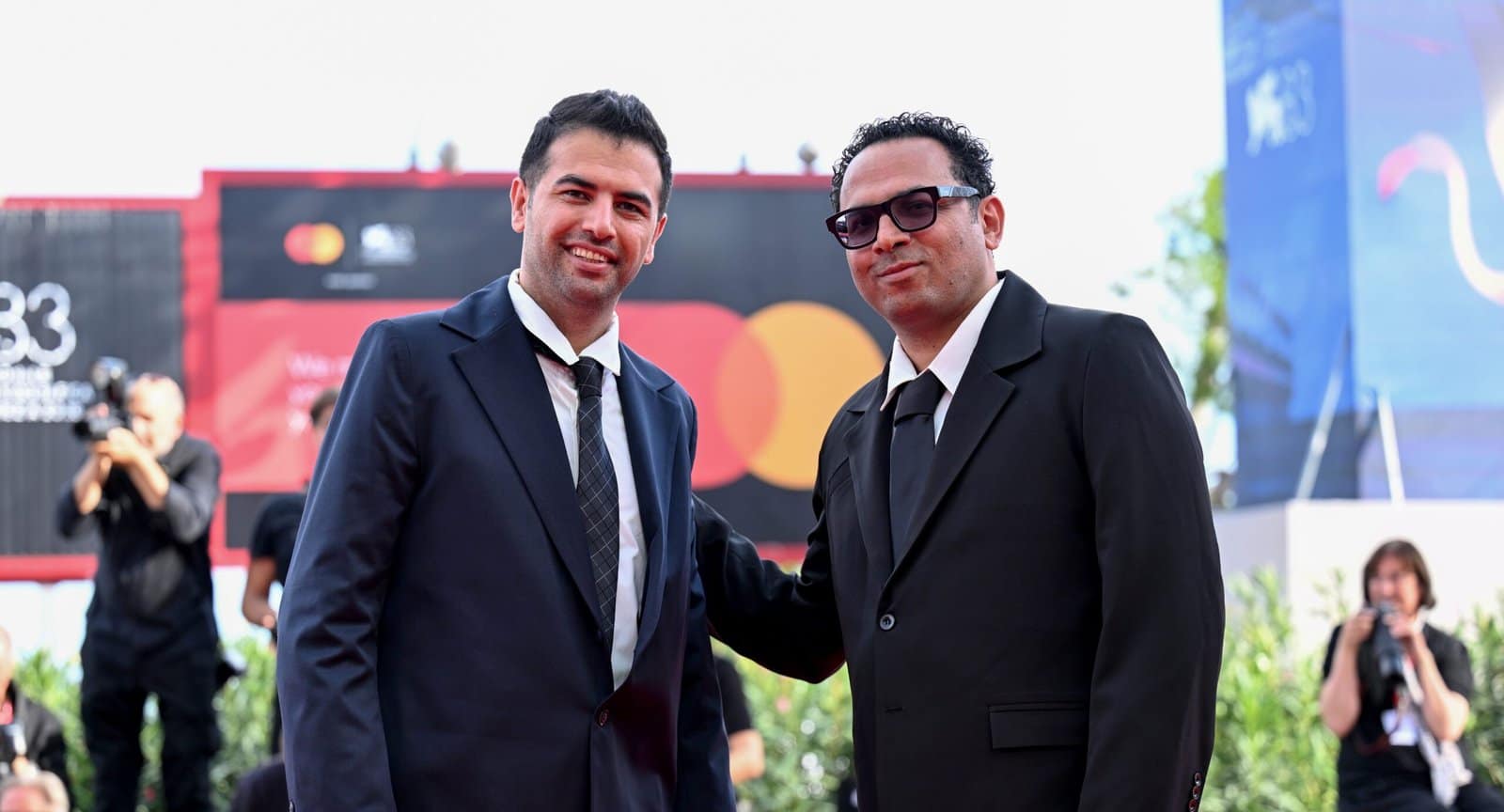
Iranian director Ali Asgari’s contemporary Tehran-set drama A Bit Of Light premiered at the Venice Film Festival on Friday evening as the penultimate competition screening.
The raw, timely drama was shot in the immediate aftermath of the Islamic Republic’s brutal crackdown of pro-democracy protests in January 2026, in which thousands, if not tens of thousands, are believed to have died.
Missagh Zareh, who played the crazed father in Mohammad Rasoulof’s Oscar-nominated drama The Seed of the Sacred Fig, stars as a doctor who does the rounds of friends and family to inform them that he has decided to take his own life in response to his sense of hopelessness about the state of Iran.
In the process, he takes the spectator on a journey across Tehran, as he stops off at his regime- ransacked surgery as well as the home of a mother caring alone for her shot-up protestor son, too scared to take him into hospital for fear he will be arrested; his sister’s incongruously serene yoga studio, an underground theater and finally his beloved mother’s simple but warm home.
Watch on Deadline
In an impromptu interview with Deadline at the Lido’s at the Excelsior Hotel immediately after the film’s buzzy premiere and 15-minute ovation in the nearby by Sala Grande, Asgari and the lead producer Milad Khosravi of Seven Springs Pictures are at once happy and sombre.
Venice regular Asgari, whose previous features Divine Comedy and Disappearance and short The Baby played in the festival’s Orizzonti sidebar, reveals the film grew out of events prior to January 2026, when the armed conflict between Israel and Iran flared up in June 2025.
“Bombs were coming down every day but at the same time people were going about their lives. Children were playing in the streets,” he explains, saying how he was stuck by the existence of “life and tragedy” side by side.
“There was a day when I had a really bad feeling because of the bombs and I called my mother. She said, ‘Come to me’. It took like 45 minutes and in these 45 minutes, she had cooked a meal and bought bread. She made tea, and we started to eat to the sound of bombs and approaching jets.”
Asgari says he had also been mulling the idea of a character who was disappointed in life and wanted to end it but had struggled with how to develop him fully and come up with the motivation for the suicidal thoughts.
“Then suddenly the January massacre happened, and the atmosphere in society was quite depressed and sad because so many people had been killed in the street,” he recounts.
With the internet down and people in the dark over the full extent of the killing, Asgari says a doctor friend had filled in the blanks for him.
“He basically lost hope for the future because he had seen so many people die and a lot of young, injured people,” says Asgari, suggesting that medical staff were the main witnesses of “the tragedy” that happened.
The film also taps into the fearful yet expectant mood in Iran provoked by U.S. President Donald Trump’s comments post the protests that he was a considering military strikes on Iran to pressure it into a deal over its controversial nuclear program.
The likelihood of a bombing campaign and the absurdity of taping up windows as a means of protection from U.S. missiles are a topic of conversation, while one character suggests he would love for a missile to takeout his crumbling home to save on demolition costs.
Asgari and Khosravi, who is also the producer of Iranian director Mohsen Gharaei’s Falling House in Orizzonti, decided to take the precaution of shooting the film between Iran and Turkey for fear of regime reprisals.
Having managed to shoot exterior establishing shots in Tehran, they headed to Istanbul to shoot the interior scenes in the homes of the Iranian community living in the city .
“We started work on the film immediately after the protests, but when the war started, everything became even more radical. The regime was more aggressive. We were worried that they would take our camera or even accuse us of being spies,” says Khosravi.
“It was also impossible for us to get official permission because Ali is known as an underground rebellion director by the regime, but we were determined to find an alternative way to make this film about this period in the history of our people,” he continues.
“We have to talk about the reality of what happened, the mass killing that happened, and also the war, and in a timely manner, in a short period of time, to bring it to global cinema now and not many years later.”
Resources were so tight that crew also ended up in the cast, with the boom operator, for example, playing the protagonist’s younger brother, while Asgari also has a cameo as a regime-supporting doctor at the beginning of the film.
Besides digging into the events of the January 2026 regime crackdown, Asgari also took the decision to show the female characters without a hijab, in a move that contravenes Islamic Republic rules stipulating women must cover their hair.
He says this is a reflection of women, the big cities at least, widely ditching the wearing of the hijab in public in the wake of the Women Life Freedom protests, sparked by the killing in police custody of 22-year-old Mahsa Amini in September 2022.
“If you go walk in the streets of Iran, especially Tehran, you don’t see women with the hijab anymore,” says Asgari.
“Filmmakers need to arrive at a point where they tell the story of the current society. When in the city you’re seeing women without the hijab, to shoot a film with women in hijab is ridiculous, even if directors are still doing it, and working with the system.”
As the film begins its international career with the world premiere in Venice, Asgari says he has no idea what reception awaits him when he eventually returns home to Iran.
“We’re living in a country where everything can be classed as a political act. When the internet was cut off, for instance, people were arrested for using Starlink. Even having internet becomes political. As the film shows, being a doctor and saving lies can be political. Everything has the potential to be viewed as political in Iran,” says Asgari.
The director reveals he was called in for questioning about the film when its Venice selection was announced.
“They asked me to explain why I made the film without their permission,” he recounts.
“I said, ‘As state Iranian TV reported been killed 3,800 people were killed over the course of two days in this country, as a filmmaker and as a human being, do I have the right to talk about it or not?’,” he says, explaining he is referring to a figure reported on state Iranian TV.
Khosravi, who currently based out of Istanbul, says he has no plans to go back to Iran right now.
“I already miss my country and my family but at the same time, I need to keep this connection between the global cinema industry and Iranian filmmakers inside, and try to support them,” he says.
He emphasizes the role the international film community can play in supporting Independent Iranian cinema, which he says is under more pressure than ever before due to regime crackdown and the war.
“We don’t want to present ourselves as victims, but it’s important to talk about the difficulties facing filmmakers in Iran… we have amazing talent and a tradition of cinematic storytelling, but without support, or we if stop because of the war, or other pressures, I fear we could lose it… it’s why support from festival’s like Venice, which is playing two Iranian films this year is so important. “
