
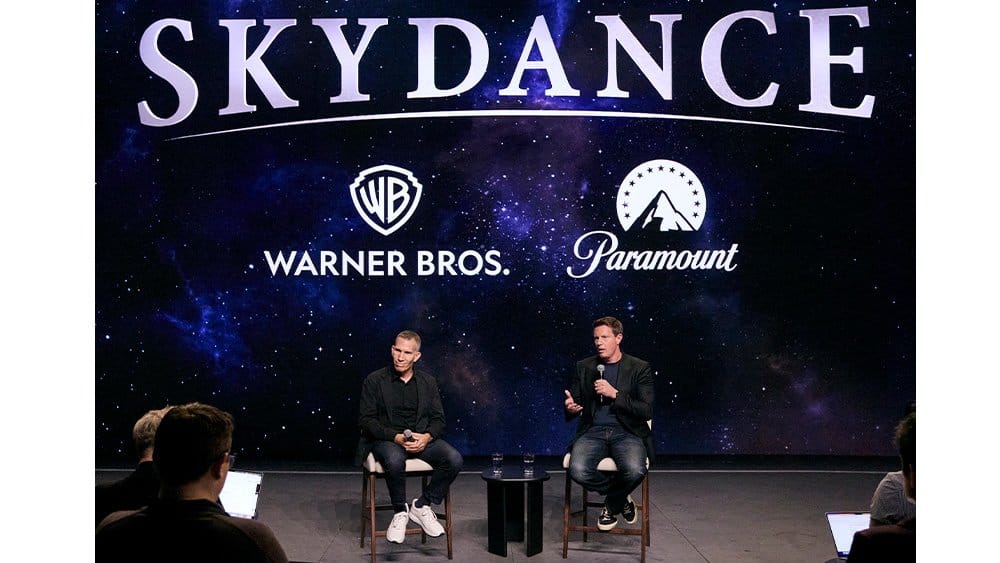
David Ellison and Ynon Kreiz spent a big chunk of their first day as CEO and co-CEO of Skydance, respectively, being interviewed.
First by CNN’s Anderson Cooper at the company town hall on the Warner Bros. lot in the morning and then by reporters in the afternoon at a press conference held on the other studio lot owned by the new Skydance, Paramount.
Ellison and Kreiz, following the trend of co-CEOs dressing alike, met with press on Stage 3, a fitting setting for a company driven by technology, as Ellison always stresses. Its manager Craig Weiss described it as “the first of its kind virtual production stage, utilizing laser projection.”
That was a major upgrade from the August 2025 post-merger Paramount press conference on the lot, which took place in an empty room nearby. (In another change, two of the senior Paramount executives who took questions alongside Ellison back then, Jeff Shell and Cindy Holland, are no longer there.)
Watch on Deadline
The Skydance team utilized the immersive projection equipment for a Day One sizzle reel promoting the Paramount and Warner Bros. titles that are coming together. Despite the event taking place on a TV stage, the video was very film-focused, largely ignoring television for the majority of it until a sequence of series highlights in the final seconds.
Ellison and Kreiz were asked to elaborate on the language from the press release announcing Kreiz’s appointment as co-CEO, which stipulated that all business units report to both of them, and explain how they divvy up CEO duties.
“There will be natural delineation between us in terms of our respective experience and concentration, which we believe are highly complementary,” Kreiz said. “Where David will focus on creative, technology, long-term strategy, including especially as it relates to the creative part of the business, I will focus more on the operations and the day-to-day management of the business, including integration, particularly the first phase.”
The duo, who will take their message to investors next, were asked to explain how Skydance, which has $79B in debt, can commit to $30B – $40B on producing new content.
“We have a business plan,” Kreiz said. “There’s a complete financial envelope to how we’re going to run the business, and content is is a spend, but you can also see it as an investment because it’s also going to drive growth. And as a whole, yes, we have debt, but we expect to reduce the leverage.”
Ellison pointed to Paramount’s balance sheet for the last year.
“We’ve over delivered on synergies, $2.7 billion basically by the end of this year, from an initial announcement of $2 billion, we did that while doubling the film slate at Paramount, from eight films to 15, greenlighting four new and returning series, and growing even significantly year over year. So you actually can do both things simultaneously.”
Other tough questions Ellison faced included his family’s cozy relationship with President Donald Trump (“I think it’s important to talk to everybody on on both sides of the aisle” & “We believe in complete editorial independence”) and how he plans to rehabilitate his image and regain the trust of those in Hollywood who opposed the merger (“I do genuinely believe this is the the best outcome for the industry. I think we will deliver for the creative community. We will deliver for our shareholders. And the best I can say to our detractors is, give us time, and we’ll prove it.”).
There weren’t specifics on a number of topics — from the timeframe to merge the company’s streaming platforms HBO Max and Paramount+, to a possible consolidation of the three TV studios down the road, to the plan for Skydance’s 30+ cable networks as well as how film and TV operations will be split between the Warner Bros. and Paramount lots, how the Paramount and Warner Bros. studios will get to the 30 movies a year goal and the status of Barbie 2.
As Ellison and Kreiz noted repeatedly, it was Day One after all.
