
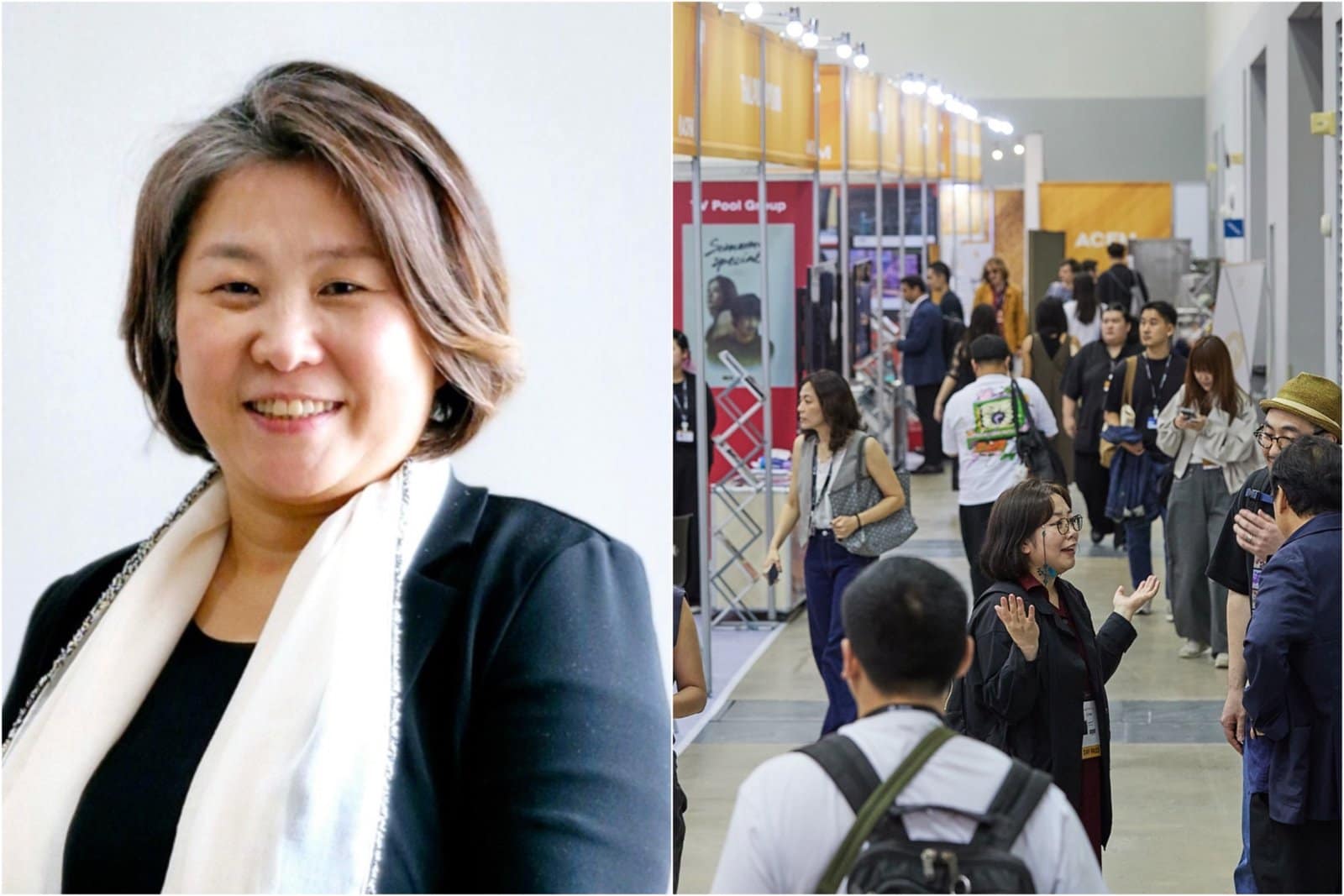
Asian Contents & Film Market (ACFM), the industry platform of Busan International Film Festival, launched three new programs last year, which are starting to yield results as they move into their second edition.
Among these, InnoAsia hosts a range of panels, workshops and other events focusing on advanced technologies and innovative business strategies, including AI, Virtual Production, microdrama, VR & AR and branded content. As ACFM market director Ellen YD Kim explains below, projects introduced through InnoAsia’s AI works-in-progress showcase last year have already gone on to raise finance and reach the international market.
Companies attending this segment of the market include Google DeepMind, Amazon Web Services (AWS), Kling AI and Alibaba Group. Kling AI, the AI video arm of China’s Kuaishou, is hosting a panel on the second day of the market, New Cinematic Possibilities: Reimagining Filmmaking, with speakers including Korean director Kim Sungsoo (12.12: The Day) and Lee Sangwook, a producer at MBC C&I AI Contents Lab.
Watch on Deadline
In addition, ACFM is hosting the second edition of DocSquare, which brings together Asian documentary filmmakers, distributors, festivals and funders. This year, the market is hosting an ‘Impact Asia Day’, during which a study of documentaries in Korea, Japan and Taiwan will be released.
Another initiative entering its second year is ‘The A’, a conference summit and in-depth report covering 15 Asian territories. This year’s panels include a session on Asian film distribution, with speakers from companies including Korea’s Noori Pictures, Thailand’s Chada Entertainment and Mongolia’s Filmbridge; and an investor panel, featuring Solaire Partners, Pathe Films and Hive Media Corp, among other speakers.
All the market’s other long-running programs are also returning – Asian Project Market (APM), which this year has selected 30 projects from 20 countries; Busan Story Market, which is presenting 25 pieces of IP from Korea, Japan, Taiwan and Indonesia; Asian Cinema Fund; Producers Hub, and Platform Busan.
Two Asian film industries will be under the spotlight at this year’s ACFM – Thailand has been anointed the first ever ‘Country of Honor’, while Japan is the ‘Focus Country’ in the Producers Hub.
Speaking to Deadline in the run-up to ACFM, Kim explains that the market aims to help the industry navigate one of its most turbulent periods – a time of mergers, shrinking capital, restructuring of platforms and the disruptions of microdrama and AI – by providing a platform to “Connect, Strengthen, and Expand”.
ACFM is taking place at BEXCO from October 10-13, during Busan International Film Festival (October 6-15).
DEADLINE: How was InnoAsia received by the Asian industry last year and what results have you seen so far?
ELLEN YD KIM: InnoAsia has established itself as the place in Asia to see where generative AI filmmaking actually stands. The industry values it for bringing together in one place the AI production tools and pipelines that global tech companies and creators are working with today.
AI projects introduced at last year’s Work-in-Progress Showcase have gone on to raise production financing and participate in the Cannes Marché du Film. Mateo AI Studio signed a promotional partnership with Kling AI; was presented at Kling AI’s session in Cannes; and raised $1.5m (KRW2bn) in pre-Series A funding. The company’s fully AI-generated feature Raphael is now being readied for release.
Producer Ham Seul-gi and director Seol Woo-in, who took part last year with an AI short, founded AIKNOW Studio and completed an AI feature, Steelay, which they will preview at this year’s WIP before it opens in Korean theaters on October 20.
Inshorts, an AI upscaling company, went from InnoAsia’s start-up strand to being presented as Korea’s representative at EFM Startups in Berlin and at Cannes Next, and has since been expanding its business with contracts in Japan, China and other Asian markets. The company returns to InnoAsia this year as an exhibitor.
DEADLINE: How are ACFM exhibitor numbers tracking this year compared to last year? Any new participants?
KIM: This year 339 institutions and companies from 32 countries and territories are exhibiting, including four with online-only booths. That is up 17% from 289 exhibitors from 31 countries last year, and the fourth consecutive year of growth, from 264 in 2023 and 275 in 2024.
The strongest interest has come from Thailand, this year’s Country of Honor, which has grown from 17 exhibitors to 28. Japan, the Producer Hub Focus Country, is now the largest international presence with 46 exhibitors. Growth across Southeast Asia is also clear: the Philippines is up from 15 to 21 exhibitors, and Cambodia from one to nine.
Europe’s presence is also notable. The UK has grown from one exhibitor last year to seven this year, with companies such as Protagonist Pictures and Cornerstone Films under the UK Film stand. Leading European sales companies including Goodfellas and Le Pacte from France, Pluto Film from Germany and Heretic from Greece. And more countries are joining for the first time or returning, among them the Czech Republic and Slovakia, Bangladesh and Kazakhstan.
The mix has changed too. Tech exhibitors have increased from seven to 18, and national agencies and film commissions from 62 to 79. The market is broadening from trading finished films into a place where technology, co-production, location attraction and the promotion of national industries feed into one another.
DEADLINE: Why did ACFM decide to spotlight Thailand and Japan this year? What strengths do these markets currently have? And what can other markets learn from them?
KIM: The two countries are taking part at different levels. Thailand is the ‘Country of Honor’ of the market as a whole. Launched this year, Country of Honor is the highest tier of ACFM’s country partnerships, and it presents a country’s industry as a whole across a wide range of ACFM’s programs. Japan is the Focus Country of Producer Hub, which works on a different scale. It concentrates on producers, and through them on the driving force of production: their projects, their co-production experience and the environment they work in.
Thailand has been developing content as a key pillar of its national soft power strategy. In 2025, the country hosted more than 540 foreign productions, and it offers eligible foreign productions cash rebates of up to 30%. At the same time, Thai titles have entered the Netflix Global Top 10, proving the competitiveness of its own content. Its strength is that it is both an international production base and a market with competitive local content.
This year Thailand presents five features as the inaugural line-up of the Busan Story Market’s new ‘Remake IP’ section; co-hosts our opening reception, and is bringing 28 exhibitors. The ties with Busan also run deep: from Pen-ek Ratanaruang’s Ploy in 2006 to last year’s APM selection, Thai projects have been traveling to the world through Busan for 20 years.
Japan today is Asia’s most dynamic co-production partner. On top of its longstanding strength in independent and arthouse cinema, bold policies centered on grants and incentives are expanding international collaboration into commercial films and series. This year ten Japanese producers will pitch their projects in Busan, including co-productions with Korea, Canada, Indonesia and France. Japan’s Agency for Cultural Affairs (Bunka-cho) is taking part directly for the first time.
Our focus on these two countries is the result of two governments’ determination to take their content industries overseas and meeting the partnership efforts ACFM has been steadily making. Thailand needed a market that could turn its soft power strategy into real business, and ACFM proposed the Country of Honor program. Japan, backed by new support policies, was looking for a place to meet international partners, and came to us first to say it wanted to take part as the Producer Hub Focus Country. The lesson for other markets is that a government’s commitment produces results when it meets a concrete platform ready to put it to work.
DEADLINE: The Korean industry appears to have picked up this year – at least with some big box office hits and titles selected for major festivals. What are your thoughts on the current health of the industry?
KIM: The recovery is real. Box office for the first half of this year reached $431m (KRW 579bn), up 42% on the same period last year, while admissions rose 34% to 57.05 million. Korean films led that recovery taking 64% of first-half revenue, with The King’s Warden becoming the highest-grossing film in Korean box office history.
What interests me more is the breadth. Success was not limited to period dramas and action tentpoles. Mid-sized films such as the romance Once We Were Us and horror film Salmokji: Whispering Water also succeeded, and audiences in their twenties were at the heart of it. A film’s strength and word of mouth, not its release date, are now deciding the box office. We have been reminded that audiences never left the cinema.
I also do not think the health of Korean cinema should be measured by the domestic box office alone. Korean IP and production know-how are at work inside local hits across Asia. But it’s too early to say the industry has regained its health. The King’s Warden alone accounted for 28% of first-half revenue, and a single distributor took close to half the market.
While the theatrical market grew, the number of Korean releases fell by 22. The average return on Korean commercial films in 2025 was minus 33%, the lowest since the pandemic, and in June one of the major cinema chains filed for corporate rehabilitation. A recovery that leans on one hit is not unique to Korea either: this year’s The A Report shows the same pattern in India, China and Taiwan.
So I see this as a rebound, not yet a structural recovery. Audience demand has been confirmed, and so has the strength of Korean IP. The task now is to rebuild a production base that can steadily supply films of varied scale to meet that demand.
DEADLINE: Has the Korean government introduced any new policies to support the industry since ACFM took place last year?
KIM: There has clearly been policy change over the past year – in three directions. First, production support has grown sharply. The Mid-Budget Film Production Support Program, introduced last year, supported nine films with $7.5m (KRW10bn) in its first year. This year the main budget of about $15m (KRW20bn) was joined by a supplementary budget of about $19m (KRW25.8bn), supporting 32 films in total.
In a single year the budget has more than quadrupled and the number of films has more than tripled. The cap on support per film rose from $1.2m (KRW1.5bn) to $1.9m (KRW2.5bn). The selections include new films by Byun Young-joo, Lee Joon-ik and Um Tae-hwa. Development funding rose by more than 80% and the government’s contribution to the film account of the Fund of Funds increased to $36.5m (KRW49bn). Public money is filling the space that private investment has left.
Second, international co-production and technology have become policy priorities. A new international co-production category within the mid-budget program selected Bound, by Australian director Eddy Bell, which on completion will be the first Korea-Australia co-production. The supplementary-budget selections include a new film by Japanese director Koji Fukada, which is also a recipient of this year’s Co-Production Support Fund from ACFM’s Asian Cinema Fund.
The Korean Film Council (KOFIC) has separately launched a pilot program for co-productions and Korea and Canada signed an audiovisual co-production treaty this year. The AI-related budget has tripled and a new AI Film Production Support Program has been introduced.
Third, this direction continues into next year. In the government’s 2027 budget proposal, announced in September, film support is set at $128.6m (KRW172.6bn), about 30% more than this year. Support for international co-productions would rise from six films to 14, and a new program would support foreign productions shooting in Korea.
There are also issues still under debate. On the issue of holdbacks, the window between theatrical release and online release, the government and the industry had aimed to reach a voluntary agreement by August, but did not. Discussion also continues on bringing streaming platforms into the legal framework for the audiovisual industry, and on requiring them to contribute to the film fund.
That said, a bigger budget does not by itself solve the problem. Policy funding also grew last year, yet actual investment was slow to follow. Investors say there are too few projects worth investing in, while producers say they cannot find money. Closing that gap is the next task, and it is the reason we created the Investor Summit within The A Summit this year.
