
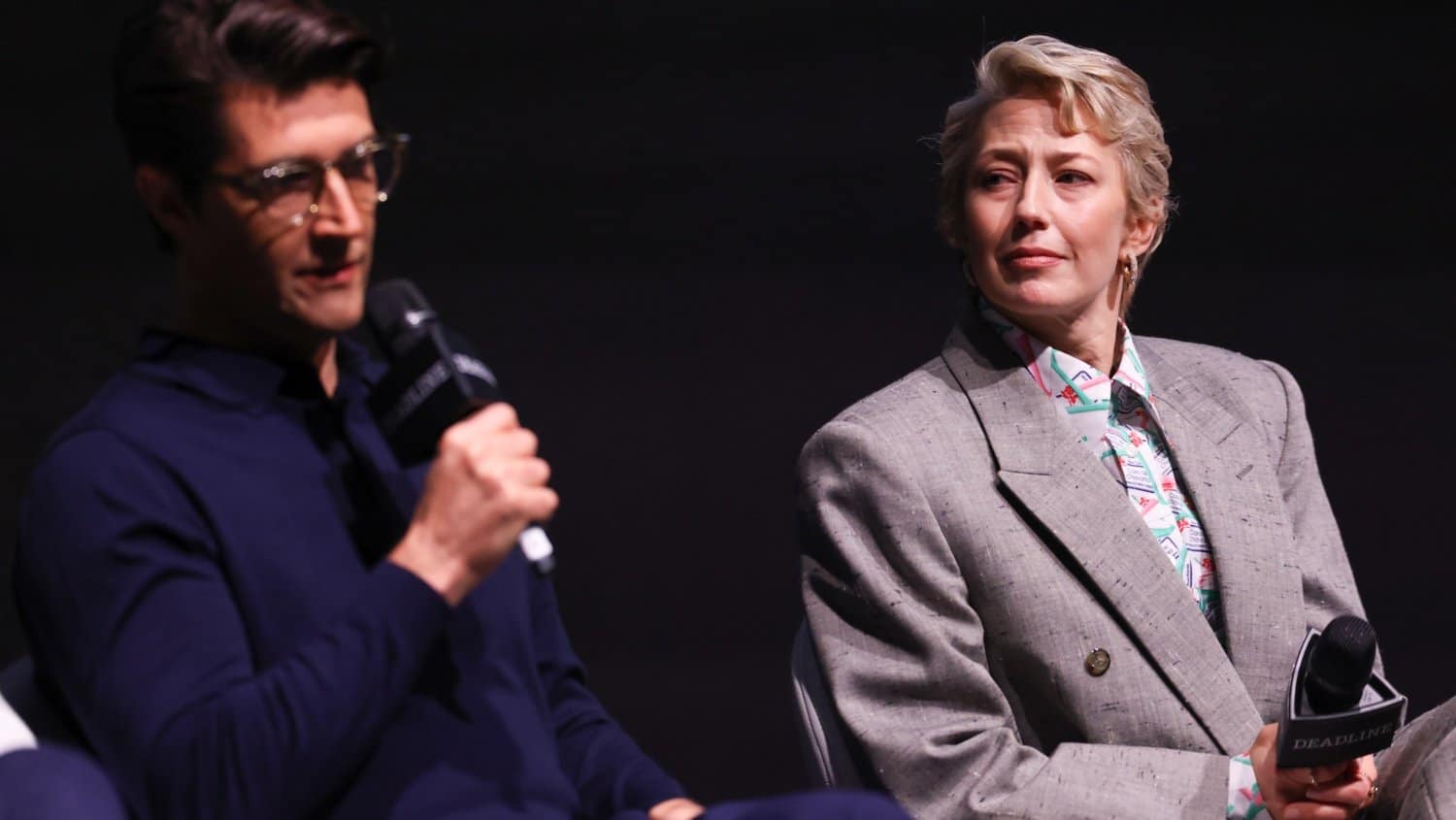
Writer-director Guy Nattiv and actress Carrie Coon joined Deadline’s Contenders London event today where the pair discussed making The Liberation, a very personal story inspired by real events from Nattiv’s own grandmother.
The film, which Bleecker Street is releasing in in the U.S. in January, is set in the early 1980s where Rita, a depressed New Jersey bank worker and Holocaust survivor (Coon), is lured into an all-female woodland commune by a charismatic leader (Lily James), while her daughters attempt a rescue.
“I was only eight when my family took me to seminars to see my grandmother and participate with her in those meetings,” said Nattiv. “I didn’t know what it meant. It was like dancing with people in the dark. I heard horrific stories from people, and my grandmother crying, it was so weird to me. But no one told me what it was exactly, and I didn’t know until I became a teenager when my family had basically broken in front of my eyes, and my grandmother left my grandfather, left our family, and just joined this. Now, we know it was a cult but at the time we didn’t know what it was.”
Nattiv said that when he was older and was processing these events as a film student, he started asking a lot of questions but didn’t get a lot of answers. It was a decade ago that he decided to take his camera and visit the cult after his grandmother had passed away. “I asked questions and I got answers…ish.”
Watch on Deadline
He entered the process with “a lot of empathy” and found that the cult “tried to free her” from her trauma of being a Holocaust survivor. “She had the courage to do something very uncommon: To leave your family, say goodbye to your daughters and your husband and go into the unknown and try to save yourself.”
Coon admitted she was “absolutely fascinated by the story” and said she watched “hours and hours” of footage from Yad Vashem and from Shoah Foundation testimonies, “particularly women from Poland,” to help her research for the role of Rita.
“There’s something very specific about the way the recounting of those unspeakable things is held in the body,” said Coon. “And also, the stories themselves, the myriad forms of trauma that were inflicted upon people. But then also that they were resilient enough to survive was also very fascinating and people had a find a way to survive and Rita had a very particular idea about what that looked like for herself…who are we to say what is required for someone to move on?”
Coon continued that it was helpful for her to view the story as “a love story.”
“What I became very fascinated by with reading is the idea that these social rules we are living by are tacit agreements,” she said. “There’s nothing written down. We wake up in the morning and we’re a wife and a mother and we follow all of these rules. But it’s all made up. We could essentially walk away from our lives at any time, but we don’t do it. And we did [in this film]. I just find that brave and shocking.”
Check back on Monday for the panel video.
