
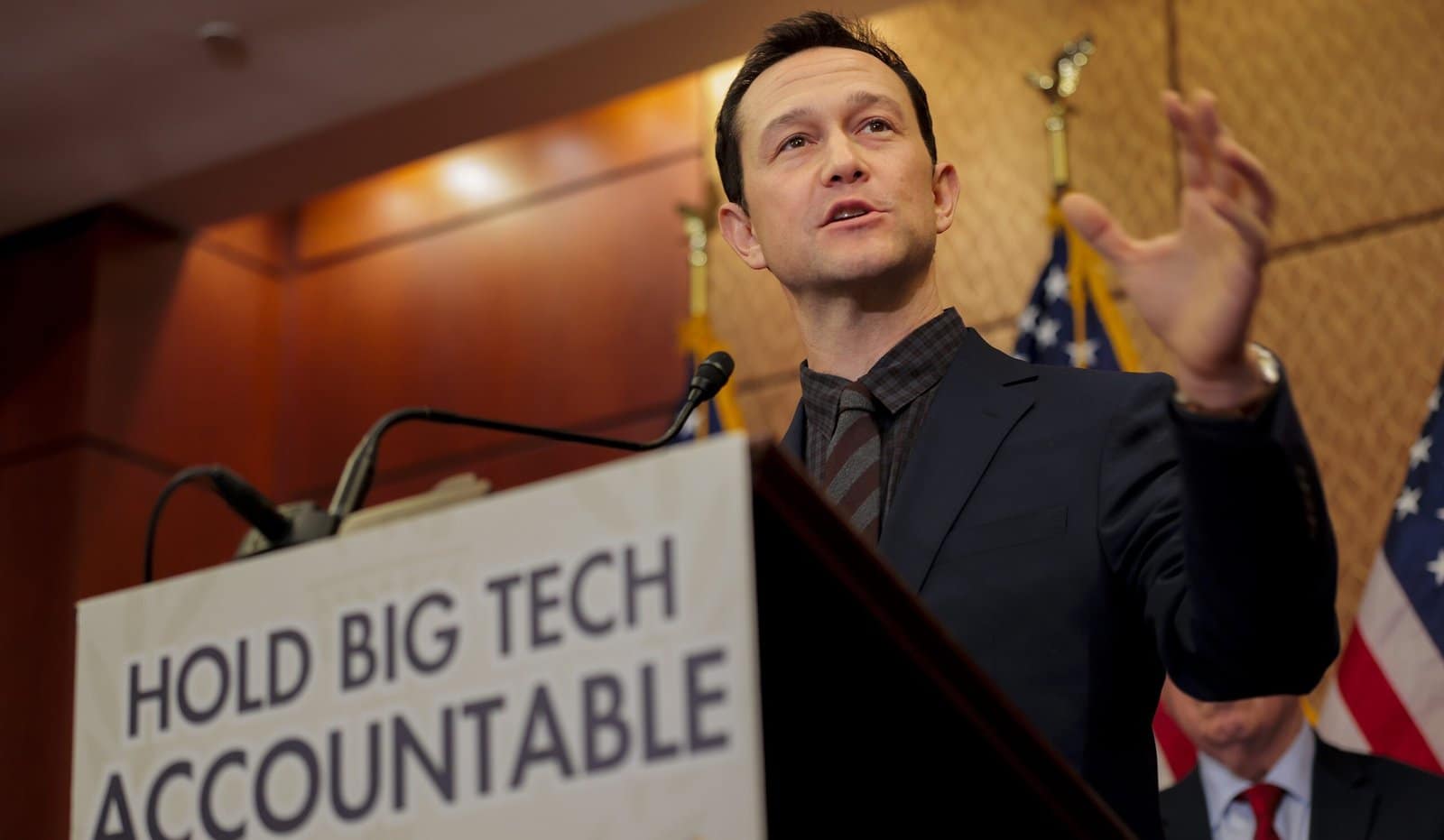
In a new video interview for The New York Times, actor Joseph Gordon-Levitt, serving as the United Nations’ global advocate of human-centric digital governance, has some concerning words about the impact of artificial intelligence. Things like the “decline of democracy, the decline of human empathy” and the hijacking “of your intimacy.”
The video interview takes place as Gordon-Levitt is in en route to address world leaders and officials gathered at the U.N. on the impact of A.I.
Watch the full video below.
First question: Why should the public listen to an actor on A.I. safety?
“Very fair question,” Gordon-Levitt responds. “Why listen to an actor? Don’t listen to an actor. You should read Human Compatible by Stuart Russell. Go look up Yoshua Bengio. Read posts by people who work in alignment and safety and policy. You don’t want to read all those things? Well, I did! So, you know, if you want to listen to me, that’s a shortcut.”
Watch on Deadline
Gordon-Levitt continues, “What we don’t want is a bunch of people confused or apathetic while these very fast-moving businesses design the future by themselves, just in the interests of their own profits. A lot of what needs to happen, I think, has to do with communication, which is ultimately kind of what acting or filmmaking is.”
At one point in the direct-to-cell phone-camera interview, Gordon-Levitt is asked what he fears most about A.I.
“At the risk of annoying The New York Times,” he responds, “I would object to that question just because reducing these concerns into one sound bite of fear — that’s one of the problems. To me, saying: Oh, I’m scared that A.I. could exterminate all of humanity — that doesn’t really get at the substance of the concern. There’s real validity to that concern. But that’s not the thing that really worries me.
“The thing that worries me is a lot more complicated and a lot more boring to talk about, because it’s a lot more dense. The decline of democracy, the decline of human empathy. These companies are betting on the notion that they’re going to take over the entire economy. That would be totalitarianism, and that would be really bad.”
He continues, “Simultaneously, these models are being trained to hijack your intimacy, to make friends with you, to get you to fall in love with it. We shouldn’t be scared of an A.I. We should be concerned about the people building A.I.”
When Gordon-Levitt, a co-founder of Creators Coalition on A.I. and recently named one of Time magazine’s 100 most influential “innovators, leaders, and thinkers” on the topic, is asked to explain the “human-centric digital governance” phrase in his U.N. title, the actor concedes “it’s sort of a mouthful.”
“It just means that digital technology should be governed by people and for people,” he says. “’A.I.’ is nothing but algorithmically recombined, human-produced data. It’s humans. Calling it artificial intelligence sort of decenters humans. It offers this kind of magical fictitious character, this A.I. that we’ve seen in various sci-fi movies, but really — really all it is is us. It’s us.”
On whether the “slow-moving” U.N. can force a “fast-moving” Silicon Valley to play by certain rules, Gordon-Levitt responds, “To be honest, this is one of the things that I have found sort of daunting or troubling. I don’t know the answer. I think if it does take, say, seven years for the U.N. to put together an internationally agreed upon regulatory framework for A.I., then seven years from now we’ll be glad that we started now.”
