
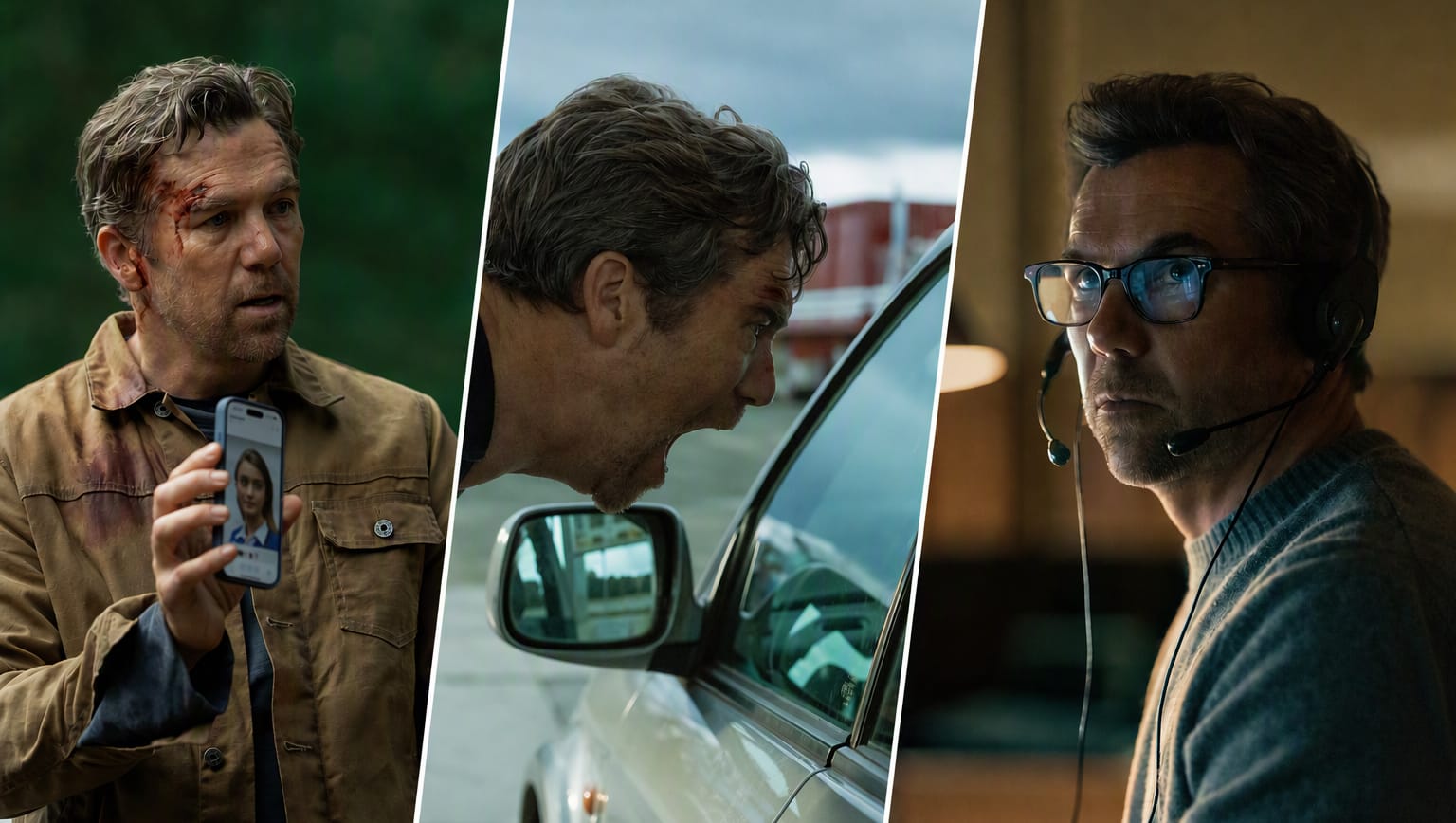
Colin From Accounts actor Patrick Brammall has changed speeds with his latest series, Apple TV mystery drama Last Seen.
The drama, which rolled out its final episode on October 7 to good reviews, came after Brammall and his on-screen partner and real-life wife Harriet Dyer brought their much-loved Australian comedy Colin From Accounts to a close after three seasons.
Brammall said switching to a dramatic role of a father desperately searching for his-long lost daughter was “a bit scary and attractive at the same time,” as he paid tribute to Apple pushing into Australian originals for the first time and director Christian Schwochow, known for work on the likes of The Crown and feature film Munich ’38.
“Apple has the resources, so we had time to shoot,” he added. “We were not struggling to shoot nine or 12 minutes a day, or constantly facing the light. We had a 100-day shoot, and you can see it. The production value is there. It looks fantastic.”
Watch on Deadline
He also reflected on the end of Colin, which was ordered out of Australia at the ABC and played in the U.S. on Paramount+ and in the UK on the BBC. “I am starting to feel the legacy of it,” said the writer and actor, while also explaining on the decision to stop after three seasons.
He also revealed the much-loved, feel-good show was almost not centered on a mismatched couple attempting to nurse an injured dog back to health. Instead, Brammall and Dyer came close to substituting Colin with an elderly lady, before reverting to their original premise. “We talked about making a statement about how we treat older people,” he said.
Elsewhere in the interview, Brammall spoke about his role as Andy’s (Anne Hathaway) love interest Peter in The Devil Wears Prada 2. “Even though it was a massive movie, the set was often very relaxed,” he said. “There were a couple of days when people gathered in the street to watch, which was strange.”
Deadline spoke to Brammall during a recent trip to London.
DEADLINE: The success of Colin will have opened up new avenues for you and Harriet. Last Seen like Colin is about family, although in a completely different way. What attracted you to it?
Patrick Brammall: The first thing I knew was that it was a big Apple show and their first major foray into Australia. I knew they had big resources and a broad scope, and that they followed through on that. Then I read the scripts and a synopsis of the second and third episodes. I thought it was interesting and it was something I was not really known for. I did a supernatural drama called Glitch more than 10 years ago, but people do not necessarily know me for dramatic acting. That was a bit scary and attractive at the same time.
It is a thriller, and the setup — a desperate father searching for a missing child — is a trope we have seen before. But when I met Christian, the director, and we worked on it more, it became clear that it was very character-driven.
DEADLINE: Given the premise has been done many times before, what do you think sets this apart?
PB: You get the entertainment of the thriller, but you also get a study of the intergenerational trauma affecting two families. It is not simply about heroes and villains. Ian, my character, is not entirely good, and Henry, the ostensibly villainous character played by Brendan Cowell, is not purely dark either.
The moral ambiguity is interesting. Then there is Sarah [Chloe Jean Lourdes], the young girl. When you meet her in the second episode, she does not seem imperilled – she seems quite happy in this family unit. You think you know what the show is going to be, but it becomes something else.
DEADLINE: I wanted to ask you about Colin. In an interview back in July, you were talking about how you were not quite ready to process what the whole show meant. Have you had more time to reflect on what it has done for you and your family?
PB: Being here in the UK helps because the show had an impact here that we did not anticipate at all… So many people saw it on the BBC. I have had a bit more time to reflect and I am starting to feel the legacy of it. ‘Legacy’ is a big word, but there is a feeling that we stopped it at the right time. People were asking, “Are you sure? It is going well. Why would you do that?” But I feel that it was right for various reasons, politically and creatively.
I am really proud of it. The reach has been breathtaking. Harry and I are seeing people responding to the third season and the ending on social media, and it has been received incredibly well. We were nervous because it has been so important to us. We put everything into it and wanted to land the plane well.
DEADLINE: It is a very British thing to end a comedy after two or three seasons, Patrick.
INTERVIEWEE: Absolutely. I understand why. In America, writers’ rooms can keep a show going for a long time. With us, Harry and I write everything, and it is exhausting. That is why I understand shows such as The Office and Fawlty Towers ending when they did. Catastrophe went for four seasons, I think, and its creators were exhausted by the end. You want to continue because you love the show so much, but there is a limit.
DEADLINE: Looking ahead, would you want to write something as closely entwined with your personal life as Colin?
PB: Colin emerged organically. It is definitely a fictionalised version of us, although the setup is pure fiction. In the writing of the three seasons, we stole elements from our own lives and from other people — friends, stories we had heard. It became a patchwork.
I do not think we would write something exactly like this again. The success of the show is not just that Harry and I write it; it is the setup. It is about a relationship, comedy and love. We will not write another romantic comedy because we have done that, and we would just be trying to repeat ourselves. Every story arises organically once you inhabit it, and this is where we found this one. We got lucky, really.

John Platt/Paramount+
DEADLINE: The dog being hit by the car is such an immediate device. You instantly understand what kind of world the show is in.
PB: Comedy is hard to set up, and that was a very helpful device. When we were writing the first season, Harry came in one morning and said, “We do not need a dog. We will get an old lady.” She had been allergic to the idea of making a cute dog show. She said, “It is an old lady. She has dementia. She does not know where she is.” We talked about making a statement about how we treat older people.
We told our long-suffering producers, Rob [Gibson] and Ian [Collie]. A couple of days later they came back and said, “We trust you guys. If that is what it is, let us go for it.” Then we said, “No, we have let it go. That was a stupid idea.” For a day and a half, we were making a show in which an old lady, rather than a dog, was hit by a car. It would have been a very different show. Rob and Ian must have gone home wondering what on earth was happening.
DEADLINE: What was the experience of working with Apple compared with Colin?
PB: It was very different for me. I am across everything on Colin. On Last Seen, I had the luxury of just being an actor. I was responsible for my own character, and that is all. It was decadent for me. Apple has the resources, so we had time to shoot. We were not struggling to shoot nine or 12 minutes a day, or constantly facing the light. We had a 100-day shoot, and you can see it. The production value is there. It looks fantastic.
Bonnie Elliott, the director of photography, has a great eye, and Christian is passionate about the show and deserves a lot of credit for balancing an art-house sensibility with the psychological and emotional realism of the story. He grounds what could have been a juggernaut.
DEADLINE: Australia is fascinating as a production community. Some of the best producers in the world are working there, and unsurprising, distinctive shows are emerging, but it is still often seen as a production location. How do you feel about the state of the Australian industry?
INTERVIEWEE: I think we are in a pretty good spot, although there is never enough work to go around. I have worked on many sets in America, and they are very good at what they do. But there is a sense of “another day, another dollar” — a workaday mentality. In Australia, it is more like, “We are making this thing. Let us all muck in.” That is why Australian crews are the best in the world. Nothing is a problem. Even when there are clearly many problems, we will solve them.
If the new Apple show goes well, hopefully Apple will invest in more Australian stories. There are quotas for streamers, which is a good thing, although I do not think the same quotas are in place for local broadcasters. Streamers may end up carrying the lion’s share of Australian content.
Hollywood productions coming in are good for the industry because the crews get work, but the stories are not Australian and the vernacular is not Australian. That is what I love about Colin: Harry and were are committed to making it genuinely Australian. We do not want to gild the lily. That is how we talk, and people should know that.
DEADLINE: What is next for you? Is it more acting, writing or both?
PB: Ideally, both. I am not great at planning. Harry and I have a film that we are writing for a British production company, but it is early days and I cannot say much about it. That is all we have on the books at the moment. We have two little girls under five, so our family is the priority. We have to make everything work around that.
DEADLINE: What was the experience of making Devil Wears Prada 2 like?

Jamie McCarthy/Getty Images for 20th Century Studios
PB: I had a lot of pressure around it because it was an iconic property and people had a strong connection with the original film and those characters. My approach was to stay relaxed and present, and the character was not especially complicated or a huge stretch, so I enjoyed it. Even though it was a massive movie, the set was often very relaxed. There were a couple of days when people gathered in the street to watch, which was strange.
DEADLINE: With the success of Colin and Last Seen, are you still talking to Australian broadcasters, or are global streamers now the main folk competing for your time?
INTERVIEWEE: Harry and I live in Los Angeles, so we are exposed to global opportunities. That is part of the reason we are there. We are still talking about smaller shows, but we ask whether they will travel and whether they have global distributors. I do not want to make something that only goes on a local broadcaster and then sits there. Shows such as Fisk demonstrate that Australian work can travel.
It is ultimately about the quality of the material. When we were pitching Colin, we knocked on every door — although at the time that meant about four doors. The ABC developed it for a short time and then passed. A few other places did the same. Then Binge launched. We saw that it had bought the HBO catalogue and had shows such as The White Lotus and Game of Thrones. Beggars cannot be choosers, and nobody else wanted us, and Binge picked us up. We were very grateful. They were incredible because they gave us the space to make the show we wanted to make. A lot of credit goes to Brian Walsh, one of the commissioners [who passed away in 2023]. He is a legend and a person who genuinely loved what he did.
DEADLINE: Brian was one of the most generous executives when I was a young reporter, happy to explain how the international distribution system worked and how Australian television was received around the world.
PB: He was incredibly generous. He was not trying to get to the next thing. He was present in his work and loved what he did. He was the real deal. It is interesting that Alison [Hurbert-Burns, Walsh’s former colleague at Binge] and Bruna [Papandrea] have now set up a company focused on Australian stories. I am delighted for them. Bruna is fantastic, and Alison is a wonderful producer with a great eye.
DEADLINE: How do you see the future of Australian television, particularly with local-content quotas?
PB: Apple, Netflix and the other streamers would prefer quotas not to exist. That is their position around the world, but having quotas is good because it forces them to decide whether they are in or out, and most of them have said they are in. It anchors the industry and gives people some sense of what will happen several years from now. The same is true culturally. It allows Apple, Netflix and Prime Video to have local offices with Australians working in them.
If you do not anchor people in a territory, you get a purely hyper-capitalist model in which the bottom line leads everything. An American executive may say they want something from Australia and send Americans to make an Australian show. You end up with a red-dirt kangaroo version of Australia rather than something genuine.
This interview was edited for clarity and length.
