
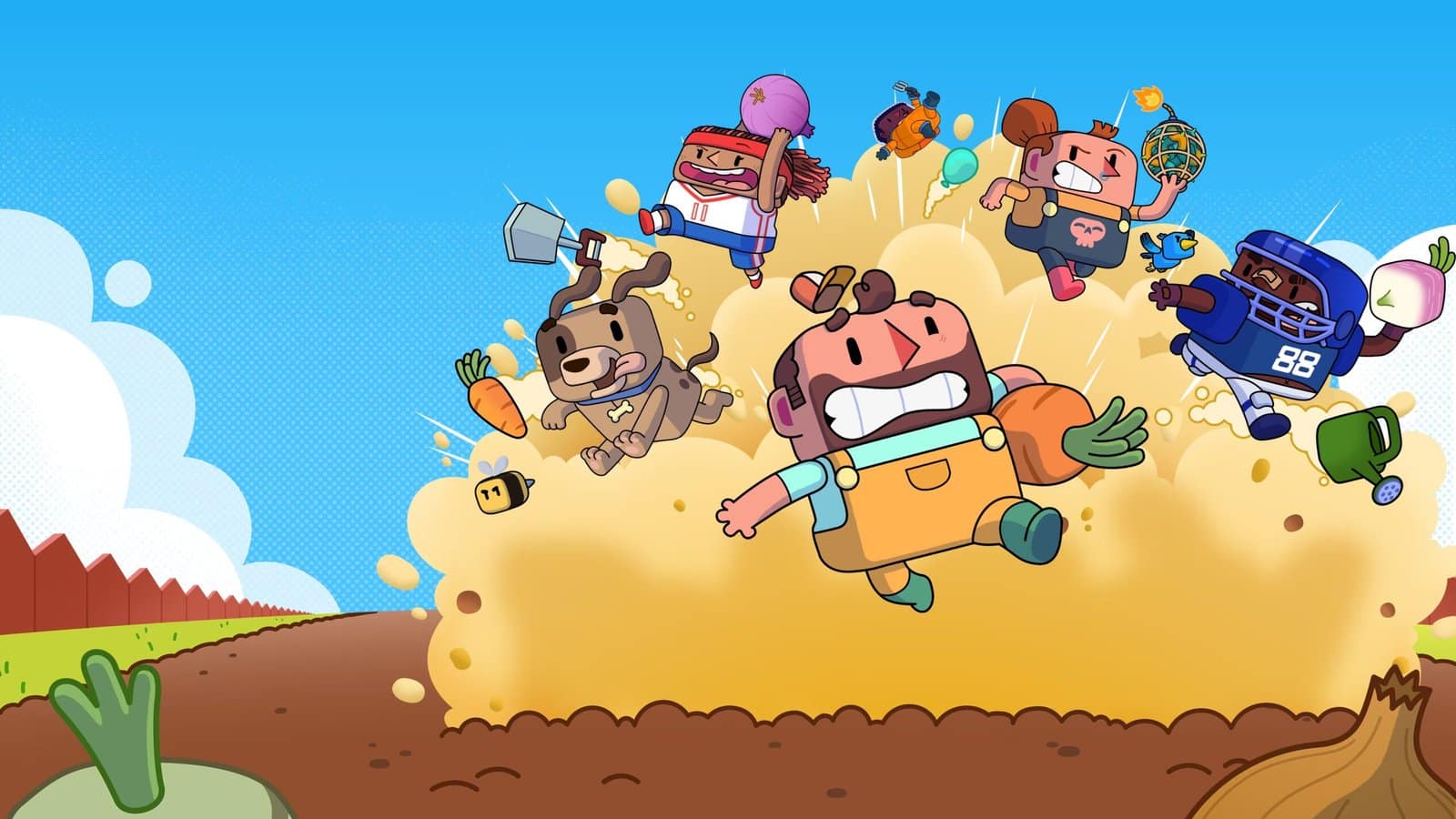
There are plenty of ways to tend to your garden, but launching a freshly harvested potato at a friend probably isn’t the first thing that comes to mind. Proverbial death by roots is the entertainingly offbeat premise behind Cloth Cat Games’ Planted!, a quirky combat game that turns gardening into an all-out competition starring your favorite (or least favorite) vegetables and assorted gardening specimens. In the game, players can cultivate their patches, grow oversized crops, and get down and dirty to protect their harvest or steal someone else’s.
Below, creative producer Ben Cawthrone unpacks how the unusual concept took root and grew into a full-fledged game.
DEADLINE: I loved playing this at Gamescom a few months back, and now it’s here. How would you explain Planted!, and where did this idea come from?
Watch on Deadline
BEN CAWTHORNE: There were a couple of things that brought it to life. From our point of view as a studio, we love multiplayer games, particularly ones you can play on the couch with your friends. Certainly when I was younger, I always had a multitap. I’d buy one for whatever console I had because I was always looking for those kinds of four-player experiences. That love of those kinds of games has never really gone away, and the same is true for some of the other members of our team. We have an internal pitching process, particularly since becoming fully independent as a studio, to decide what we’re going to focus on project-wise.
I pitched the team the idea of “what if gardening was competitive?” What would that look like? The idea was to mash together the gentle art of gardening with a competitive sport, almost framing it as a beat-’em-up. You’re going through the same sort of gameplay loop you would if you were growing and harvesting crops, but everyone else is doing the same thing. They’re doing it at arcade speed, and then you start competing against each other to see who can sell the most or get the most points.
That’s how it started. We built a little prototype, and it worked as a four-player local multiplayer game. We found the fun in having four humans playing together and decided that, if we were going to take it further, we would commit to making it an online multiplayer game as well. If you don’t have four people, the world’s moved on. Not everyone has all their friends around their house anymore. That was a big technological challenge to figure out. We then moved that initial prototype into what’s called a vertical slice, where it had all those features.
DEADLINE: There’s such a funny contrast between the peaceful idea of gardening and the absolute chaos of fighting your friends. How much did that juxtaposition inform the game’s tone and identity? Was it difficult to blend the real-world rules of gardening with the more outlandish elements?
CAWTHORNE: That is absolutely what we focused on. I think the reason it works is that certain ground rules anchor it in reality. You’re growing things. You claim land by digging it, which means it’s your player’s patch for growing produce. Each patch actually tracks how much water it has and what nearby water sources are available, so it knows what resources are in the ground when you plant a seed.
Each piece of produce grows at different rates depending on what it is, and some require more water. Fertilizing gets the produce to supersize. So there’s some basis in the reality of what it takes to sow and grow these things. But then you pull them out of the ground and throw them, and that’s when things start getting ridiculous. We realized the game had to be non-serious because the concept itself is ridiculous. But at least there are fundamentals that people will understand from other games or simply from the reality of growing a seed and having a plant at the end.
What became apparent to us was that the game was like a sponge for silly ideas. Once we established that people were competing over a garden, it didn’t necessarily have to end with just being a garden. That’s why we take players on this journey around arenas where you wouldn’t normally garden. That’s where the extremity comes from, and it gave us many options to expand the gameplay beyond that initial loop.
DEADLINE: Thinking about all those mechanics, from fertilization and watering to how players interact with one another, what was the biggest challenge in creating the game?
CAWTHORNE: Creatively, with all games, scope is what you’re battling. It’s about how many features you build in and when there are too many for a player to understand at any given time. We wanted to make sure the progression of play happened in stages. You understand one thing, and then a new element comes in.
Even in the speed of an initial multiplayer round, everyone starts at zero, so no one is ahead of anyone else. The technical challenge is figuring out whether someone setting up a garden in a certain spot is at a disadvantage to anyone else in the arena. A lot of the time we spent was balancing the arenas so everyone has access to some resource that will help them. It might not be the same resource as everyone else, but it can balance out.
For example, if you’re close to a water source, you’re probably furthest away from where you can sell your produce. You might be able to grow your produce bigger, but it’s going to be a bit harder to sell. Someone closer to the selling zone might not have access to water as easily. That expands to access to power-ups, fertilizer, and particular seeds that are worth more points. All that balancing was the challenge: making sure that, however you wanted to play, the game would accommodate you to a certain extent. We also get into the idea of stealing produce from other people and sabotaging them. That’s a legitimate tactic, but growing a very big patch with lots of large vegetables is also a legitimate tactic. We want people to find the way they like to play, and then it’s up to them to react.
DEADLINE: Hopefully, you have a little time to figure that out before someone’s beating you the whole time.
CAWTHORNE: Absolutely. It really helps when everyone’s at the same learning stage. But I think you played a couple of rounds, and it only takes a couple of rounds before you’re like, “Right, I get it.” We’ve also got the single-player mode, which can guide you more gently into learning how to play. You can jump into the fire, or you can say, “I’m just going to learn the ropes, and then I’ll play with my friends or online.”
DEADLINE: Cloth Cat works across both animation and game development. How has that animation background influenced the character design, visual style, and comedic timing of Planted!?
CAWTHORNE: I used to work in 2D animation before I moved into games. Our lead artist, Tom [Lucas], who came up with all the character designs, is a super-talented animator who brings that kind of graphic energy to them. We refined the characters and the world around the idea of those watermelons that they grow in boxes, so they’re cubic. They’re often sold that way in Japan. That was an influence because they’re square, but slightly round. So “square but round” became the motto for the characters and the objects you interact with.
That’s how we came up with these weird, slightly cubic beings, whether they’re dogs like Rolly, who’s one of the playable characters, or this robot that our game’s mascot, Leeky, describes as cutting-edge, but looks like a computer from the ’90s. We built these characters around the aesthetic Tom initially devised. Because everything in the game started as a drawing, the process beyond that was about our 3D artist trying to remain true to it. The same goes for animation, color, and lighting. Everything stays true to that original 2D aesthetic, but in a 3D world. It’s meant to be very bold and chunky, and very characterful. Each of these characters has a big personality.
DEADLINE: Which vegetable is the most dangerous weapon in the game?
CAWTHORNE: I don’t know. Some of them get enormous when you fully fertilize them.
DEADLINE: A lot of them get big, yeah. I remember there being a lot of carrots.
CAWTHORNE: The potatoes are scary because you can’t grow them, but they get fired at you from our turret. There’s a deployable defense turret called the Spud Turret that fires hypersonic potatoes at people if they get too close. So they’re lethal. Maybe a potato is the most dangerous object in the game, but some other vegetables get very big, making them huge projectiles. It’s a non-contact sport, but if you throw something at someone else, they’re going to get stunned.
We implemented this sort of ragdoll system so that characters can get yeeted around the place. It’s a lot of fun, particularly when someone’s carrying something you want. You can chuck something at them and see if you can get it off them.
DEADLINE: What was the most ambitious or ridiculous idea the team wanted to include in the game? Was there anything that sounded completely absurd on paper but ended up working really well?
CAWTHORNE: I think, in the microcosm of our game, we’ve got all these power-ups, and we’ve had some pretty outlandish ideas for them. But making them work across a network is always really hard because, if you’re doing a lot of animation or creating physical effects, those physics have to sync up.
We did a lot of work on some of the power-ups. We’ve got this ejector bomb that drills down below the ground and ejects someone else’s vegetables. It’s a pretty ruthless power-up. If they’ve been growing this beautiful garden and they don’t get there in time to defend against the drill bomb, their beautiful vegetables just get thrown across the arena. It’s quite a spectacle.
One idea that isn’t in the game is something called a hare strike, which is a bunny bombardment. You call in an airstrike, and it’s actually hares, like bunny rabbits, that come down, land, and then eat their way through whatever’s in front of them. I would love for this to be in the game, and if I’m committing this to print, that means our lead developer has to figure it out. I love the idea of the pun.
DEADLINE: What do you hope players take away from Planted!?
CAWTHORNE: I really hope it becomes part of that group of games you play when you get together with your friends. It’s something you pick up and play. It’s a non-serious competitive game you can have a lot of fun with, no matter your level. I hope people enjoy horticultural combat, because who knew it could maybe become a genre? There isn’t really a long line of competitive gardening games, but we hope this one maybe steers the ship in that direction.
Planted! is now available on PlayStation 5, Xbox Series and PC via Steam. A version for Nintendo Switch will be released sometime in 2027.
