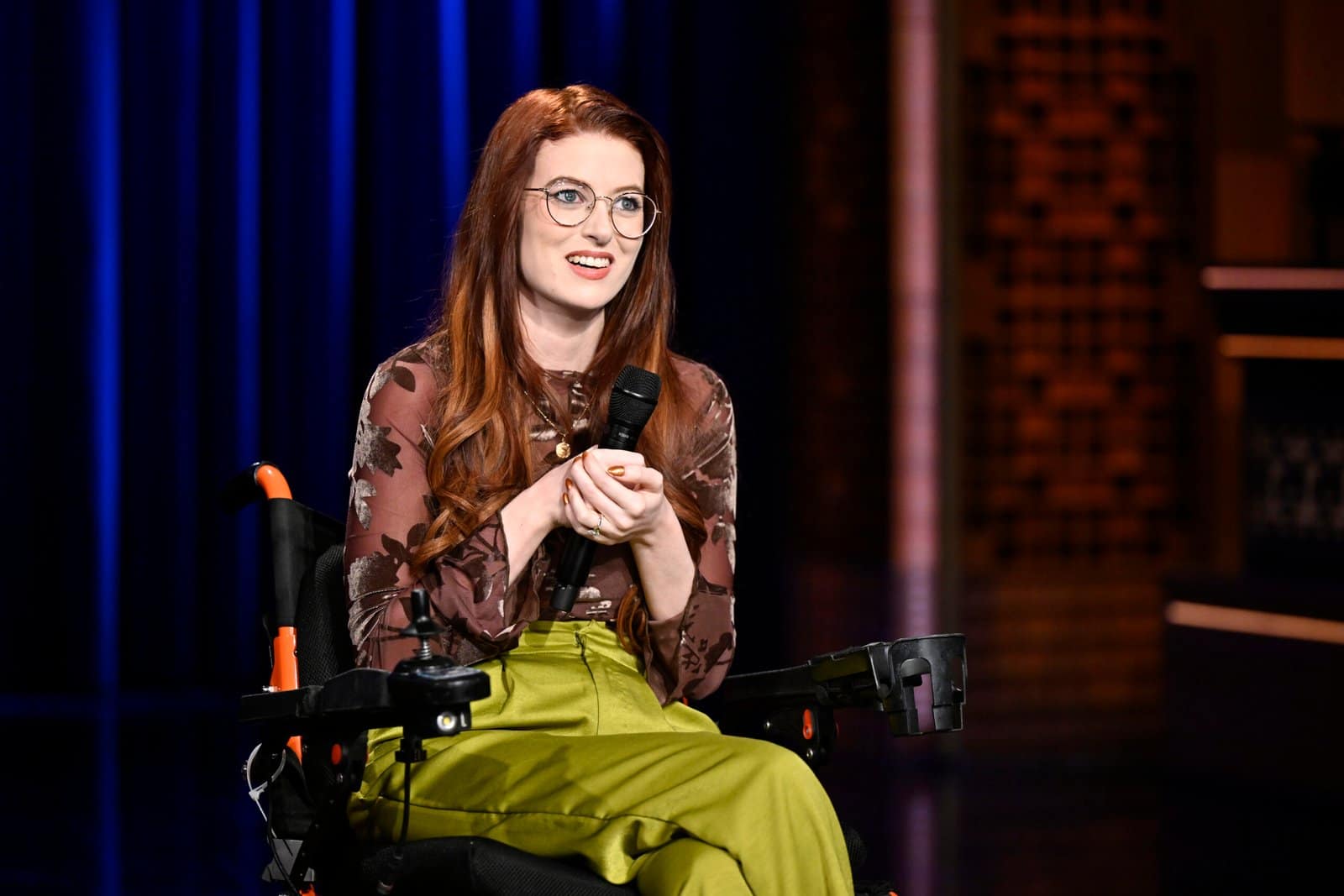
Comedian Fiona Cauley is calling the disabled community to the front of the class, er, stall in her new digital series Talking Sh*t. No more hiding in the wings.
Produced by Inevitable Foundation‘s newly launched digital arm, the satirical web series is designed to foster discussions about disability, which might otherwise feel forbidden, in a way that’ll disarm the audience and welcome them in, rather than push them away. Think Ziwe or Between Two Ferns, Cauley and Inevitable Foundation co-founder Richie Siegel tell Deadline.
Shot inside an ADA bathroom stall, the show has guests answer Fiona’s pressing questions about disability and share the occasional awkward moment. Because what better place to have a chat than the ultimate hot seat?
“This is often such a taboo subject that no one knows how to talk about,” Cauley said. “The fact that you can get people to relax and exhale a little bit, and be like, ‘OK, we can engage with this as people, and it’s not off limits,’ is wonderful. This topic and this community can often feel off limits.”
Watch on Deadline
The series, which launched October 29 on Cauley’s YouTube channel, is already generating some buzz. In the lead up to the premiere, content from the series had already garnered over 1 million views. Cauley didn’t just bring her comedy and her social following to the project, she also brought the guests.
She says that Season 1 — featuring guests including Bill Nye, Shapel Lacey, Robby Hoffman and more — “kind of ended up being me riffing with my friends while interviewing them.” Season 1 guests also include Adam Ray, Lisa Gilroy, Brad Williams, Jeremiah Watkins, Steve Furey, and Matt Taylor.
In the interview below, Cauley and Siegel explain how the series came together and give viewers a taste of what to expect from what they hope will be the next satirical talk series to take the internet by storm.
DEADLINE: Can you tell me a little bit about what inspired the series?
SIEGEL: Yeah. Do you want me to start, Fiona? Does that work?
CAULEY: Yes.
SIEGEL: I’ve watched Rick Glassman’s podcast for probably the last year or so. He’s a very funny comedian. I think it’s objectively fair to describe his humor as autistic, because he is autistic. It’s basically three-hour, long-form sketch comedy.
CAULEY: Yeah, it’s called Take Your Shoes Off. Definitely worth watching.
SIEGEL: He has a two-hour episode, for example, with Michael Cera and Paul Rudd. I won’t tell you what happens, but it’s just batsh*t crazy, basically. Fiona was on one of the episodes, probably seven or eight months ago. She was telling the story — and correct me if I’m misremembering this — of how she has a genetic condition that’s progressive, and her siblings have it, too. As she got older, her mom thought she was making fun of her siblings as she started developing symptoms. I was just like, ‘That’s an insane story.’ I wanted to see if there was anything we could do with it.
We originally thought, ‘Is this a TV show? Something around Fiona’s life?’ We reached out to her team, had lunch and initially started talking about a movie idea, which is kind of where this started. Inevitable has Inevitable Studios, which is a more traditional film and television production company. We have a development fund, and we’ve been developing a number of projects over the last year and a half. The conversation started there. We’re still working separately on developing some sort of rom-com based on Fiona’s life, which we’re very excited about.
Then we started thinking about the digital space and what to do there. My co-founder, Marisa [Torelli-Pedevska], and I were having lunch, and one of us came up with the idea of a talk show in a bathroom, kind of like Between Two Ferns or something like that. We were like, ‘Who could we do this with?’ We were already talking to Fiona, so we thought, ‘Oh, we should just ask Fiona.’
DEADLINE: Fiona, what were your thoughts?
CAULEY: I was like, ‘This is really unique. I haven’t seen anything like it.’ I kind of like how doing it in a accessible bathroom levels the playing field, you know? Walk into my space, kind of thing. When Inevitable Studios first reached out, they sent me an article about the company and its mission. I thought it was really beautiful. They were trying to give a voice to disabled creators and actors, and talk about disability without making you feel like you’re supposed to feel sad for the person. I had never seen anything like that, and I think that’s exactly what we’re doing.
It’s been cool because we were like, ‘All right, it’s an interview in a accessible stall. What’s the overall purpose of this?’ We decided it has to be funny. We went in with a lot of stuff planned out to ask, and it kind of ended up being me riffing with my friends while interviewing them. It took on a life of its own, but I think it’s fun and sort of educational. It points out all these knowledge gaps that, for the most part, people don’t know about disability. I don’t blame them, but now it’s time to learn.
DEADLINE: I really like what you said about the show’s mission of talking about disability without feeling like you have to feel bad for the person and using comedy to make the conversation more disarming. Can you talk about navigating those conversations with your friends and finding moments to make them educational, while carrying out that mission?
CAULEY: To be fair, as a comedian, that is kind of my own mission. That’s what I’ve been trying to do. Before I did comedy, I created a web series in 2019 called Capable. They were short, five-minute videos that were supposed to be funny, but also had sincere moments about being young and disabled and people just not understanding. I realized pretty quickly, once I was diagnosed and understood what was happening with my body, that we all have a very two-dimensional concept of disability. It’s so much more complicated than that. People get very upset about my speech and the fact that I’m not paralyzed but use a wheelchair. Some people think I’m not disabled enough, or they’re so uncomfortable that they can’t look at me. There’s no sweet spot. I’m learning. I come from a pretty broken home, so comedy was always used to talk about things or dance around the hard topics.
SIEGEL: Can I just add something, Katie? Part of it for us is that we have this weird structure where we have a nonprofit at the top as the parent company, where the mission lives. But increasingly, through both Inevitable Studios and Inevitable Digital, we’ve been working to create commercial entertainment to carry out that mission. On the spectrum of ‘Let’s get a bunch of people in a room and put up a PowerPoint and have a really serious conversation’ to ‘Let’s host a talk show in the bathroom,’ we’re moving this way in terms of what we think can be effective.
As Fiona was saying, there’s a version of this where other disabled people find it funny and really enjoy it, and I think that’s great. There’s also a version where it expands the conversation and drives some awareness. Even with the word ‘education,’ the version we mean is: If you want it, it’s there. We’re not trying to lecture anyone or force anyone to believe anything. We’re trying to bring you into this world. Through osmosis, you might walk away thinking, ‘Maybe I won’t use the accessible stall next time, because if I’m not disabled and I use it, maybe I’m blocking someone else from using it.’ There’s a part in the Robbie episode where Fiona talks about how flight attendants putting their coats and luggage in the closet that’s supposed to hold wheelchairs makes her life way harder. Those little moments build up over time. But it’s through this ridiculous container — a talk show in a bathroom.
DEADLINE: Once you had the idea for this, how did you figure out who your guests would be, and what were the initial conversations you wanted to have?
SIEGEL: I’ll add one little bit about the premise from more of a business perspective. We had this idea and a vision for how we wanted the show to play out. We needed to find a partner who wasn’t just talent and could host the show, but who also brought an audience. One of the really exciting parts about working with Fiona was that, for a number of years, she’d been building a massive audience on social media. They show up to her shows. Our idea was that if we just opened an Instagram account tomorrow, it would start with zero followers. We could make the show and have someone host it, but no one would see it. We’d waste all our time. The idea was to be smart about who we partnered with — someone who could bring distribution and an audience.
I don’t think we would have gotten anywhere near the guests we got in Season 1 if Fiona hadn’t texted these people, because they’re her friends. That was a key part of the partnership: What are we each bringing, and is it complementary and valuable? But, yeah, no Fiona, no guests, is one easy answer to that question.
DEADLINE: Fiona, how did you decide whom you were going to text or who you wanted to have on the show?
CAULEY: I wanted a variety of people: people I’ve become friends with who I know I’m the only disabled person they know, people who are very invested in the disabled community, and then we had Brad Williams, who’s disabled himself. I wasn’t even sure if I was allowed to call him disabled when we started our interview. He was like, ‘Yeah, what? Of course.’ I was trying to offer a range of perspectives so viewers felt seen. I didn’t want to have a bunch of experts. I wanted people I had a good dynamic with, so we could bounce off each other. I’d say the biggest guest this season is Bill Nye the Science Guy. I met him in France, because we were both on a panel for a drug for my disease. I was doing comedy, but I found out Bill is really involved in ataxia research because his family — his dad and sister — had or have a form of ataxia. He feels really close to it. I think it might surprise people. There are more celebrities like that out there who are very invested in research and disability, because disability affects a ton of people — I think more than we’re aware of.
SIEGEL: I think the stats now are that up to one in four people in America have a disability, and most people usually know someone or have someone in their family who does. But something Fiona is getting at, and that we’ve thought about for a long time, is this paradox: It’s technically the largest minority in the country, but it’s an invisible group of people for so many reasons. Part of our work is figuring out how to close the gap between the scale and the numbers and the awareness. The Bill episode was great, because it’s very funny to see a man in a bow tie in a bathroom stall on a talk show.
DEADLINE: I’m interested in the idea you bring up about filling those knowledge gaps and having a range of people on the show to illustrate different understandings. Fiona, you said you weren’t even sure if you could call another guest disabled, and earlier you talked about what ‘disabled enough’ means. How do you navigate that conversation throughout the series?
CAULEY: Man, that’s becoming a really big conversation, especially right now, and it’s so hard because I don’t know that we talk about it too much…It feels like there’s a hierarchy within disability.
SIEGEL: I think something we’ve thought about is how to separate the idea that there are probably a lot of people with disabilities who wish they didn’t have the disease or condition that causes their disability from the idea that, regardless of what they have, they should still be treated as humans and have access to public spaces. Those things get conflated a lot, but I think there’s some separation there. There’s a great bit in the Brad episode where Fiona asks, ‘What’s the best disability?’ Brad says a guy once came up to him and said, ‘You and me are just alike,’ and the guy was missing one small part of one finger. I think the point Brad is making is that there’s a big difference there. That person can call himself what he wants, but being a little person is a very different experience from having a little piece of a finger missing. I think that’s what he’s trying to get at.
We also posted the teaser last Thursday and got hundreds of comments on it. It was fascinating to see people saying, ‘I have an invisible disability, so when I walk out of the accessible stall, I get weird looks sometimes because people don’t think I need it.’ There’s all this complexity around what’s invisible and what’s visible.
CAULEY: I relate to that, because mine used to be invisible. I needed the grab bars, because I didn’t have the balance, but I could walk. My little brother has what I have, but he’s in the walking stage right now. People don’t realize he’s disabled. They just think he’s drunk, so they’re very judgmental of him. He won’t park in the accessible spot, because he doesn’t want the looks. I remember thinking, ‘Oh my God, I can’t wait until I’m in a f*cking wheelchair so people will see something is wrong, and I won’t have to explain.’
DEADLINE: That’s kind of what I was thinking, too, in terms of invisible illness and invisible disabilities. Even without having that exact conversation directly in the show, showing a range of discussions about a range of people experiencing a range of disabilities inherently does that. To your point, people often judge: Are you allowed to use the accessible parking space? Are you disabled enough to do that?
CAULEY: Yeah. Even now, I’ll park in an accessible spot, and people just see that I’m not an old lady and come up and say, ‘You can’t park here.’ I’m like, ‘Wait till you see my ride, dude. You’re gonna freak out.’ Disability can affect young people, too. It doesn’t matter.
SIEGEL: Especially with where we are in the world right now, there’s been this thing — if you want to talk about hierarchy — of litmus tests and ‘Prove it.’ Even Disneyland has changed the rules around who can use the fast lanes, and that’s had really weird implications.
CAULEY: I have a joke about this, but it’s just a real thing that happened. For my bachelorette party, I went to Dollywood because I thought cutting the lines would be cool. I hadn’t been to an amusement park as a disabled person, and they made me take a whole quiz to prove I was disabled enough for the fast pass. For real.
DEADLINE: Oh my God!
CAULEY: Yeah. I’m in a wheelchair. What are you talking about?
SIEGEL: I think one of the underlying, subliminal messages of the show is just: Give people what they need to enjoy their life. If it’s this bathroom, this chair or this ramp, there are so many basic parts of access that are a struggle for people in this community. One of the questions Fiona asks in almost every episode is, ‘Could I get into your house if you invited me over?’ It’s such a simple question. There’s a great response in the episode with Adam. He says, ‘Well, you walk in,’ and she goes, ‘You lost me at walk in.’ No one even registers that they started the sentence that way. That’s the space we’re trying to play in, rather than making a PSA about building a ramp, which has its own purpose somewhere else. I think you can get farther and do better with this version, which is much less on the nose.
DEADLINE: What are you looking forward to about premiering the show?
CAULEY: I’m excited for everyone to see it, obviously. I’m really excited, and I hope it does well online. I hope the disabled community feels like they’re the main character — like they’re being talked about in a fun way instead of a sad way. I hope everyone enjoys it and maybe looks at the world a little differently. Just keep humanizing everyone. I don’t know. What about you, Richie?
SIEGEL: We’ve been working on this for about five months. On the one hand, that’s a lot of time. On the other hand, it’s so fast to go from an idea to a fully released thing. I’m excited for people to see what we’ve been working on together and the real collaboration that it was. This wouldn’t exist in the way it does, or reach the people it reaches, without Fiona playing such a huge role. I’m excited to see how close to the line we can get comedically while still maintaining the goal of the show. There are some fun moments that give it a good run for its money in terms of what can be talked about and how Fiona can navigate all of that.
As she said, I’m excited for people to have a fun time watching and maybe think about something differently afterward. Maybe the next day they won’t give someone a dirty look. Those little things add up. It goes back to what Fiona said: Disabled people are human. That’s at the core of so much of our work, and of this show, too. I’m excited for a lot of people to see it. It’s already happening and will only happen more. The release is this moment where it’s out in the world and it’s not ours anymore.
I also hope it finds a home on the internet, in an internet culture where Between Two Ferns, Z Way and some of these other things exist. This space is so underdeveloped. I hope we’re not just the first entrant, but also the best entrant into that space, and maybe we can make more of them.
