
Daniel Chong cannot stop working with animals. His storyboarding credits span Toy Story shorts, Cars 2, Dr. Seuss’s The Lorax and Inside Out, to name a few, but his first creator credit came with Cartoon Network’s Emmy-nominated We Bare Bears. As an Asian American creative in the industry, Chong explored social anxieties, friendship, assimilation, self-care and belonging through three bear brothers’ attempts to fit into human society. Now back at Pixar as a director, he brings those sensibilities to his first theatrical feature, Hoppers, and punches them up several notches.
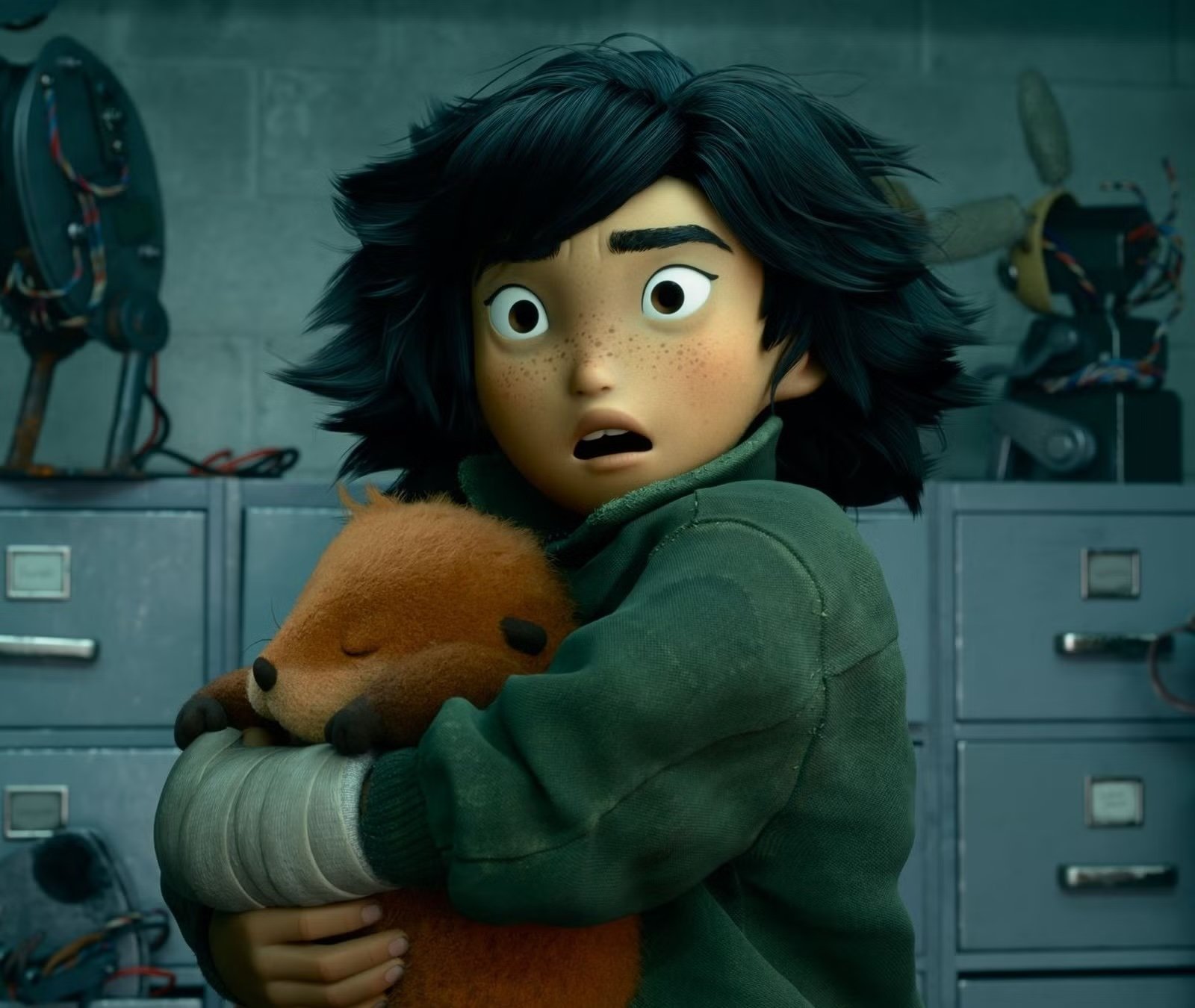
With environmentalism at its center, the film follows animal lover Mabel Tanaka (Piper Curda) as she tries to rehabilitate a local glade that was special to her and her late grandmother. To succeed, Mabel transfers her consciousness into an animatronic beaver and goes undercover in the animal world. Then all beaver dams break loose. The deeper Mabel goes, the more she uncovers the dynamics of the natural world, including those shaped by the pond’s ruler, Prince George (Bobby Moynihan), which causes her simple plan to save the glade to go awry.
It’s a fun and heartfelt adventure that arguably breaks the mold of Pixar’s more conventional releases. The film features a great white shark assassin (Vanessa Bayer), wildlife happily coming to terms with their own deaths, and a caterpillar (Eman Abdul-Razzak/Dave Franco) hellbent on revenge and domination. Chong and writer Jesse Andrews give the comedy room to run wild while making space for the beauty and importance of the natural world—and for the struggle to protect what you care about, open yourself up to others and find a community that supports you.
Watch on Deadline
“[This movie is] the idea that we’re all animals. We’re all part of this ecosystem together,” Chong tells Deadline. “I feel like when we center ourselves as animals, it reminds you that we all have a stake in this together, we all have a responsibility to all of it together. I don’t know if people, even better yet, children, carry that into their lives. I think that could be a powerful thing. So, if there’s one thing people do take away, I hope it’s that.”
Below, Chong talks with Deadline about blending humor with social justice issues, the challenges of bringing the natural world to life and entering his sage-advice era at Pixar.
DEADLINE:OK, take me back to the early stages. How did Hoppers come about? Did you have to pitch it to Pixar, or did you already have a script?
DANIEL CHONG: It was just me at the time. I came in empty-handed after [completing his Cartoon Network show] We Bare Bears. I didn’t really have any ideas. Eventually, I pitched this idea, and at that time it was called Penguin Avatar, and I didn’t think they were going to pick it. I was like, “This is just a funny pitch. This is the get-a-laugh pitch, and then we’ll move on.” But six years later, we made the movie. We just had to substitute penguins for beavers, but that was the gist. Then Jesse Andrews came in and wrote Hoppers with me.
DEADLINE: That still sounds like a hard idea to get people on board with. What do you think worked?
CHONG: The joke that this is like Avatar was in that pitch because it felt like just an easy way to clue people in into what we were parroting a little bit, but also let them know you’re going to think it’s Avatar, but it’s totally not [laughs]. That was a big one. The other was just the idea that there was this opportunity to go into the animal world and feel the inner life of these animals. That was something Pixar hadn’t quite done specifically in this animal world, and I think that’s what sold it and why it appealed to them.

Disney/Pixar
Animation adds a level of surrealness that everyone can still easily connect and relate to…but it will also allow me to venture into some weightier topics while still keeping things fun.
Daniel Chong
DEADLINE: How did you and Jesse talk through making the script?
CHONG: Without a script and just an outline, we had a sense of where we wanted to go with it, but we worked very fluidly with how we created the story. That’s why the movie is so freeform. We wanted it to be very organic and unexpected. We didn’t want the audience to feel the structure of it. And if you think about it, Mission: Impossible and those bigger action-type movies are built that way. They are built around crazy set pieces, unexpected twists and turns. So, I just knew that one of the last things that I wanted to do was work on this in a linear way.
When Jesse came on, he had the tough task of working the way I wanted to work, which was just out of order. He would write something in Act 2, then go to Act 1, then jump to Act 3. We went around and around, putting up reels in a hodgepodge way, and then started shaping it to make sense. It’s madness to work that way, but it made the movie what it is because I think that was the only way we could go so wild and take so many swings in so many parts of the movie. We had an anarchic way of our process.
DEADLINE: Using wild animals seems to be the throughline of your filmography so far. What speaks to you about using these creatures to tell your stories?
CHONG: There’s an inherent charm in seeing animals anthropomorphized that has always appealed to me. And doing this in animation adds a level of surrealness that everyone can still easily connect and relate to. The humor and silliness come pretty easily from there, but it will also allow me to venture into some weightier topics while still keeping things fun, because at the end of the day, it’s a stack of bears and a beaver with a crown.
DEADLINE: And what about the robotic portion of the premise? This could have just been about regular animals saving their habitat.
CHONG: I think that came from my interest in robot animals. I was reading a lot about animatronics, and A.I. wasn’t quite what it is today, but it was definitely building its way into the zeitgeist. So, I was reading a lot about robotics. I learned in some documentaries that they actually put robot animals into nature to spy on them, and they have cameras in their eyes. If no one has seen them, they are up on YouTube, and you can watch them. They are incredible and a little cheesy looking, and I don’t mean that in a bad way, because robotics are amazing, but they don’t look like real animals [laughs]. When you see them, you look and say, there’s no way an animal is going to buy this, but then the animals poke and prod it, probably questioning whether it’s a friend or a foe. So, I was imagining: What if that technology was so good, the animals could not tell the difference?
DEADLINE: Since Hoppers was released in March, there’s still so much online discourse about the absurdist, playfully dark humor that you all managed to get into the film that hasn’t really been done before in the Disney/Pixar canon. How would you describe your comedic sensibilities?
CHONG: I grew up with a lot of pop culture. I was a kid raised on movies, TV, and comic strips. I loved Garfield, Calvin and Hobbes, Far Side–I read that a lot as a kid, and I owned every book. I remember recently looking back at it, looking through the jokes, and I was like, “Oh my God, this is our movie.” It’s similar to our anthropomorphic animals. It’s a little bit satirical. It’s very absurd. And it just felt like that language was really what I grew up on.
And because I’m a kid of the ’80s, I love early Tim Burton, just really weird, strange, and tonally off-kilter movies that you can’t even put in a box. Is it horror? Is it comedy? Is it action? And that’s the kind of mind meld that my brain was exposed to growing up with all these things. So, I just brought that into Hoppers, thinking about all these genres. I just wanted it to be all those things.
DEADLINE: I want to break some of these comedic beats down. You’ve got Diane, the shark, who is hoisted up on a highway by the avian creatures to help squish the mayor to death. In a post-credits scene, you’ve got the animals playing with another character’s face mask. There’s so much. What was the thing you had to fight for the most or stick to your guns about?
CHONG: Listen, we had to fight for everything [laughs]. I want to be clear that the studio was behind a lot of it, but we did get a lot of notes. And because Pixar has been around for a very long time, it was a lot of, “Is this a Pixar movie? Is this what we are going to make?”
DEADLINE: There’s truly nothing like it.
CHONG: I think that’s because there’s a sense of humor that’s a little bit chaotic and illogical. Pixar movies are built so much on logic in a lot of ways. There was a freeness in the humor that many people were unsure about. For example, when they saw the animals with crowns, even if you start with something as simple as that, I think an older Pixar might have noted the situation to death. It would have been something like, “OK, why do those animals have crowns? Explain it to me. So, they just have them? Well, we have to know where they got it from.” So, you would get questions to logic out all these decisions. But now, it’s kind of about explaining that something like that would ruin the joke, and it shouldn’t be explained where the crowns come from. So, if we liked something enough, the work was on us; we just had to figure out how to get it through so it didn’t trip up the audience when they watched it.
So, instead, we came up with that joke where one of the scientists goes, “Where’d they get those little crowns?” And this other scientist goes, “Is that your question?” And that was our way of just going like, “We know this is crazy. We know it doesn’t make sense, but it’s all crazy, so go with it.”
And I think once you’re starting to train the audience to go on this ride of craziness and absurdness, I think then you get them to a place where a shark gets raised into the sky with some birds, and you just go, “OK, I guess that’s the natural conclusion to this movie.” And faces getting ripped off. I would say the only issue was sometimes it got a little scary for kids when we did audience previews, which we didn’t know until the end of the making of this movie. So we had to tweak a couple scenes, but overall, I think I got everything I wanted in there [laughs].

Disney/Pixar
I think [the reception of Hoppers is] because there’s a sense of humor that’s a little bit chaotic and illogical. Pixar movies are built so much on logic in a lot of ways. There was a freeness in the humor that many people were unsure about.
Daniel Chong
DEADLINE: I’m still in shock that the killing of the butterfly made it in. It was the only thing I heard people talking about. And the reactions in the screenings I went to? People were screaming. Talk about how that scene came about and what was your experience watching it with others?
CHONG: I love talking about it. Honestly, having a movie and getting to know that that is going to happen and everyone is going to react a little differently is one of the funnest parts about this movie, especially watching it in a theater. I remember when we were in audience previews, Pete Docter [CCO of Pixar] turned to me and was like, “That’s why we go to the theater to have moments like that.” And he’s right. Like you said, you got to experience that with the crowd, because they’re looking around going, “Did that happen?” And they need somebody to validate it, so they can laugh because it’s so crazy.
We had the idea for this scene pretty early on, though in our story discussions. We did something like eight internal screenings on the movie, to vet it with our own studio. Even I thought it was going to get cut because it was just a joke that we put in that was funny for now, but come on, there’s no way we can do it.
But all the credit goes to the people up at Pixar, like Pete Docter and Andrew Stanton, who were like, “That is staying in the movie. We are not changing that.” And they protected the scene. We never got a note on it. So it made it all the way to the end with no problems. We got more notes on the shark than that [laughs].
DEADLINE: Incredible.
CHONG: Yeah, I think it’s because Pixar knew they had something good with that moment and they wanted to protect it. When they took it to audience previews, they saw that the audience loved it. And it’s such a pivotal point for the movie because it’s when the movie turns and you start running down a hill and you can’t stop. And that’s the sensation I wanted with that squish. And Meryl Streep was incredible with it. I was afraid she would say no to the role because she wouldn’t be around past her only scene, but she got the joke and was game. So everything about it was just…I could talk about it forever, but I love it.
DEADLINE: We’ve talked a lot about the humor, but let’s get into the emotions. There’s a lot of heartfelt material there too. What scene made you more emotional than you anticipated after you finished making it?
CHONG: The scene with Mabel when she breaks down to George and says, “I’m so tired of fighting alone, doing this alone.” I think that line and the way Piper [Curda] delivered it, man, there is just an authenticity. And that’s one of the reasons we hired her; she brought such sincerity to that line. And I feel like, oh, she’s speaking for all of us. That is how it feels out here: that we are alone in our battles and in the things we care about. I just felt the connectedness that moment brought.
But the other thing is that we added a moment at the end of the movie, and it was the last thing we animated because we needed people to love Mabel even more. It’s when Mabel returns to live with her grandmother before she dies, her parents leave, and Mabel decides to stay with her grandma. So, she lives and takes care of her and feeds her and brushes her hair and becomes a caretaker in the last days, months, years of her life. I remember when we added that, that was everything. It really tied together her love for her grandma and for this place, the glade, they shared together. And that part gets me every time I see it.

Disney/Pixar
DEADLINE: The animation of the water, the glade and fires is gorgeous. What was the most challenging depiction and how did you get through the other side?
CHONG: It’s funny because the whole movie was this whole, like “How are we going to do this?” To be honest, the reason this movie exists is because of my naivete and my inexperience in making CG films. My producer always tells me, “If you knew how hard these movies are to make, you would not have made this film, because there were so many things like fire, water, and all these effects and crowds that logically you would never put together.”
But to answer your question. It was that dam breaking at the end of the movie. There was no bigger technical challenge than breaking that thing apart, with all those crowds on it, all that water flowing down, and then taking out the fire. The effects, the set, the cinematography—nightmare. [Laughs.]
There were young 20-year-olds just like Mabel who we brought on to show the movie, and to get notes and feedback from them to make sure it was authentic to their experience as activists. And a lot of the way that they would describe what helped them endure in the fight for the things that they cared about was community, was having other people there to fight with.
Daniel Chong
DEADLINE: Not to add to your PTSD, but how did you get through that?
CHONG: Luckily, we had a great team. I can’t take too much credit. These are typical teams at Pixar who are just excellent at what they do. Also, they came off of Elemental, so they were like, “OK, well, we’ve been through that. We have some experience with some elements.” They know complexity, and they rallied together.
DEADLINE: What was the most important theme for you to get through in this movie? There’s a lot of environmentalism, isolation, togetherness. What do you want people to resonate with most?
CHONG: Two things. The first thing I would say from a Mabel standpoint is the power of community. We brought on a bunch of environmental organizers. There were young 20-year-olds just like Mabel who we brought on to show the movie, and to get notes and feedback from them to make sure it was authentic to their experience as activists. And a lot of the way that they would describe what helped them endure in the fight for the things that they cared about was community, was having other people there to fight with.
And that is Mabel’s biggest issue: she’s alone in the fight until she learns to connect with other people, learns to talk with them and bring them in, as opposed to pushing them away. And that is the thing that all the activists really connected with. And that’s why at the end of the movie, we have her connecting with those scientists because that’s going to be her community from now on. And of course, she’s got George.
The other thing I wanted to throw out there is the idea that we’re all animals. We’re all part of this ecosystem together. And I feel like when we center ourselves as animals, it reminds you that, oh, we all have a stake in all of this together, and we all have a responsibility to all of it together. I don’t know if people, even better yet, children, carry that into their lives. I think that could be a powerful thing. So, if there’s one thing people do take away, I hope it’s that.
DEADLINE: So, what’s next for you after this massive undertaking?
CHONG: I’m getting more embedded into helping Pixar’s future. So, they now have me as an executive producer on one of their upcoming films, Ghost Market. I’m excited. If anyone liked Hoppers, they will love Ghost Market. It is a huge swing. It is unexpected. It’s full of crazy things. Our writer, Jesse Andrews, is co-directing it, along with one of my good friends, Trevor Jimenez, and they are cooking up something incredible. And I’m so happy I get to be along for the ride with them, and I get to be a mentor and share my experiences making a movie with them, as they are first-time directors. There are some other projects at the studio that I’m giving feedback and notes on, and I’m also back in development, and they want an idea, so we’ll see what that is. But to be fair, they aren’t rushing me [laughs].
I like that I can take a moment just to focus on helping other people, and it’s such a gift to share the things I know with other people and guide other people. It’s a totally different skill set to encourage people as much as you can without overstepping, and to help them be the best they can be.
