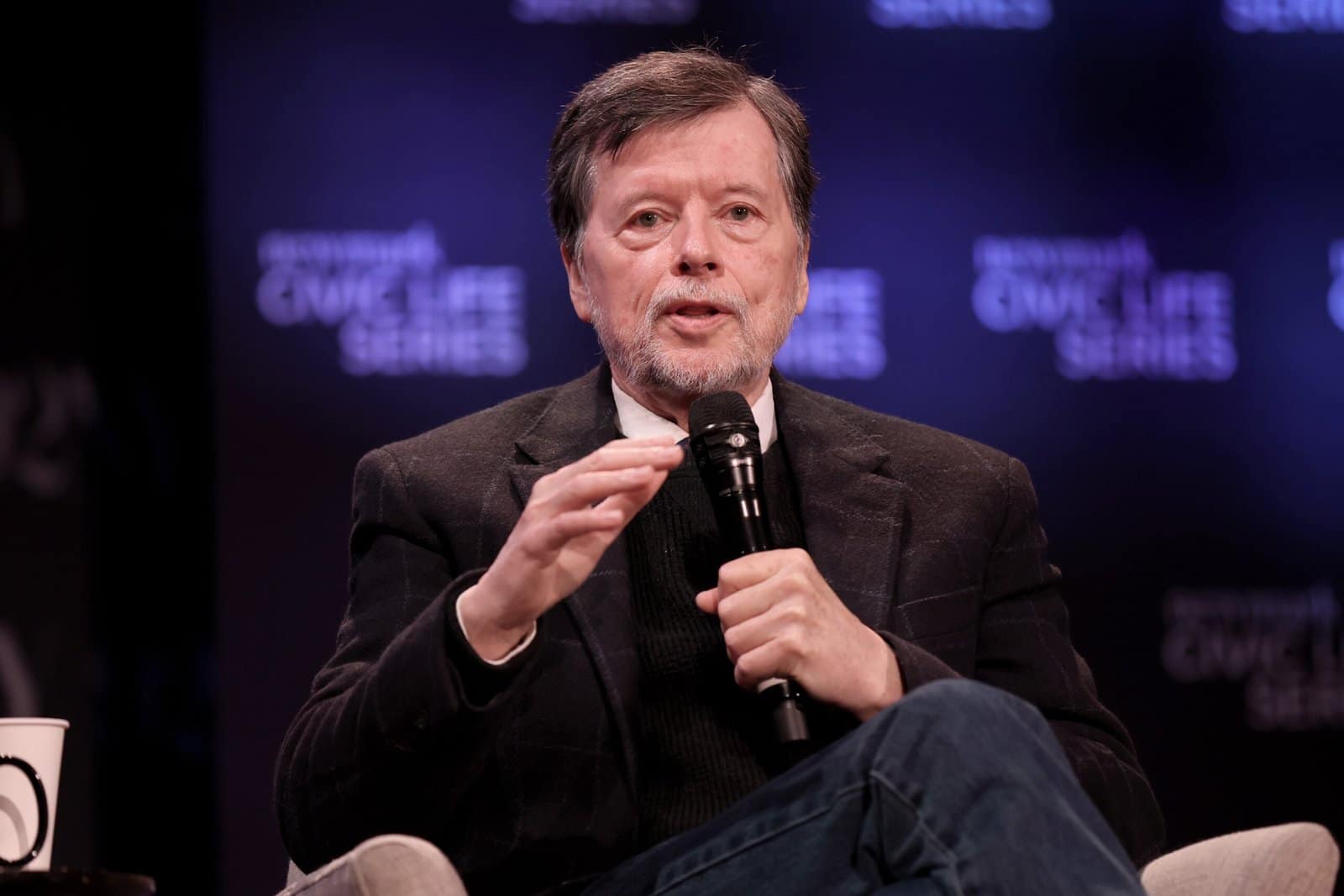
Ken Burns keeps a neon sign in his editing room reading, “It’s complicated.”
That was certainly true of his illuminating and nuanced The American Revolution, the 12-hour documentary series that presented the nation’s founding years in varying degrees of context, and through an array of points of view.
While the project challenged the glossy sheens of history that are being put forth on this semiquincentennial, as in previous milestones, The American Revolution avoided becoming yet another element of the culture wars, or the effort to de-woke-ify the nation’s heritage.
Watch on Deadline
According to the network, it made the Nielsen top 10 streaming list for the first time. As of earlier this year, an estimated 20 million viewers have watched and 4 billion minutes have been seen on all platforms.
PBS is making available Burns’ The American Revolution to stream for free through July 12, and will be rebroadcast starting Friday, with the remaining episodes on Saturday. That will lead in to the network’s live Independence Day special, America — Made in Virginia: 250 Years Together, from Colonial Williamsburg.

PBS
In an interview with Deadline, Burns cautions not to simplify some of the often overlooked causes of the Revolution, like the desire by colonists to expand westward over the Appalachians, and the British resistance to it.
He said, “It’s not that the British were against that. They just couldn’t afford to protect the settlers doing it, and all that did is just hasten the developing disagreements, and then as their treasury was depleted, and they realized how untaxed we were, that they decided to tax us. And that, and many, many other contributing factors, couldn’t go to the top. We always try to simplify it, and it’s never simple.”
Burns also puts much of the fretting over this year’s America 250 celebrations, taking place in polarizing times and in an environment where the president is making himself the center of it, into some perspective.
DEADLINE: How you will be marking America’s 250th on the Fourth of July?
KEN BURNS: The way I always do, which is at the cottage at the lake with my children and grandchildren, and I make them listen to me reading the Declaration of Independence before they get to eat. It’s the main meal of the day, with the hot dogs or hamburgers and the ribs or whatever the meal is for the day.
DEADLINE: That said, what do you think is the most impactful way for people to mark this occasion?
BURNS: I think in just that way, in the intimate ways they’ve always done it. There’s something really nice about lying out on the lawn after you’ve had that meal and heard the Declaration, perhaps. And with strangers, nobody asks you what party you voted for, or what your politics are. You’re lying out on the lawn and watching fireworks, hearing patriotic music, doing it together.
This is what we do, and at the same time, I think, given the extraordinary milestone of 250 years, given the sort of climate right now of worry and anxiety about our future, I think it’s good to go back to the story of our origin. Just as a person who is in a crisis would see a pastor or a professional, and the first thing they’d ask is, “Where were you born? Who were your parents? Tell me about your childhood.” And I think having an origin story that’s complex and durable and accessible to everybody is a good way to begin to put the current moment in perspective and figure out ways to draw from the inspiration of the past and commit to another 250 years.
DEADLINE: There is so much polarization now. Can you put this celebration of this milestone in the context.
BURNS: We were more divided during our Revolution, more divided during the Civil War, more divided during the period after the Civil War called Reconstruction, the subject of a film I’m working on right now, and have been for several years. And more divided during the Vietnam period. So having the perspective of history and the long view, at least you can sort of not just devolve to a Chicken Little, ‘the sky is falling,’ sitting in a fetal position, waiting for the worst to happen. There’s something narcissistic about every age, and it always feels like it’s the most important, it’s this, it’s that. But in point of fact, the Revolution can, in many different ways, give you calm and courage to go forward. I think it’s inspirational to realize that for the first time in human history, people were no longer subjects but citizens with lots of responsibilities, and that democracy is an active thing, not a passive one. If you can pull that out of the story of the Revolution, then it makes whatever crisis less critical.
DEADLINE: Do you worry that Americans are losing sight of their history?
BURNS: That was a complaint in the decades after the American Revolution. Your question is a manifestation of handwringing, and so, yeah, a lot of people don’t pay attention to it, and that’s okay, and a lot of people do, and that’s better. … We like to say that history repeats itself. It never has. No event has happened twice. Mark Twain says history doesn’t repeat itself, but it rhymes. If he said it, it’s really true. The Bible, the Old Testament, Ecclesiastes says what has been will be again, what has been done will be done again. There’s nothing new under the sun. The same amount of venality and virtue exists today as did back then, and so human nature just doesn’t change. And so you will find all of these things were new technologies, when the telegraph came in, people said that’s the end of letter writing. Every new technology is the end of something. It’s in our nature. I have a quote in the Baseball series. He says, “You know, they don’t play baseball the way they used to when I was a boy. I don’t mean that they don’t play by the same rules. It’s just that they lost the spirit of the game.” That was read by a guy named Pete O’Brien in 1858, 11 years from when they started paying players professionally.
DEADLINE: What were you doing on the Bicentennial?
BURNS: I was in Amherst, Massachusetts, played a softball game, drank a lot of beer, which I could do back then, and watched some fireworks. And of course watched on TV the tall ships in the harbor and stuff like that.
DEADLINE: Does what’s been planned for this time around feel a lot different?
BURNS: Well, I think that some of the aspects of it have seemed to have been captured by partisanship. I mean, we can take some really simple lessons. We can take three big lessons just from George Washington’s farewell: avoid partisanship, avoid foreign entanglements and leave office. These are his great examples. So, yeah, there’s some aspects of it. Other states are doing amazing things: New Jersey, Massachusetts, Virginia, New York, all around the country, not just the 13 colonies, but around the country, people have really robust investigations of it. I think it’s going to be terrific. People can find what they want to find in it.
DEADLINE: At the Bicentennial, a lot of the impactful events were at the local level.
BURNS: When you think of the Bicentennial, you think of tall ships in New York Harbor. And also let’s just remember where [we] were, we’re post-Watergate, in a presidential election cycle. There’s great division. The bombings that have characterized the last few years of the last year of the ’60s have continued. There are hundreds of bombings that have been going on during this time. Can you tell me when the last bombing was? Did it go off? Was it stopped? You can’t tell me. You don’t know when the last bombing is. There were hundreds of bombings, in school buildings and Bank of America branches in California here and there, and it was a big deal. A friend of mine, who was in the financial services [industry] during the ’08 meltdown, [came to me] and he said, “This is a depression.” And I just looked at him, and I’ve been through the Depression in four or five films that I’d worked on, and I said, “In the Depression, in many American cities, the animals in the zoo were shot, and the meat distributed to the poor.” If that happens, I’ll agree, we’re in a depression. And it gave him just [perspective], like he could exhale. Okay, it’s a really bad recession. You see what history does? It’s the best teacher there is.
We were more divided during our Revolution, more divided during the Civil War, more divided during the period after the Civil War called Reconstruction … and more divided during the Vietnam period. So having the perspective of history and the long view, at least you can sort of not just devolve to a Chicken Little, ‘the sky is falling,’ sitting in a fetal position, waiting for the worst to happen.
Ken Burns
DEADLINE: The American Revolution countered that it was just about big ideas.
BURNS: It was a very, very violent revolution and a civil war and a world war all at once superimposed on top of each other.
DEADLINE: Why do you think the full context of the founding of our country is is so difficult to grasp for many Americans?
BURNS: We accept the violence of the civil war and we accept the violence of the 20th century wars we’ve been involved in. It’s understandable that we would protect the big ideas of the Revolution as if somehow they’d be diminished by telling the full story. In fact, I think they’re made even more exhilarating and impressive by the fact that they coexist with a very bloody revolution and civil war and world war. That can make it more interesting. And the realization that we made it so spectacular, the most consequential revolution in history, duh, without a doubt. I started to say out on the road in the year of promotion during ’25 that it was the most important event since the birth of Christ. And I’m not there to argue, I’m there to have conversations, and I’ve had wonderful conversations over that. So, this is a big deal, and I think it’s understandable that… we do a lot of that in history, sort of make it a bloodless, gallant myth, and particularly our founding, and particularly our founders. They are all very complicated, deeply flawed people, and we can revel in it. Look, if you think George Washington’s perfect, then you can never be like him. If you understand how deeply flawed he is, and he is, then you realize you can do things that he did do, and that’s really good for our country.
DEADLINE: What response to The American Revolution really surprised you?
BURNS: How total it is. I mean, within a few days of the broadcast, which garnered 20 million people, which does not happen anymore in PBS, we’d entered for the very first time, PBS had a program in the top 10 of streaming shows, never happened before, and the metric they had was 565 million minutes of streaming. By early February, that was over 4 billion minutes… I have been flabbergasted by the extraordinary response in every quarter, and where you normally expect criticism, particularly something like the Revolution as fraud, that you would assume that there would be accusations of wokeness — a few couple of little places, and it went nowhere, no traction, and people have just reveled in a good story. This is a great story, and it’s about us, capital U.S., and also lowercase us.
