
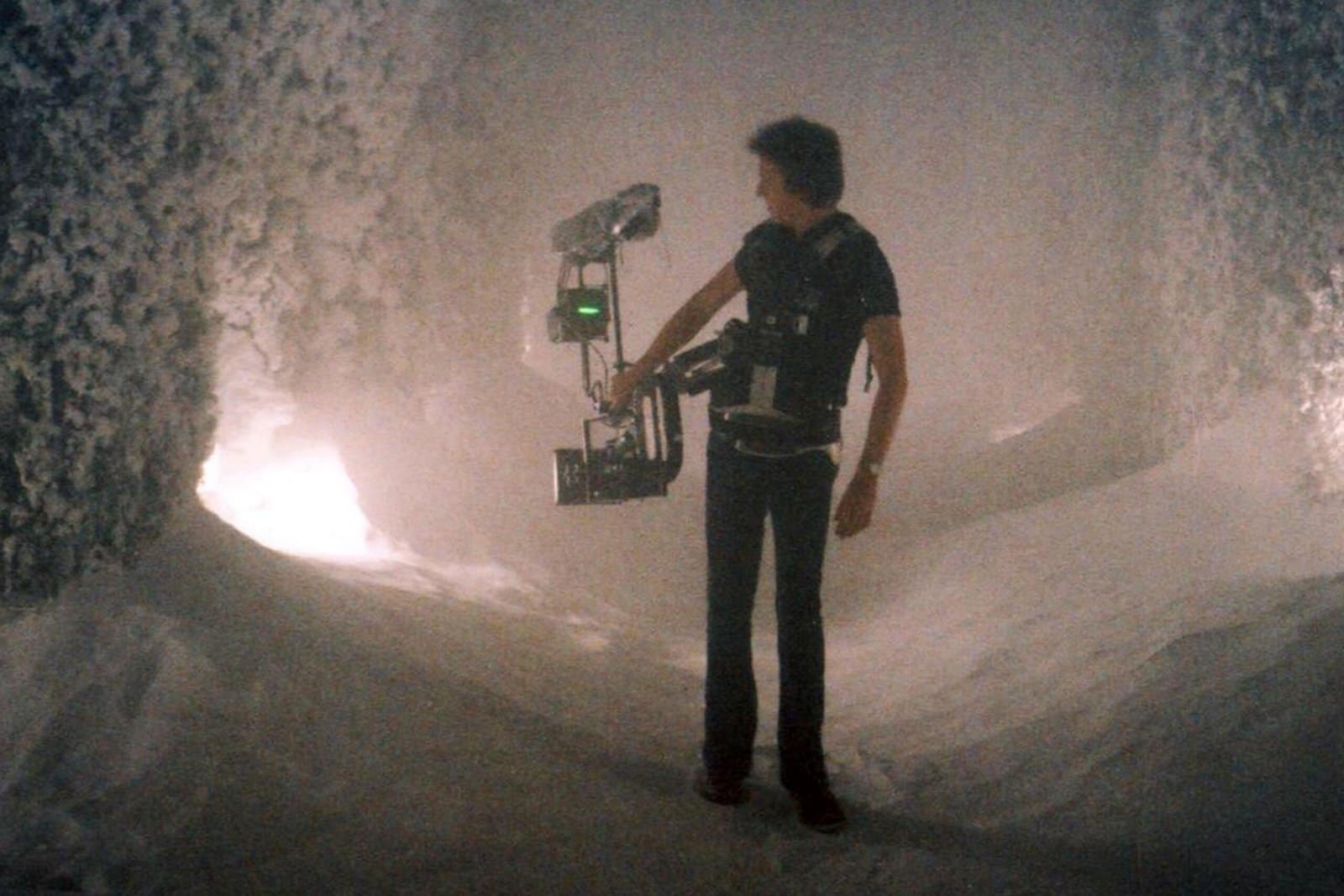
EXCLUSIVE: Production is underway on Thank You Mr. Brown, a feature documentary on the extraordinary career of Garrett Brown, inventor of the Steadicam, the SkyCam, and the DiveCam.
Francis Ford Coppola is executive producing the project alongside Lauren Zarelli Renaud of C’est What Studio. Andrew Schwartz is directing the story of the cameraman and inventor whose work has dramatically impacted the visual look of cinema, “liberating cameras from tripods and cranes, changing the way we see the world forever.”
Brown has earned three seminal awards from the Motion Picture Academy: a 2006 Scientific and Engineering Award for developing the concept of the SkyCam flying camera system; a 1999 Technical Achievement Award for creating the Skyman flying platform for Steadicam operators, and a 1978 Academy Award of Merit for the invention and development of the Steadicam.

Courtesy of Garrett Brown
Brown not only invented the Steadicam but operated it in some of the most significant films in the history of Hollywood, beginning with Hal Ashby’s Bound for Glory, “continuing through his iconic shoots among The Shining’s hedges and Rocky’s steps, and even the speeder bike chase from Return of the Jedi.”
Watch on Deadline
The start of production on Thank You Mr. Brown was announced by EBE owners William Forbes (who will also produce) with line producer Douglas Skinner (Name of the Game, John Henry) and Nick Ditri, producer and music supervisor on the project.
In a statement, EBE’s Forbes said, “Everyone can learn from the persistence and unrelenting grit that made this inventor from Philly go from building contraptions in his barn to changing movies, television, sports, and the world forever.”

Courtesy of Garrett Brown
“Garrett Brown has been a mentor and friend for nearly 20 years, and he remains one of the most curious and energetic minds I’ve ever encountered,” said director Andrew Schwartz. “His life story is equal parts Albert Einstein and Forrest Gump. As he works on his book, I’m thrilled to finally pull back the curtain on a man who revolutionized storytelling and image-making in movies, television, music videos, and sports around the world, but I am even more grateful to share the life of my incredible friend.”
Filming is taking place in Brown’s hometown of Philadelphia (site, of course, of Rocky), as well as in New York and Los Angeles. Co-producers of the film include Kim Berrios Lin, Colin Geddes, and Katarina Gligorijevic (Name of the Game, Mad God).

Courtesy EBE Productions
Among those interviewed for the film is pioneering Steadicam operator Larry McConkey, who has worked on Django Unchained, World War Z, 12 Years a Slave, Shutter Island, The Sopranos, Carlito’s Way, Sleepless in Seattle, and dozens of other notable films and series. He has said of Brown’s invention, “Steadicam really was a powerful way to tell a story, and it did have merit and value beyond being a technical feat. It seemed to resonate with people and not just with filmmakers. That was a revelation for me.”
Before Brown invented the Steadicam, about the only way to create a smooth moving shot on a film was to use a dolly, a technology that had been around since the early days of filmmaking but required heavy track that could only be laid so far. The length of a Steadicam shot was limited only by a director’s wishes and the camera operator’s ability to walk whatever distance was required.

Albert L. Ortega/Getty Images
“It was not a ‘eureka’ moment. It wasn’t a ‘leap up out of the bathroom,’” Brown said of his Steadicam brainchild, speaking in an interview with the Television Academy. He said the idea sprang from a question: “Could you make a pole that you could hand hold, could you stick a camera on it and hold it in balance and put some weights on a T-bar to make it stable? And I got very excited by that.”
Brown recounted that after that question occurred to him, he went to a hardware store in upstate Pennsylvania and someone in the plumbing department “made me a pole for $4.50 with a T-bar and two plumbing weights on it and I bolted my Akai video camera to the front of it.”
That became the prototype of the Steadicam. In that Television Academy interview, Brown spoke of what spurs him to create something new.
“If I invent something it’s because I want something and it isn’t there,” he said. “People tend to ignore what’s missing and don’t think about it. Everything I’ve tackled is because I wanted it.”
