
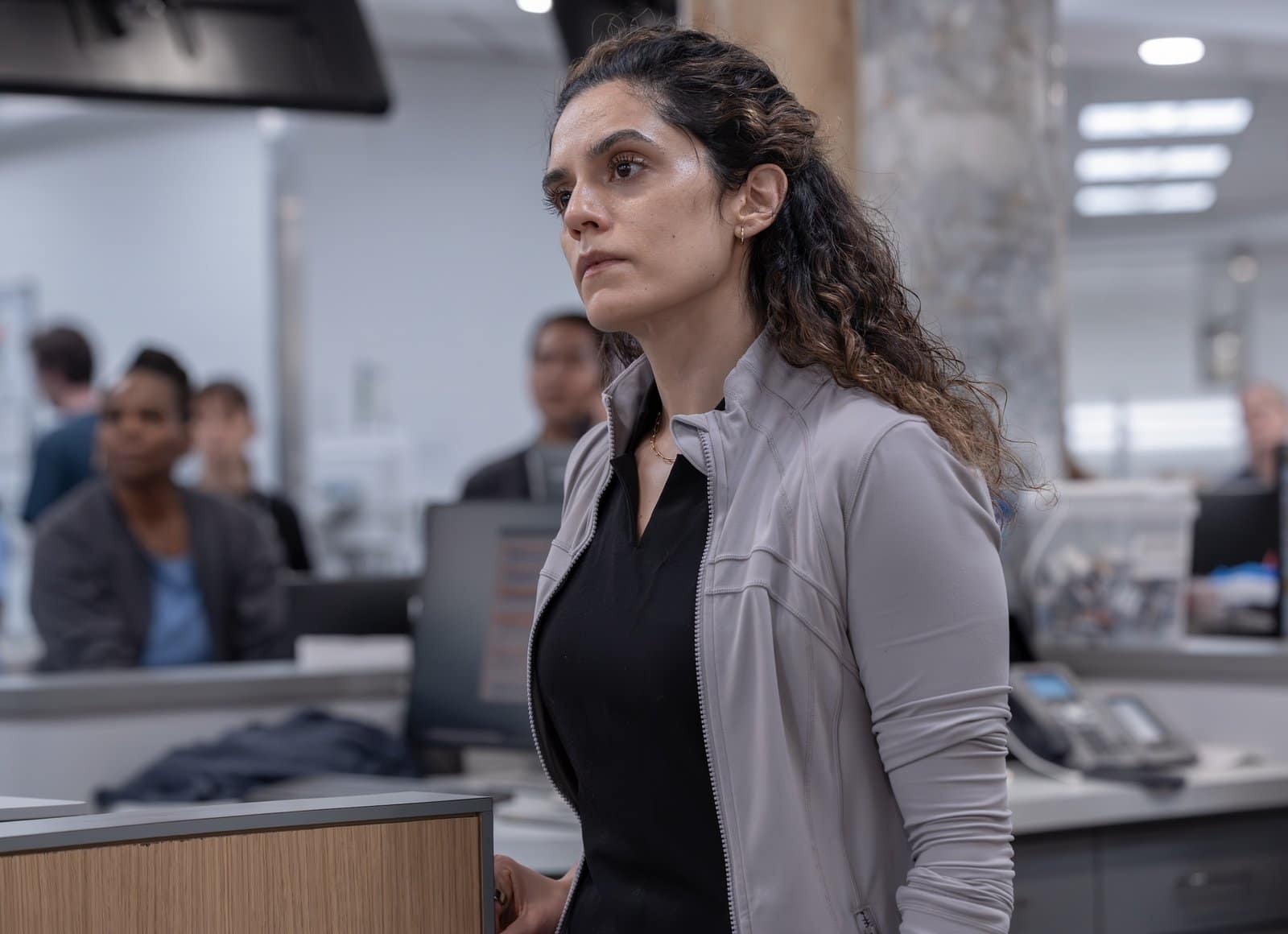
Being the first woman of Middle Eastern descent to be nominated for a Primetime Emmy Award in the supporting actress category is still something Sepideh Moafi is wrapping her head around. “My life story is crazy,” says the Iranian-American actress, who was born in a refugee camp in Germany after her parents escaped the Islamic Revolution. “Things could have shaped up in a very different way for me and my family.” To receive the accolade for playing Dr. Baran Al-Hashimi, the new attending physician in the Pittsburgh Trauma Medical Center, or ‘The Pitt‘, makes the acknowledgement even more meaningful. “We have historically been cast at the periphery of stories and been a two-dimensional device for main protagonists,” she says. “To be able to embody this woman with such fierce intellect, courage, empathy, vision and tenacity is incredible in and of itself. And then, to have this historic nomination playing a woman like that – I’m over the moon.” Here she talks to Deadline about what she brought of herself to the role, the challenge of a slow reveal and where we find the previously contentious Dr. Al-Hashimi and Dr. Robby (Noah Wyle) in Season 3 of The Pitt.

Warrick Page/HBOMAX
DEADLINE: Did you bring something of yourself and your past into this role?
Watch on Deadline
SEPIDEH MOAFI: Not consciously, but some of the stuff that you get for free just lives there, under the surface. My first day on the set of The Pitt was Dr. Al-Hashimi’s first day in the hospital. We were navigating similar emotions. [There was] a bit of intimidation, excitement, uncertainty, confidence in our ability, but also trying to test the waters and navigate our path gently and cautiously. That’s the stuff as an actor that’s so fun because you don’t need to work for any of it. And then you can really commit to the actions – where she came from, what she’s doing, what she’s saying, all those things. But I think we share a similar heart. We’re heart-driven people, and we’re intensely focused and meticulous about our work. Her about medicine and me about my craft. And I think coming from a background without a sense of belonging, having fractured identities and often feeling like a black sheep, I think that was really relatable. I feel changed by having played her. I feel much more organized in my relationship to these things because of her. And, as we’re filming season three right now, she continues to inspire me and teach me so much. I love this woman.
This is not just some, rah-rah feminism. People have brought up that, ‘It’s not always about gender discrepancies or the gender gap.’ But it is. Especially in medicine, not a single woman I’ve spoken to has said something different about their experience.
DEADLINE: She comes in with this can-do attitude. Is that who she is, or is that a defense mechanism in this situation?
MOAFI: I think both. She’s found ways to armor herself because women – and women in leadership, in particular – are constantly being questioned. Look, this is not just some, rah-rah feminism. People have brought up that, like, “it’s not always about gender discrepancies or the gender gap.” But it is. Especially in medicine, not a single woman I’ve spoken to has said something different about their experience. So, that was important for me to capture in her essence, and how she shows up, because you have to be strong enough to be taken seriously. And you don’t want to be too domineering or too overpowering. You constantly have to check yourself and check how you’re balancing your presentation, how you’re balancing your energy. How you’re balancing your appearance – this thing of looking presentable and looking good, but not looking too good. It’s so crazy what we as women have to navigate. Imagine going to a meeting and not thinking about your appearance. How do people then perceive you? It tells a story and she’s aware of the story that it tells. And she’s aware of the stories that she’s hiding and the stories that she’s highlighting. It’s wild to see how a woman with such a strong point of view easily gets backlash or gets a harsher lens than her male counterpart.
DEADLINE: Because if you think about, say, Dr. Robby’s first day, I doubt he would give thought to anything you just said about policing his tone or what he is wearing. But this is every woman, everywhere.
MOAFI: It’s the whole system and we are all products of this system. When these sorts of dynamics have been normalized and embedded in the culture, it’s hard to even see it as it’s happening. I think subconsciously Dr. Al-Hashimi has just accepted that this is the way it works, in order to be taken seriously.

Warrick Page/MAX
DEADLINE: It’s only four months between Seasons 2 and 3, but has comfort changed her veneer a little? I’m assuming she’s running the show now.
MOAFI: Yes, things have definitely shifted. And, as always, she goes about things responsibly. She’s accountable. She’s taken the appropriate measures to continue working in the ED. And she runs a really healthy but tight ship, and things are going really well under her watch. The whole environment seems to flow really nicely and more easily. And yeah, that gives her a sense of comfort because it’s not like, “Look what I did.” It’s more like, “This is how it should be.” It’s not an easy job. We’re burnt out no matter what, but we need tools and to create mechanisms to help us offload some of this burden. We need to find ways to take care of our own mental health. We need to find ways to responsibly lean on each other. We need to find ways to give each other encouragement because that gives a lot too. When somebody says, “Good job,” or they see you, whether conscious or subconscious, it does light you up a bit. It does lighten your heart because you feel seen, you feel appreciated. And I think that despite all of the different actual technical adjustments and changes that have taken place in the hospital, there have been emotional and tonal shifts that have happened, too, that I think work for the benefit of everyone who works there.
DEADLINE: It’s also Dr. Robby’s first day back. How does he fit in?
MOAFI: Yeah, that’s fun. I’m excited for people to see that. I’m having fun with Noah exploring that. Because he’s obviously gone away and we’ve both changed a lot in these four months. Things have shifted and settled. And I think part of the anticipation of meeting each other again is seeing where he is in his journey and him seeing where I am in my journey. I’m excited for audiences to see that.
[I’ve had] these beautiful messages and beautiful interactions with people from my part of the world who are like, ‘What this character means, what your work in this role means, the way that you’re giving us visibility as so much more than just mothers, daughter, wives of terrorists…’
DEADLINE: Your storyline in Season 2 is phenomenal. The first time I did not see it coming. How much did you know of your arc going in?
MOAFI: When I was auditioning for the job, in the last step of the process I knew that there was a neurological condition that Dr. Al-Hashimi was managing. When I got cast and read Episode 1, and it ends with that freeze at the end, it seemed pretty clear that that’s what was happening. But sometimes in auditions they’ll experiment with different storylines or different things just to see the actor’s range, and it doesn’t necessarily mean it’s going to end up in the script. So, I reached out to the team, and I said, “I just want to make sure this means that she has temporal lobe epilepsy.” And they said yes. So I knew from the very beginning that at some point towards the end of the season, there would be a reveal. I didn’t know how it would be explored, how it would be done, but I knew it would happen at some point. But it was really cool seeing cast, crew, the entire production wonder and try to speculate. They all had their different hypotheses. They were like, “I think she must have lost a baby. It must be some sort of trauma.” Is that what you thought too?
DEADLINE: Yes. She’s very good at hiding the truth.
MOAFI: As actors, as people, we know how to keep secrets. We know how to lie when we need to. And it’s not that she’s lying, it’s that she thinks that if people know, then they’ll judge her. There is a stigma around neurological conditions, around disability, around any kind of health condition. And even though there are protections from the ADA, it’s kind of irrelevant. People still judge you or see you in a different light.
She’s kept this zipped up from everyone except the people that absolutely need to know, her entire life. That gave me the confidence to be very convincing in my choices of hiding. Because you don’t want to indicate anything. And frankly, that’s the kind of acting I respond to. I really like to be surprised and to wonder what’s happening inside a character rather than being told what’s happening inside of the character.

HBO Max
When we get to this moment in Episode 7, where she goes to the bathroom – where she can show a little bit more, but she’s still trying to keep herself from unraveling – that was interesting to me because I know that I don’t need to play at it. It’s just there living inside of me, and then the camera captures it because of the size of the frame. So, it was a really fun dance throughout the season to play with the levels.
And then towards the end, there’s a moment where she has another seizure and Robby sees her. The next interaction is him questioning her. I think that’s some of her best lying. She’s like, “What are you talking about? I have no idea what you’re talking about.” And in the next episode, she reveals herself to him. I think, at that moment, she knows that he sees her. I think that’s part of their connection – what repels them and attracts them is the fact that they really see each other. They can’t hide from each other. So, she decides to fully reveal herself to him, hoping that it’ll bring them closer, but it has the opposite effect.
DEADLINE: What was the challenge of doing the scene where you tell Dr. Robby about the condition and he has to figure out that it’s you?
MOAFI: I’m getting emotional thinking about it. What I felt through that 14-hour shift, through those seven months, was that I was trying to control the way that I was perceived. As Dr. Al-Hashimi [I thought], “If you show a little bit of weakness or if you show one mistake, that gives Robby reason to come down on me.” She’s so steady. She is so precise. And in that scene it felt like I was five years old again. It felt like there are no protection mechanisms at all.
So that scene, the cliffhanger scene, was not easy. It was a lot more clear, emotionally, what was happening when we got into the scene itself in the following episode. That felt like riding a colt or something. It was like a live wire. There were some scenes where it was purging out of me and other scenes where John [Wells, EP and director of the season finale] wanted me to really control it.
Throughout the season, the last couple episodes in particular, she’s almost surfing this volcano beneath the surface. And then the volcano begins to erupt a bit. It starts to spill out. And you’re trying to contain the emotion. Actually, that’s probably the hardest thing that I’ve had to do as an actor, is the riding of the rising emotion and having to control it but not mute it. You don’t want to push it down. That’s what she does for most of her professional life is push it down. But this is a different moment where you’ve kind of opened the door a bit and it’s wanting to fly open and you keep your hand there, but it keeps wanting to just blow open.
That was a tricky scene to navigate, but I really enjoyed doing it with John because it felt like he was an orchestra conductor. All the things were there and he was shaping it in every take. And ultimately you never know which take they’re going to use, but I think the take they used really told the story in a way that was effective.
DEADLINE: And then there is the full eruption in the car.
MOAFI: First there’s the fight. After first rehearsal, our whole crew started clapping. It was really funny. That scene was intense and there were levels there. It was never mild. It was always pretty warm to very hot. What John ended up using was a lot more tame than I expected. It got bad in there. We kept checking in with each other, and being like, “You good? We good?”
And then that last scene in the car, we did all the technical shots of the driving for a few hours. By the time we got in the car, we only did two takes. Again, I was working with John who’s so precise about his vision. So after the first take, he’s like, “We got it. Do you want another?” And I said, “Yes, I want another one, for sure.” And we did another take. Then he said, “Do you want another one?” and I said, “No, no, no. I don’t need it…” Because I have the type of personality that’s like, “Let’s just keep going, let’s go, let’s go.” But with these kinds of scenes, I feel like now at this point in my life, at this stage in my career, where you have to give and trust.

Warrick Page/HBO Max
DEADLINE: When you’re screaming in the car, is part of you like, this is the end for Al-Hashimi. This is the arc. She’s never coming back.
MOAFI: No, that didn’t enter my mind. But it definitely felt like, as the character, a very low moment. Because you’ve spent your entire career doing everything perfectly. Not a single misstep, not a single mistake. And then in 30 seconds, someone threatens to take it all away from you.
It brings up the reality that, yes, she gets these cluster seizures. She hasn’t had seizures in a while, but now she’s had two in one day. And that’s obviously alarming. She needs to take care of that and consult with her whole medical team. There are so many ways that the hospital can and must accommodate doctors. Not just doctors with neurological conditions, but doctors with health conditions, with chronic illness, with disability, who are aging, who are pregnant. It’s not like, “Okay, something’s wrong. Now we’re done with you.” And that’s kind of the way that Robby made it seem. Like, “You’re out for six months, or you’re out.” So, while she knows that he’s wrong, there’s still that little girl in her that’s like, “Everything I worked for is gone.” The catastrophist. Whenever we’re in these places of deep mourning, and everything feels like it’s collapsing down on us, we live in the worst of the situation. That’s where she is.
It’s also just a moment where she realizes, I can’t keep sprinting like this. There is some truth to what he says in that you can’t do this in this way anymore, which is overachieving to the extent that it’s almost terrifying. You need to slow down. The advice you give, you need to take. You need to take care of yourself. You need to prioritize your health. You need to acknowledge and deal with your trauma – from life, from her condition, from working in war zones, from growing up in an immigrant family. It’s just so many things, unhealed wounds, that I think this gives her an opportunity to address. But of course in that moment, it feels like life or death.
DEADLINE: Which is why I’m relieved to hear that she’s back. Have you received feedback for your character?
MOAFI: It’s huge. Because she’s so multifaceted, I get so much feedback – just these beautiful messages and beautiful interactions with people from my part of the world who are like, “What this character means, what your work in this role means, the way that you’re giving us visibility as so much more than just mothers, daughter, wives of terrorists… “ She gives visibility to the type of women that I know. That doesn’t mean women who are high-achieving doctors, but women with the ferocity, the tenacity, the empathy, the leadership – you don’t have to be a doctor to embody these qualities. These are the kinds of women that I grew up with. So there’s that part.
And then the overwhelming response from the medical community, specifically people who manage some sort of condition, whether it’s health condition, disability or neurological condition. Not just in the health community actually. People in life, I’ve had a few of my own friends tell me that they didn’t realize they’re having these epileptic episodes until they watched the show. That happened with two of my friends. Several other friends have emailed or texted me and said that they’ve been living with this their whole life. I didn’t know. They said having this representation has been almost cathartic for them because they’ve never seen these types of seizures explored [in pop culture].
And just women in medicine being like, “Oh my God, thank God. That is exactly what it’s like. That is exactly how we’re treated.” I’m overwhelmed with the range of people who have reached out about this role and this show. And kids too. That’s what blows my mind. Little kids who are fans of the show or fans of this character.
DEADLINE: How young?
MOAFI: Like nine years old. I’m not kidding. I’m like, “Why are you watching the show? How are you watching it?” But, also, I want to mention the people who have reached out and said that they want to go into medicine. And the thing that has really moved me, are the people who are doctors who want to go into humanitarian aid work because of this character. It blows my mind. It’s not like we’re saving the world or anything, but to make people feel connected or to make people feel seen, or to make people feel enough in themselves, or to make people feel inspired, it’s more gratifying than anything else in the world. I grew up not feeling seen, like I didn’t fit in. I felt aimless. I felt unwanted. I never had a sense of belonging. I grew up displaced. And so for people to feel a little bit more solid in themselves because of something that they’ve watched or some storyline that’s been explored means the world to me.
DEADLINE: What was it in your life that gave you agency and direction?
MOAFI: At first it was music, when I started singing. Because I had really bad ADHD. And I tried medications and they didn’t work with my body. So I really struggled in school until I found music, and then everything in my life organized, and I became a different human being really. And then from music, years later I went into acting. But all of us have meaning in our lives, and just finding that, it restructures your entire existence. That’s certainly what happened with me.
All episodes of The Pitt Season 2 are streaming on HBO max.
