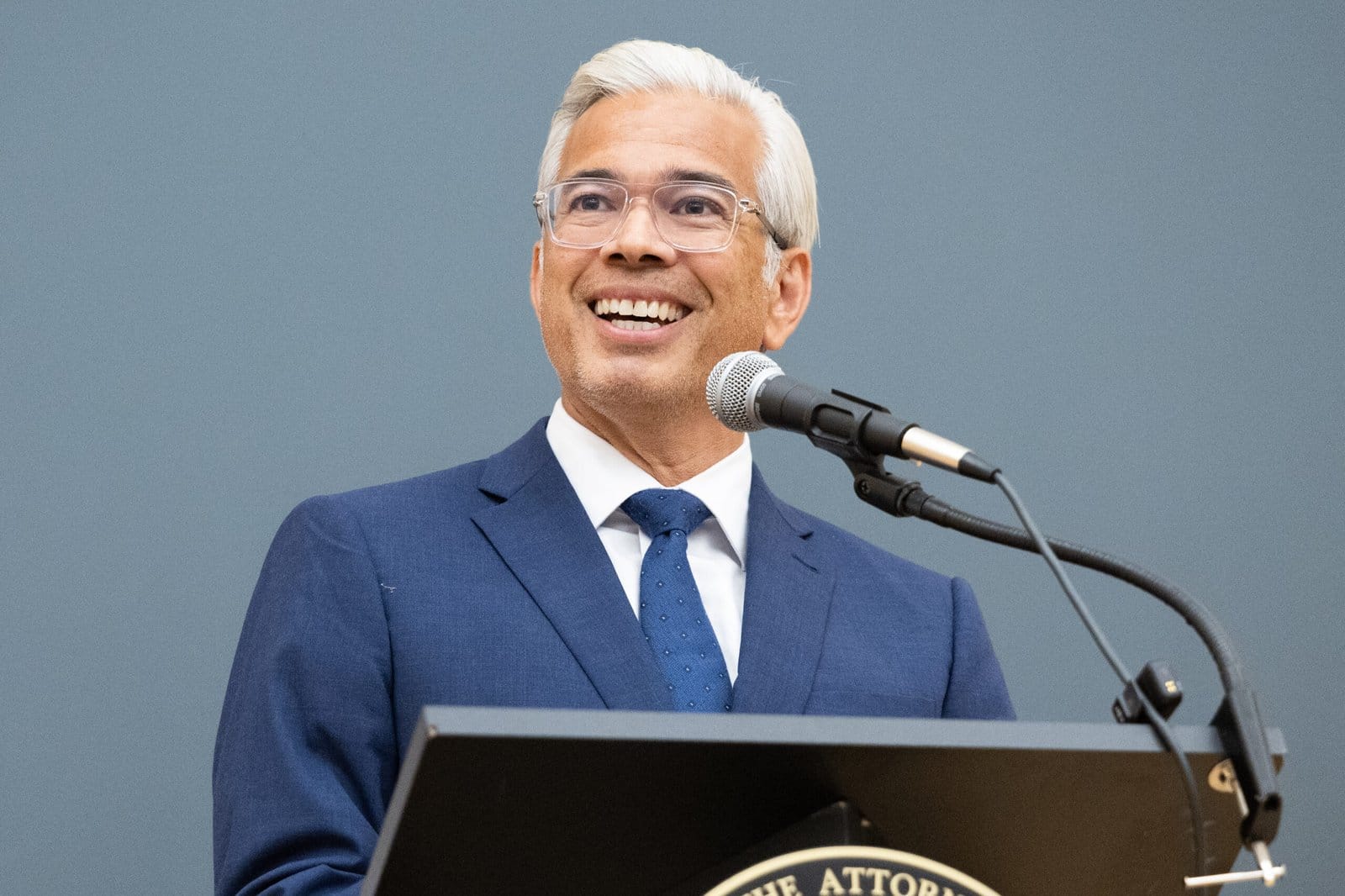
California Attorney General Rob Bonta has revealed terms of a settlement with Paramount allowing it to acquire Warner Bros. Discovery, stressing that the agreement is “not a blessing” of the mega-merger.
Speaking at a news conference Monday, Bonta detailed a list of items to which Paramount is committed. The list ranges from stepped-up film production in the U.S., an editorial oversight board for CNN and CBS News, commitments to theatrical releases and more. Not on the list, surprisingly, were any structural remedies. Repeatedly, Bonta has emphasized that only structural, not behavioral, remedies would be deemed acceptable by the AGs.
The closest thing to a structural remedy is a requirement in the consent decree that the companies negotiate pay-TV deals as separate companies. If they fail to adhere to that provision during the 5-year span of the agreement, they can be forced to sell off cable networks as punishment.
Watch on Deadline
California and 11 other states sued in July to block the deal on antitrust grounds, as did the Writers Guild of America. The agreement announced Monday addresses both suits and removes the final hurdle for Paramount as it looks to close the $111 billion transaction, which will transform Hollywood and join together two century-old studio operations.
“This settlement is not a vote of support for this merger,” Bonta said. “It is not a blessing for the broader merger … which doesn’t serve the economy or consumers well.” Later, the official added more bluntly, “I don’t think these companies should merge.” He noted several high-profile transactions his office has thwarted, including the merger of supermarket chains Kroger and Albertsons and airlines Spirit and JetBlue.
Outweighing that sentiment, he added, was the conviction that he works for the people of California and had an obligation to help their situation. “I’d rather resolve the case in the boardroom rather than the courtroom, and that’s what happened here,” he said.
The combined company, which Bonta said currently produces just 5% of its projects in the U.S., has pledged to spend $1.5 billion more over five years on shoots in the U.S. It will raise the share of domestic production to 20% if the U.S. passes an uncapped federal tax incentive plan for film and TV production, and if California or New York pass uncapped state tax plans the number would hit 40%.
Mirroring oft-repeated promises by Paramount CEO David Ellison in recent months, the company has agreed to produce 30 theatrical releases in the first two years, with that number rising to 32 films over the next three years.
Bonta called the arrangement “the opposite of Disney-Fox,” and a framework that “locks in a massive upside.” Since the Disney-Fox deal closed in 2018, as many Paramount-WBD deal opponents have noted, the film output and workforce at 20th Century Studios has declined markedly.
At least four of the films must be independent films and 20% must be blockbusters. (The former was left undefined, while the latter was specified as films costing at least $50 million.)
Paramount must also establish a $5 million independent film fund and pay $9.5M annually for workforce training. It also will establish a news editorial independence board “to assure independent fact-based reporting” at CNN, Bonta said. Recent overtures to Donald Trump by Ellison and his father, billionaire Larry Ellison, have raised concerns that the extensive makeover of CBS News and signature shows like 60 Minutes would be replicated at CNN – or even that the two would be completely melded together.
While the settlement provides some influx of funding and support for the entertainment industry in California, preserves two fabled Hollywood lots and prevents Paramount from making good on threats to leave the state, the ultimate impact on jobs remains unclear.
The company has promised to deliver $6 billion in cost savings from the merger, which is likely to entail significant layoffs. A study by the L.A. County Economic Development Corp. estimates that at least 4,000 jobs could be lost – though there have been mounting worries about the limbo state persisting given the industry’s many challenges. A trial in the antitrust case had been set for March 2027, but California Gov. Gavin Newsom, L.A. Mayor Karen Bass, presumptive Newsom successor Xavier Becerra, as well as Hollywood unions, major exhibitors, media CEOs and other have publicly called for a settlement.
Bonta’s comments represent only the states’ part of the story. Despite the specifics offered up by the attorney general, there are many details to be filled in on the corporate side of the deal. The same company will find itself with two studios, two large-scale news operations and two general entertainment streaming services, among other assets, and an extensive org chart to overhaul. It is expected that the deal will formally close within the next couple of days, especially given that Paramount will owe a $7-million-a-day “ticking fee” starting October 1.
