
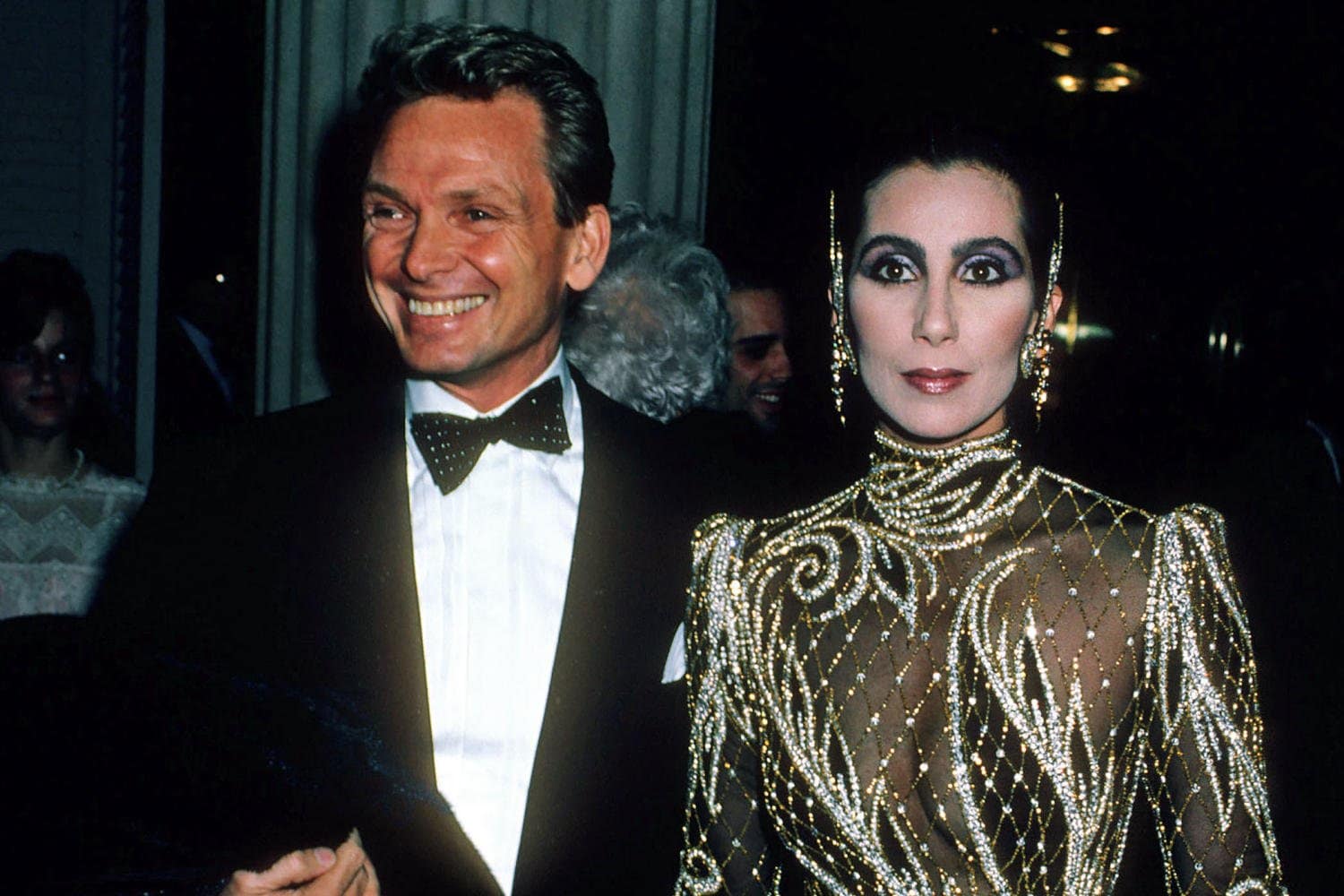
Legendary fashion and costume designer Bob Mackie, whose sequined gowns for Cher, Diana Ross, Tina Turner and other stars dazzled red carpets for decades, has sewn his final stitch.
Mackie died Monday at 87, according to a post on his Instagram account.
“He lived his 87 years to the fullest, fulfilling his dream of being a Fashion and Costume Designer, which is all he ever wanted to do,” the post read. “His genius and extraordinary designs will live on forever, continuing to bring beauty into this world.”
His longtime publicist Jenelle Hamilton confirmed that he died of pneumonia Monday morning in Palm Springs, California.
Known as the “sultan of sequins,” Mackie dressed some of Hollywood’s biggest names over more than 50 years. His creations for celebrities like Carol Burnett, Liza Minnelli and Barbra Streisand stunned both performers and fans alike and remain some of the most iconic costumes ever worn.
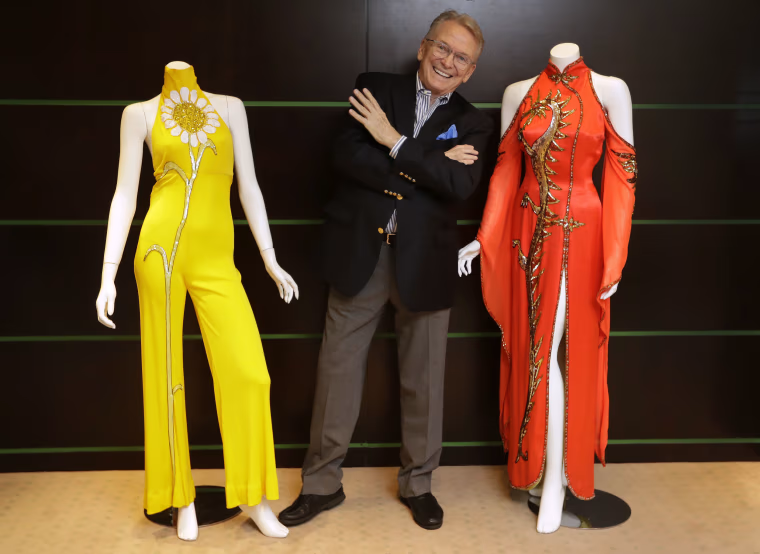
“Every time I put something on that Bob made, I felt very, very special,” Sir Elton John said on social media Monday. “His costumes were works of art, and he will go down as one of the most legendary designers ever in Hollywood.”
“He loved glamour like I love glamour, but more than anything, we shared the same sense of humour and had so much fun together,” he added.
Born and raised in the San Gabriel Valley east of downtown Los Angeles, Mackie was a fan of movies early on. Dave Karger, a Palm Springs friend of Mackie’s, as well as a host for Turner Classic Movies, said Mackie recalled taking a cable car to downtown L.A. at age 5 to see Judy Garland in “Meet Me in St. Louis” in 1944.
“He, from the youngest of ages, was a true fan of great actors and actresses and singers and performers,” Karger said in an interview with NBC News on Monday. “So I think the fact that he then got to live his dream and be an important figure in that industry meant a lot to him.”
Mackie first attended nearby Pasadena City College before he transferred to what would become the California Institute of the Arts, according to his Television Academy biography. He dropped out to work as a costume sketch artist in 1961, which included sketching the skintight, beaded dress Marilyn Monroe wore in 1962 when she sang “Happy Birthday” to President John F. Kennedy.

A year later, he was hired by the man who would become his lifelong romantic and creative partner, Ray Aghayan, to work on “The Judy Garland Show.”
The pair went on to win the first Emmy Award for costume design in 1967.
Aghayan died of kidney failure in 2011 at 83.
Mackie was briefly married to Marianne Nicholson, an actor known as Lulu Porter, according to her IMDb bio. Their son, Robert Gordon Mackie Jr., who worked as a makeup artist, died from complications related to AIDS in 1993.
His work with actor, singer and dancer Mitzi Gaynor in 1966 caught Burnett’s attention, according to a short biography on his website. Her producer hired him to design the complete wardrobe for “The Carol Burnett Show,” a post he held for 11 seasons.
A star was born.
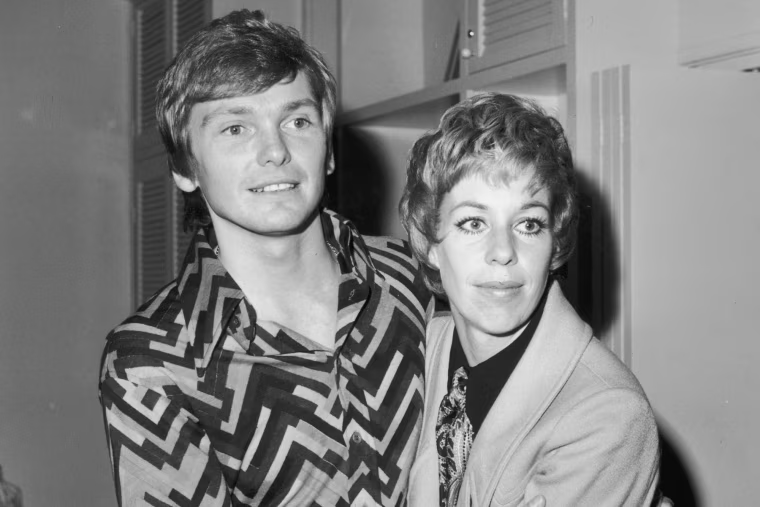
Karger, who interviewed Mackie for a forthcoming book on Hollywood, said one of the designer’s most iconic costumes was made for a Burnett sketch lampooning “Gone With the Wind,” in which Scarlett O’Hara’s dress is fashioned from drapes and curtain rods, transforming her into Burnett’s Starlett O’Hara.
Karger said Mackie called it the “Wind Dress.” It’s now part of the collection at the Smithsonian’s National Museum of American History.
He said Mackie didn’t enjoy attention but deserved recognition that came later in life.
“When you think of Bob Mackie, you think of his loud, vibrant designs,” Karger said. “You think of the clothes that he designed for Carol Burnett to wear on her show or for Cher to wear at the Oscars or in a music video. When you knew Bob Mackie, you quickly learned that wasn’t him at all. He dressed in a very conservative way, almost kind of, like, preppy with a lot of tweed.”
Mackie created bold looks for Streisand for the 1975 film “Funny Lady.” She posted a photo of a dress she wore for the movie on her Facebook page Monday.
“Bob Mackie was an incredible talent,” Streisand said in a statement that accompanied the photo. “He designed one gorgeous outfit after another for me in Funny Lady. He might continue designing creations for the angels.”
National Comedy Center Executive Director Journey Gunderson said Mackie found a potent communications channel in costumes.
“Throughout his extraordinary body of work, Bob Mackie understood the unique power of costume in comedy — to help create a character and become part of the creative energy that drove the comedy itself,” Gunderson said in a statement.
His work with Burnett, Cher, Joan Rivers, Bette Midler and Lucille Ball “helped shape some of comedy’s most memorable moments on television and stage,” he added.
In 1982, Mackie launched a ready-to-wear collection and a line of collectible Barbie dolls, which featured red carpet-ready dresses complete with headdresses, dramatic long trains and his signature sequined glow.
Throughout the decades, his designs took on an increasingly universal appeal despite — or perhaps because of — their sheer scale and luminosity. One of his most famous pieces, the flame dress, has been worn by pop icons Beyoncé and Turner, as well as Cher, with whom he also shared a lengthy creative partnership.
The dress, a version of which debuted in 1968 on “The Fred Astaire Show,” initially featured large gold paillettes. By the time Cher and Turner donned matching versions on “The Sonny & Cher Show,” the paillettes were replaced by smaller sparkly sequins that came to typify his work.
