
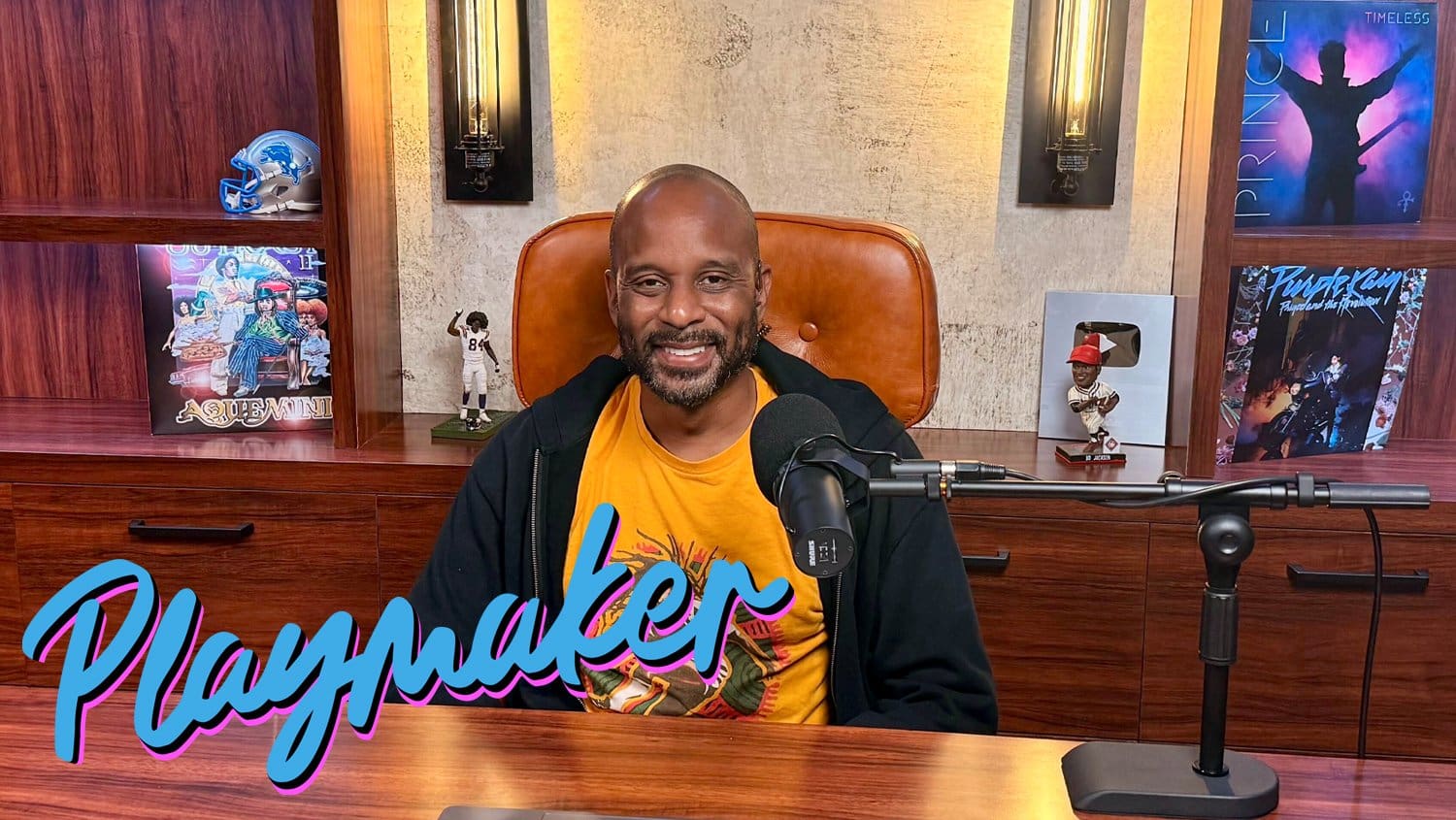
EXCLUSIVE: Bomani Jones, best known for his stints at ESPN and HBO, is teaming with podcast firm Playmaker for his long-running show The Right Time.
The New York-based Playmaker, which is owned by Danish digital sports media company Better Collective, has built an estimable roster of podcasts with a eye toward the increasing cross-over to video. The company’s roster includes The Roommates Show with New York Knicks teammates Jalen Brunson and Josh Hart, a bowling series hosted by L.A. Dodger Mookie Betts and various Shaquille O’Neal projects.
The Right Time launched in 2018 under ESPN’s auspices, and Jones acquired rights to it in 2021. He kept hosting it until leaving ESPN in 2023 and as he debuted as host of Game Theory, a late-night series that aired on HBO in 2022 and ’23.
Watch on Deadline
In a conversation with Deadline, Jones talked about the new era for his podcast, which a few days ago started daily production at a new, purpose-built studio in Harlem, NY. He also weighed in on the fast-changing sports media ecosystem, the rise of athletes as media creators, and how his early experience doing radio prepared him for the podcast age.
The conversation has been condensed and edited for clarity and length.
DEADLINE: How is the show changing, if at all, with the move to Playmaker?
BOMANI JONES: At this point, the audience is much more invested in the product itself than where it comes from. Like when I when I left ESPN, I think that I could respond to people with a certain sort of resentment because to me at that point, I was only doing the podcast for them anymore. I wasn’t doing television. So it didn’t matter if it was ESPN or not. ESPN at that point was not really prepared or knew what to do really with the podcast they had in terms of monetization, terms of promotion, and all of those things. Now, coming here, I didn’t really want to talk as much about Playmaker until we were ready to do everything at one time. We’re going to move into a new studio. We’re going to change the imaging around the show. So I wanted it to be that when people looked up, one day it was going to be like, ‘Oh, wow, this is different. This has been improved. This has been elevated.’
DEADLINE: YouTube is constantly updating its product with new features and AI tools. Having worked a lot in traditional media, does the amount of technical resources available to creators ever amaze you?
JONES: One thing you see across industries in different ways that has really become more stark and more pronounced post-pandemic is how readily and largely cheaply people can produce high-quality video content. That becomes important for people like me who, throughout the years, have had the advantage of being promoted by a large platform. Creators are just people, right? Just guys, just women who are able to put together something that looks very similar to the thing that you are putting together. Um, and that is where YouTube, in a lot of ways – I’m reluctant to use the term has democratized things, because I think that kind of misses the point – but I do think that it has created a situation where the competition that you have when you’re putting together a show is so many more people. You can’t be somebody like me or with the background that I have and be arrogant about the fact that you have this background and somebody else does not. There are a lot of people I’ve never heard of who are out here putting up really, really big numbers, and I’m the guy that has to figure out how to learn from them as much as vice versa.
DEADLINE: There’s also this new lane for athletes. So many of them are now media figures and podcast host. Their experience lends an authenticity to what they do, but not all of them are exactly entertainers. What do you make of it?
JONES: It’s a very wide range with athletes because the difference between the athletes and most celebrity digital products versus everybody else is, they’re not getting those jobs because they’re good at it. That doesn’t mean that many of them are not good at it. That’s just not the reason that they’re necessarily getting that opportunity. The people in charge of these places figure, ‘Hey, man, if we get a big name, and depending on what their audience is and who surrounds them, then we can build a product that people will listen to and that people will click on. We can get enough people to set it up and put it up window dressing around them that will support them.’ They can get guests and guests show up immediately with a different level of comfort. So, yeah, it’s a very interesting game to me now watching what it means for an athlete to have a show because it could be so many different things. Playmaker has the Roommates show with Jalen Brunson and Josh Hart. I went to the block party that they had. They can get 10,000 people there, and they can get Mariska Hargitay as a guest. They had Fabolous and Jim Jones. And a big part of that is, if you’re a Knicks fan, you want to hear from your favorite players. I think there are different roles, and different shows can play, but the competition with athletes is not really like my team against their team, as much as it’s all of us against the fact that there are only 24 hours in a day.
DEADLINE: In terms of revenue, like, obviously you have advertising. What about subscriptions or other sources?
JONES: We are working on subscriptions. Some of that I still need to talk with Playmaker about. I am a bit of an artiste in the sense that what I really want to do is come out here and make stuff. Uh, you know, and then by large, you know, by and large, we go and we work the other things out. But I know one thing that we talked about initially and part of why I was open to coming back into a studio. Um, was that the studio itself will make it easier for them to sell in different ways. Like, I think a great example, if you look at [YouTube and ESPN host] Pat McAfee’s show, it is just littered with all kinds of knickknacks, and if you look close, it’s like, ‘Ooh, it says UberEats right there. Oh, you know, it says this in those different places.’ And so I, one of the draws for a play of Playmaker for me was there appeared to be a creativity on their end about sales.
DEADLINE: It seems like you have found a happy medium betwee big media institutions and do-it-yourself, do you feel that way?
JONES: Yes, but I’ll be honest with you. I have been doing this since I was 19 years old, so 26 years and change. My goal is I always have my own goals that I am trying to achieve while also being cognizant of the agreements that I’ve made with people. And so I have to fulfill the obligations that I have made to them. Yeah. So now, I have been doing this long enough now. that I exist as a brand myself. Not as big as ESPN, obviously. But I exist there and I’m all, as I’ve been before, it’s just more pronounced because of the way it goes. I am working to do best for myself, and I am always looking to have partners who see my interest and their interests as being complimentary. And I have been fortunate enough now again to find another company that sees it this way, and that’s always an exciting thing.
DEADLINE: Are you encouraged by the state of sports media? There are increasing signs of influence by leagues over what appears on ESPN or other places. But then again, there are a wide range of digital outlets out there. Is there a significant diversity of voices in your opinion?
JONES: My my only concern about the industry at this point, and it’s everywhere. This isn’t just in sports, is, like, if somebody knew was to come come into the game, I don’t know how to tell them to, like, what they need to do to get their voice to cut through. Yeah. Like, it’s it’s so much that’s going on. Like, it gets you into, like, the Neil Postman idea – and he was just talking about television – that as it becomes a bit unregulated in terms of who can be heard and who can put things out. It is winding up with so much noise all over the place that how do people decide what there is to listen to? How does anybody truly matter? Like, we don’t really make big music stars anymore. For example, because there’s just so much all over the place. How do you cut through to become big? That is one question I have now about the industry. I do think that there’s a certain measure of ideological capture, one could argue, but I think a lot of that has to do with the attitudes of whoever is running the given company right now. Like the attitudes of the people in charge of ESPN 10 years ago are not the same as the attitudes of the people now. So it’s going to kind of land different. It’s gonna kind of sound different.
