
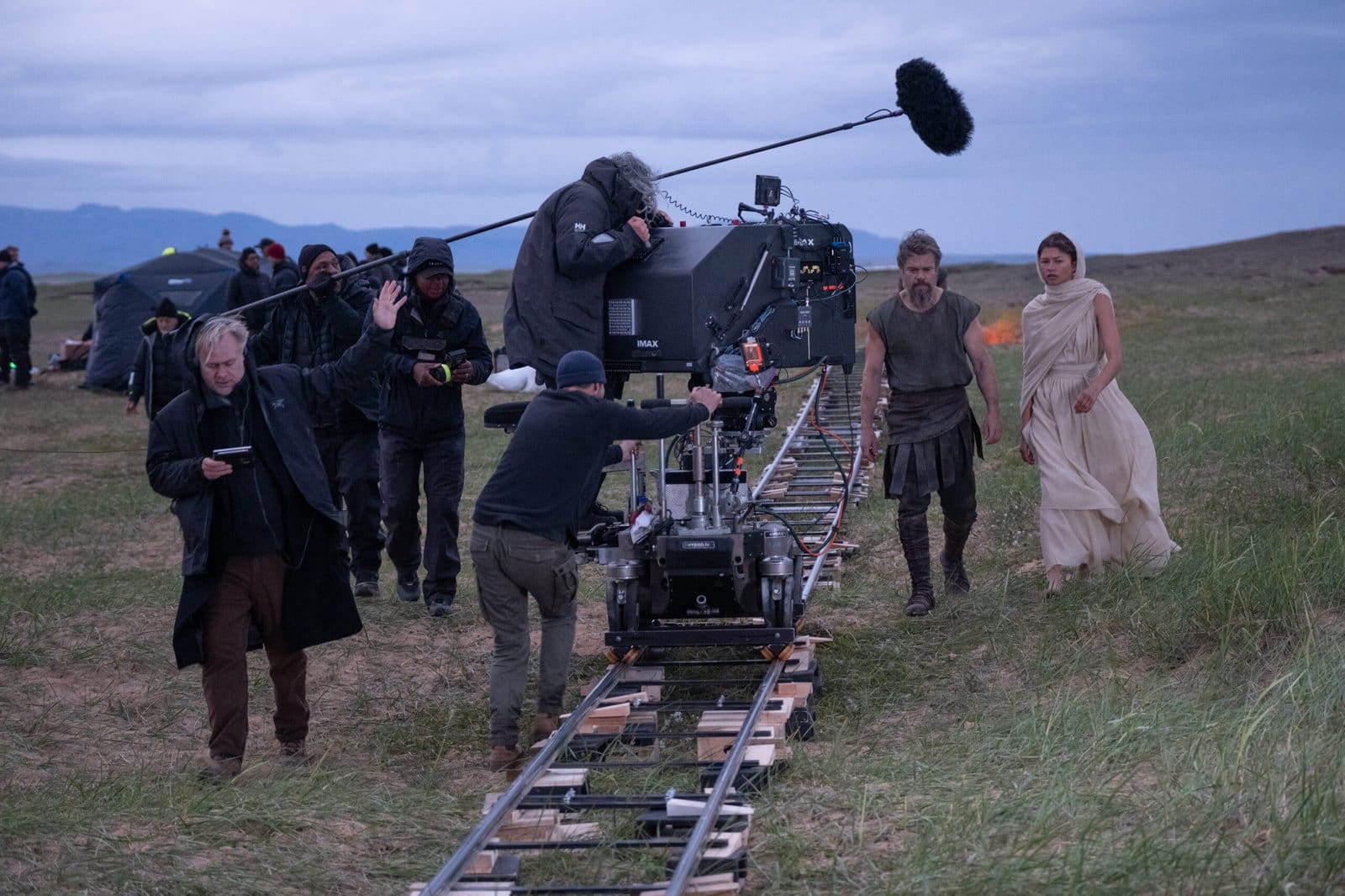
“As they say at the awards shows, I was humbled to learn that Nolan has read at least the first line of my translation of The Odyssey into iambic pentameter. In at least one interview, he cited my version of the first line of the poem: ‘Tell me about a complicated man.’ But I would be ashamed to have written any part of this script.”
That’s Emily Wilson, whose poetic translation of The Odyssey is probably the most well-liked and eminently accessible for modern readers, writing in the London Review of Books about Christopher Nolan‘s latest film. Wilson is not your stereotypical, John Houseman-type academic. She’s a lot younger and hipper than Houseman’s ilk. She can speak easily about Zendaya and Athena. She has tattoos up and down her arms. She smiles.
Maybe it’s surprising, then, that her piece in the LRB is fairly hard on what many critics consider the best version of Homer’s story ever put onscreen. Wilson, who has a deeper knowledge of The Odyssey than just about anyone — including Nolan — seems to find a way to twist a knife of contention even when she’s offering praise for the film.
Watch on Deadline
“Christopher Nolan’s $250 million action movie version of Homer’s ancient Greek poem is an entertaining way to hide from the high temperatures for a few hours,” she writes. “Nolan’s trademark jumps and twists in the narrative structure are relatively easy to follow, and appropriate for The Odyssey, a narrative of tales nested in tales. My teenagers had a good time. Unlike some of Nolan’s other films, The Odyssey is not boring, thanks to the source material, which is impossible to mess up entirely. It’s a family-friendly audiovisual spectacle, like an elaborate Fourth of July fireworks display — and with about the same level of narrative and emotional depth.”
Her main complaint seems to be that Nolan’s film does not do justice to one of the foundational texts of Western literature. That might be true. But what adaptation does? She lists Euripides’ Helen, Virgil’s Aeneid, John Milton’s Paradise Lost, James Joyce’s Ulysses, Derek Walcott’s Omeros and Margaret Atwood’s Penelopiad among the most “creative responses” to Homer’s original. On the big screen, one might throw in Stanley Kubrick’s 2001: A Space Odyssey. But that’s very, very rare air — just a handful of entrants over thousands of years — and a steep ascent for a modern filmmaker working with runtime of two hours and fifty-two minutes.
Wilson admits that adaptations or “creative responses” must take liberties.
“Adaptations needn’t and shouldn’t follow the original with anything like the exactitude of a translation. Some of the best radically transform or resist the source material, providing what Harold Bloom called ‘strong misreadings’ of their ancestors.”
She adds, “Despite the manufactured online outrage, there is nothing inherently wrong with the movie’s attempt to approximate contemporary American speech. If you’re not going to compose a script in Homeric Greek, or even in metrical English verse, you might as well use something like conversational American English.”
In fact, Wilson did something similar with her translation of the poem, using iambic pentameter rather than the archaic Greek dactylic hexameter “because it is the conventional meter for regular English narrative verse.”
She praises Nolan for maintaining Homer’s story-within-a-story narrative framework, but says the director simplifies his characters.
“As in his previous films, Nolan is interested in the discontinuities of space and time, in magic, tricks, craft, technology, rivalry, substitution, masks, miscommunication, what we remember and what we choose to forget. Yet again, survival is portrayed as a kind of triumph. Yet again, there are long, claustrophobic scenes of drowning and near-drowning, and technically impressive episodes in which buildings are engulfed in flames and vehicles explode. Yet again, we watch a male character’s desperate quest to recover and/or avenge a female love object. I had hoped that Nolan’s affinity with these Homeric themes might push him to new creative heights, and enable him to conjure more believable characters. But The Odyssey features his usual combination of grandiosity and superficiality.”
More specifically, Wilson says, “Damon’s Odysseus isn’t complicated or wily or artful.” He isn’t “a complicated man.”
Homer’s Odysseus survives on his wits as much as force of arms.
“Damon’s Odysseus is motivated mostly by anxiety and guilt” over his complicity in war, she says. “But the representation of Odysseus as a reluctant warlord makes a nonsense of the movie’s imagined world. We are not shown that war or killing are bad, only that good men sometimes feel bad about it — a very different point. Any serious depiction of violence, ancient or modern, must show the perspectives of the victims as well as the perpetrators, and the Homeric poems easily clear the bar — but Nolan doesn’t. The Trojans are dehumanised by their masks; we know none of them by name or face. The hands of Odysseus and Telemachus are bloodied only by the most righteous, computer-game modes of killing, and we feel no pity or horror at the deaths of their victims, whether Trojans, giants, suitors or slaves. During the sack of Troy — which he supposedly organized — Odysseus gazes around in bewilderment and horror, as if he has never seen a massacre before.”
The more modern sensibilities of Nolan’s Odysseus extend to other areas that are more morally ambiguous in Homer’s text.
“Many of the film’s implicit values directly contradict those of Homer’s poem. Deception, warmongering, extramarital sex, cruelty to animals, abusing women and yearning for honour — all perfectly fine in the world of Homer — are, in this version, very bad. This is not in itself a problem, but it is a problem if the film’s own values and vision don’t hang together, and if the characters’ motivations don’t make sense on their own terms.”
That may be Wilson’s main point: She doesn’t think the narrative or the characters work.
“Nolan lets the fragments of an incomplete set of big ideas spin around in the epic whirlpool, with no plank of solid, specific human experience to which we might cling,” she writes.
Anne Hathaway, as Odysseus’ wife Penelope, is a shell of Homer’s vision, says Wilson.
“Hathaway’s face is as expressive as ever, and she looks beautiful and mysterious, glimpsed mostly through the veil of a clever set design that separates the women’s quarters from the main hall. But the script gives her nothing to do except yearn for Matt Damon, for reasons unknown. The couple have no chemistry and nothing in common. Throughout his wanderings, the uxorious Odysseus clings to a little doll figure, intended to represent his wife (like the spinning top clutched by Leonardo DiCaprio in Inception); the real woman is barely more interesting.”
She also complains about the lack of sex onscreen, which again highlights the mores of ancient Greece vs. those of modern-day audiences.
Homer’s hero has extramarital affairs with goddesses Circe and Calypso — the latter of whom traps him and forces him top sleep with her each night for seven years.
By contrast, says Wilson, “Charlize Theron’s Calypso looks gorgeous, but she is never angry, never funny, not skilled in rhetoric, and never consumed by lust for her scraggly mortal victim. She’s an unpaid therapist, soothing the soul of the bedraggled, PTSD-ridden Odysseus with drugs, and graciously listening to his disjointed tale of woe.”
The scholar does have high praise for one actor’s performance: Robert Pattinson as Antinous, whom she says “deserves one of the Oscars that will shower down on this movie like the golden rain of Zeus.”
When it comes to internet outcry over “diverse casting,” Wilson says there is “nothing progressive about it,” and uses the topic to lodge another objection.
“The race-neutral casting of Nolan’s Odyssey was inevitably deplored in some quarters. But there is nothing progressive about it. Most of the non-white actors – Zendaya, Lupita Nyong’o, Himesh Patel, Corey Antonio Hawkins, Travis Scott – play versions of the Black best friend, whose only role in the drama is to provide aid to the white protagonist…Nyong’o’s double part as Helen and Clytemnestra is hugely underwritten; she is given only a few minutes of screen time to perform a set of brief tableaux of female victims (the outraged bereaved mother, the abused wife, the repentant adulteress).”
She also deplores the lack of visible gods in the film — they have a large presence in the poem. That complaint is shared by others. It is the primary gripe about the film from The New Yorker’s Richard Brody.
Wilson curiously saves another complaint for the very end of her essay: “The most troubling ethical problem with Nolan’s Odyssey concerns the decision to film part of the movie in the occupied territory of Western Sahara, thus normalizing the ongoing violence against the indigenous Sahrawi people.”
In the end, however, Wilson does express a degree of appreciation for the film’s impact, if not its art.
“Despite all this, the release of The Odyssey is still an event to celebrate. In what we are told is the streaming era, this epic is bringing audiences back to cinemas…Nolan, who studied English at University College London – where students still study The Odyssey as a first year ‘foundational text’ – is doing his best to get the general public reading again, and I am grateful.”
Watch Wilson’s recent interview at the 92nd Street Y below.
