
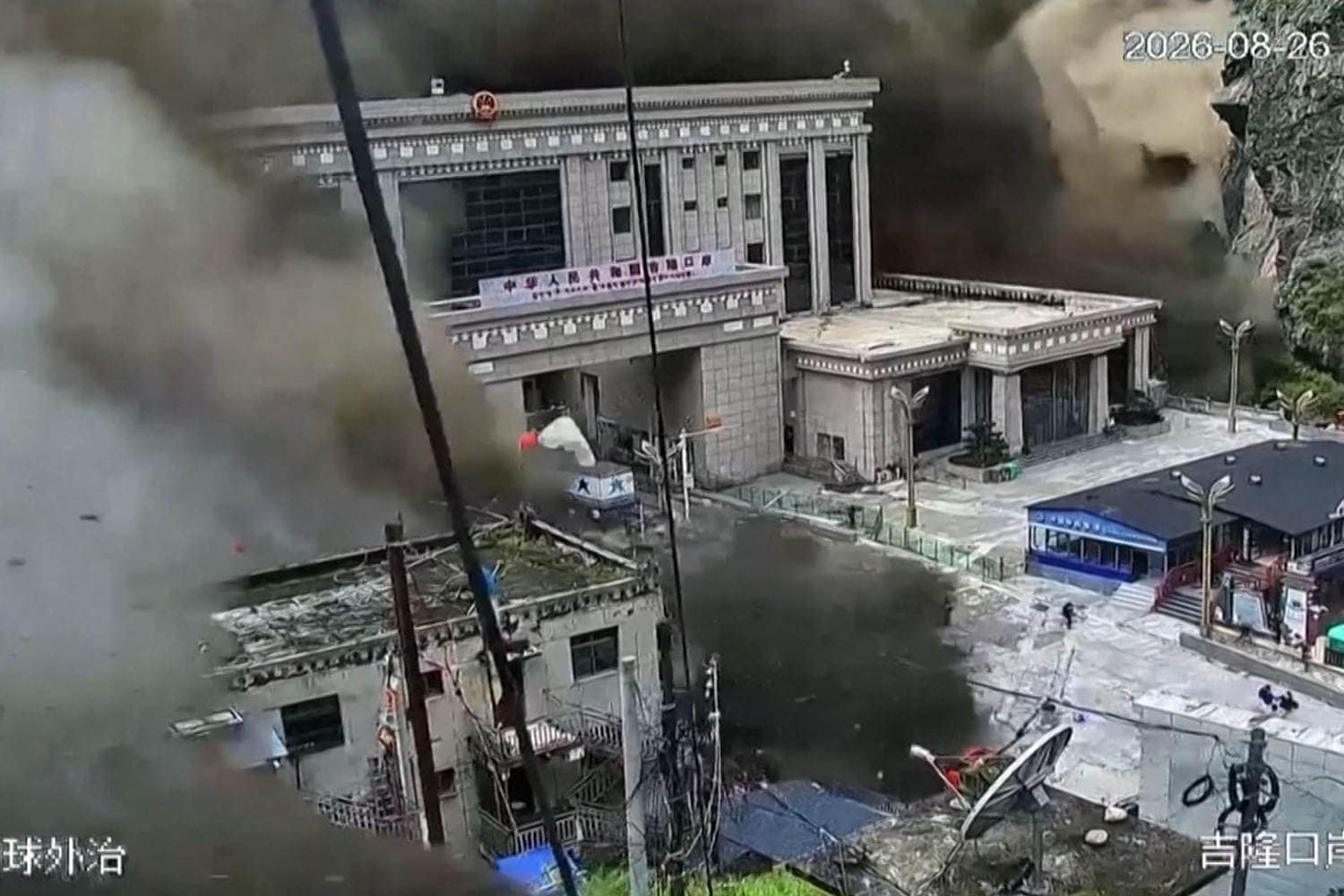
High casualty counts are also feared in Tibet, where hundreds more people are missing, with both Nepal and China declaring emergencies and scrambling rescue teams.
“There is devastation everywhere we look,” Tula Bahadur BK, a health worker in Rasuwa, told Reuters. “The settlements next to the river have been completely swept away. Five of my own relatives are missing.”
Sasmit Pokharel, a Nepali government spokesperson, said the government has asked both India and China for help with the rescue efforts.
The cause of the inundation was not immediately clear, but climate experts at the Kathmandu-based International Center for Integrated Mountain Development said an avalanche from a glacier most likely caused Wednesday’s flash flood.
The U.S. Geological Survey reported a magnitude-4.4 earthquake early Wednesday, about 60 miles north of Kathmandu.
“The Lhende Khola has flooded twice in 14 months, this time triggered by an ice rock avalanche from a glacier on the Nepal side that blocked the river and released a sudden surge downstream,” said Saswata Sanyal, a disaster risk reduction specialist at the climate research group.
He noted the importance of early warnings in “a warming Himalaya.”
Alton Byers, a faculty research scientist at the Institute of Arctic and Alpine Research at University of Colorado Boulder, has studied glacial outburst floods and other alpine hazards in Nepal. Byers told NBC News the flood was the worst he’d ever seen.
“It’s just horrific. I’ve never seen a flood of this magnitude,” Byers said.
Byers also said it’s not exactly clear what happened yet, though initial reports suggest that an earthquake might have triggered an avalanche in Nepal, which somehow released floodwaters.
