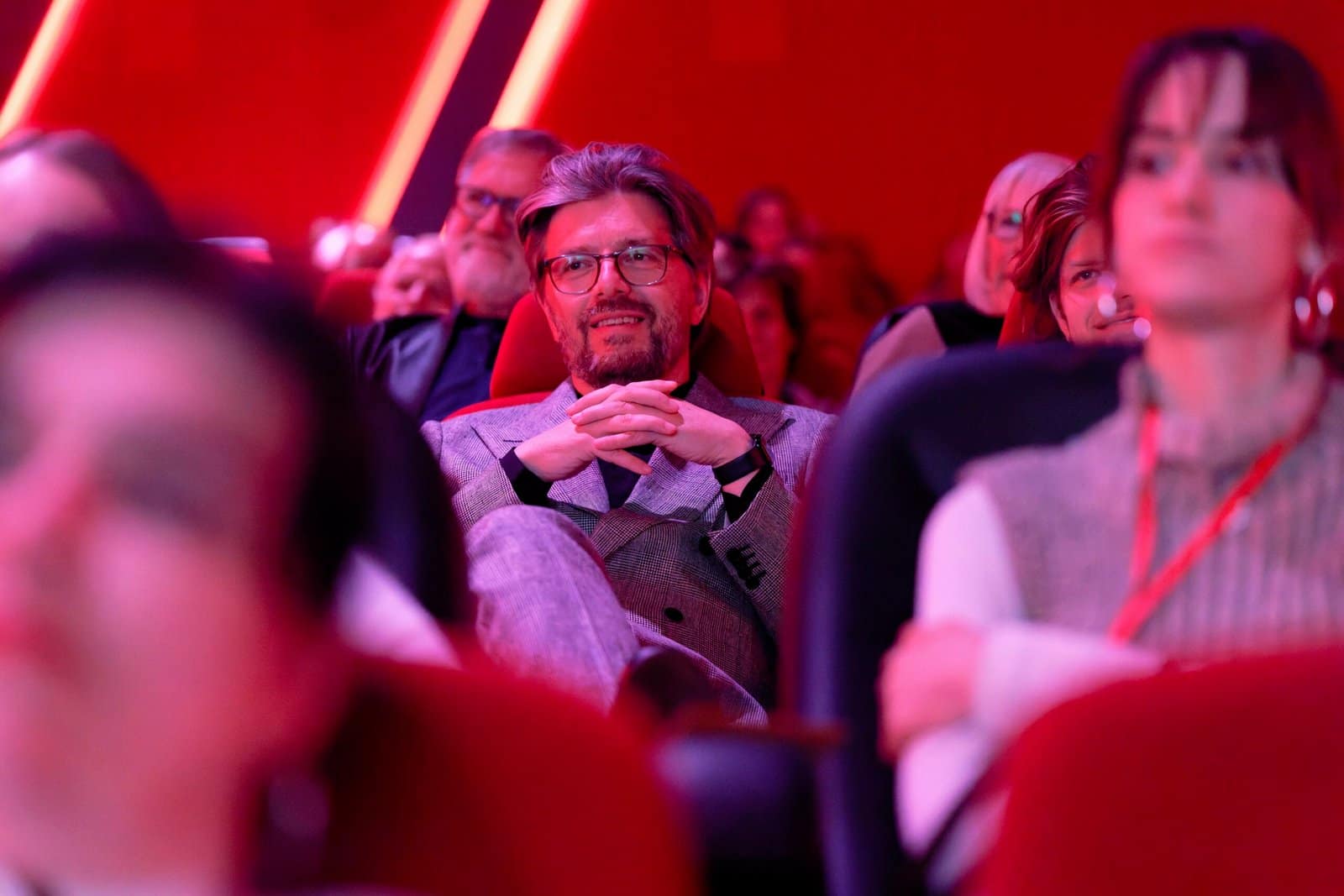
Last month, German cinematographer Florian Hoffmeister wrapped on Edward Berger’s latest, The Riders, starring Brad Pitt, and returned to Germany, although not his home base of Berlin, but the small town of Marburg, where he was awarded the Marburg Camera Prize.
Established in 2001 and presented by Marburg University, the award recognises and celebrates the work and careers of cinematographers. The honoree travels to Marburg, where they take part in a three-day academic conference based around screenings of their work. They are also given a 5,000-euro cash prize. Previous winners of the award include Ed Lachman, Hélène Louvart, and Agnès Godard.
“The beautiful thing about the entire process is that it is purely about the work,” Hoffmeister told Deadline of his Marburg experience.
Watch on Deadline
Best known internationally for his work on Todd Field’s Tar, starring Cate Blanchett, Hoffmeister is one of the most celebrated DoPs working today. He was Oscar-nominated for Tar and won the top prize at Camerimage and an Independent Spirit Award for his work on the film. He also landed Emmy, BAFTA and ASC Awards for the BBC’s Great Expectations (2012), making him the first cinematographer to win all three for a single project.
Hoffmeister is also one of the industry’s most in-demand DoPs. Before The Riders, he shot Lanterns for HBO, with showrunner Chris Mundy (Ozark), directed by James Hawes (Slow Horses), and starring Kyle Chandler and Aaron Pierre. He also lensed last year’s The Roses, directed by Jay Roach and starring Benedict Cumberbatch and Olivia Colman. His other credits include True Detective: Night Country (HBO), written and directed by Issa López and starring Jodie Foster and Kali Reis; Pachinko for Apple TV+; The Deep Blue Sea; A Quiet Passion; Antlers; Official Secrets and Mortdecai. Beyond cinematography, Hoffmeister is also a director. His directorial debut, 3° Colder (2005), won the Silver Leopard at Locarno. His next feature was The Have-Nots (2016), a post-9/11 drama.
Below, Hoffmeister speaks with Deadline in depth about the experience of analyzing his decades-long career in Marburg, how social media has helped cinematographers gain more respect for their work, and reuniting with his long-time friend and colleague Berger for The Riders. The film is an A24, Scott Free, Plan B and Nine Hours production. We also touch on Hoffmeister’s next directorial effort, Her Story.
DEADLINE: Florian, congrats on the prize. Were you aware of the award? I’d heard about it previously, but had completely forgotten about it until you were announced.
FLORIAN HOFFMEISTER: Yes, so the award was created 25 years ago by one of the academics at Marburg University, and for the first two years they actually just held a conference where they would invite a single cinematographer and discuss their work. Two years later, they added the prize, so there’s no industry in the sense that nobody is using this as a platform to meet an agent or sell gear. It is purely about the work. They contact you well in advance to organize the trip because it’s not a singular event. You go there, and for three days, they screen nine of your films. They start at 9 am each day and finish at 9 pm. You also take part in three masterclass sessions.
When they called me, they asked whether I could join in April, and I asked them to push it back two weeks into May because I was still shooting. And, of course, it worked out that I actually finished shooting on The Riders in May. I finished my last day on set at 3:30 AM, walked onto a plane, and flew directly to Marburg, where I immediately walked into the first screening, which was my very first film. I had absolutely underestimated the emotional implications of it all. I just finished a film with Brad Pitt, and then came back to sit there and watch my first film. This year was also the 25th anniversary of the award, and my 25th year as a cinematographer. It was a mind-blowing experience.
DEADLINE: Yeah, I’ve always felt like Poland and Germany respect the work of artists like cinematographers much more than other countries.
HOFFMEISTER: I’d agree with Poland, but in Germany, within the industry, I would say no. There are some pockets within Germany, like this prize was started by sociology and film academics at a university who decided they had to do something about cinematography. And they’ve invited a mix of German cinematographers and international artists like Raoul Coutard and Ed Lachman.

DEADLINE: It feels like people have a lot more appreciation for the work cinematographers do, and I actually credit social media for that. There are so many accounts on Instagram that only post stills from films and analyse the images.
HOFFMEISTER: Absolutely. It has changed significantly within the last 10 years. What I found interesting about Marburg was who actually attended, like the German cinematographer Jost Vacano. He shot Das Boot (1981). He’s now 92 years old, and he goes to Marburg every year. He once sued Bavaria Film Studios over pay. The Studio made so much money from Das Boot, a really substantial amount of money. In German copyright law, there’s a clause that says if the work of an author has gained a substantial amount of profit and the fee the author earned is not appropriate in relation to that profit, the author is entitled to sue for better compensation. He took this law and argued for more money. It took 14 years. He went to the highest courts possible. In the first round, he forced them to open their books, and then they had to pay him compensation. They paid something like half a million euros.
But it wasn’t about the financial compensation. It was that the courts had to recognize the cinematographer as an author. We are as much authors of the film as the writer, for example. Social media has certainly raised awareness of the cinematographer’s job description, which is interesting considering the rise of AI.
DEADLINE: I read online that a project you’re set to direct, Her Story, was presented at a pitching session in Bulgaria. That would be your third feature as a director. Can you tell me anything about it?
HOFFMEISTER: Oh, yes, we pitched it. I have kind of divided my artistic life. I went to a holistic film school, where we made short films and every student had to rotate roles. So you had to work on cinematography, sound, directing. I was attracted to lighting as an expression, and people recognized that I could somehow create a mood that would correspond with a scene, so I got a lot of work as a cinematographer. I then fell out of film school and worked as a cinematographer internationally quite quickly.
But I still had a script that I had worked on at film school. I decided to make that film. It was selected for Locarno and won the Silver Leopard, so I have my little arthouse life here in Germany, and then I work internationally. I would love to do another film, although I do feel completely fulfilled as a cinematographer. But what I do miss is the editing process. It’s really the birthplace of a film.
DEADLINE: It sounds like you’ve created an artistic distinction between your work as a director and your career as a cinematographer. But theoretically, as an Oscar- and BAFTA-nominated cinematographer, I’d assume you could use your name to finance your works as a director. It sounds like you’re defiant in wanting to keep them separate.
HOFFMEISTER: That’s a good question. I’ve never really thought about it like that. When I did the second film, The Have-Nots, it took forever to finance, and in the end, we made it on a tiny budget. We financed it through the broadcasters. I remember, in pre-production, we decided to shoot the film in black and white on short notice, and that was possible because nobody really cared about us. They almost forgot about us. So that kind of freedom is liberating, and I’m maybe saving myself for that. But the entire world is upside down right now. Everything is shifting; small films become gigantic, and gigantic films just fly past without being noticed. Who knows where all this goes. What do you think is going to happen?

DEADLINE: I see a burgeoning counter-culture developing in opposition to the violently extractive and rapidly growing orbit of corporate and tech companies. But I think the question is whether it will develop enough for people to have sustainable lives and careers. But what do you think? People are more interested in that.
HOFFMEISTER: It’s a really interesting question because I do see the counterculture, but then again, what is counterculture in the age of the internet? I’m not a sociologist, so I can’t answer that question, but during my time in Marburg, I once again realized what fascinates me about cinematography. It reminded me of the theory of resonance, developed by the German sociologist and philosopher Hartmut Rosa. Resonance could be, for example, waking up in the morning, walking down the street, and suddenly seeing a sunrise. It’s unexpected and wows you. And that’s basically my job as a cinematographer. I’m trying to create a framework where resonance is my artistic guidance.
In the age of AI, the interesting question is going to surround whether this will still be possible on bigger productions because the technology will do so much of the initial realization that the work will only be a matter of execution. The element of resonance would literally disappear. It goes without saying that if 200 people make something together, it’s a human experience. If somebody sits on a computer and asks AI to make a picture, that’s a singular experience. And I think this communal experience is the backbone of what I love about filmmaking. It’s going to be interesting to see where the shape of this mammoth called the film industry is going to move.
DEADLINE: Finally, Florian, what can you tell me about The Riders and working with Edward Berger?
HOFFMEISTER: I’ve known him for more than 30 years. We basically grew up in the same region, and our paths have crossed many times. We worked together on the series, The Terror, which was his first big international production. After that, we fell out of sync, and I actually turned down one of his projects and recommended James Friend. They have now formed this amazing collaboration. So it was interesting to go back and do something with him. It was a beautiful experience.
I don’t operate much anymore, but on this film I did a couple of shots here and there because we were quite tight budget-wise and had to travel a lot, so once in a while, we slimmed down the crew, and I worked the B camera. So in the first week, I was just there with Brad Pitt in front of the camera. He’s such an icon; you really have to pinch yourself. It was the same with Jodie Foster and Cate Blanchett. He’s just such a movie star. He has a particular aura in front of the camera. And he’s a super nice guy and very easy to work with.
