In Jane Schoenbrun’s latest film, Teenage Sex and Death at Camp Miasma, Hannah Einbinder stars as queer director Kris Williams, who is gearing up to helm a new installment of Camp Miasma, a beloved cult horror slasher franchise. While trying to coax Billy Presley (Gillian Anderson), a reclusive actress who played the “final girl” in the original Miasma film, into returning, Kris finds herself pulled into a psychosexual frenzy as the film’s killer, Little Death (Jack Haven), comes to life.
Bringing that strange world to life on screen were production designers Brandon Tonner-Connolly and Matt Hyland, who had just 25 days to create the film’s distinctive visual language in Canada’s Pacific Northwest. Working closely with Schoenbrun, the cinematographer and local artists, the pair tackled the film’s most technically demanding sequences using an old-school optical glass matte technique, while developing flesh-like walls and importing theater carpet across the border — all the way down to the seemingly inconsequential details, from fried chicken dipping sauces to trails of delectable candies.
Here, Tonner-Connolly and Hyland talk to Deadline about crafting Teenage Sex and Death at Camp Miasma’s visual style and the practical filmmaking techniques that helped bring its strange world to life.
Watch on Deadline

DEADLINE: Let’s jump right into the unique world of Jane Schoenbrun. I want to talk about framing those maze-like square imagery portraits that pop up throughout the cabin. What kinds of conversations did you have with the art department about their existence?
BRANDON TONNER-CONNOLLY: In the script, it was very much about explaining Little Death’s mask and that it had an air vent-like quality to it. Then we went about in prep designing the mask with the help of the specific effects house. We went back and forth on different drafts and concept art until we got it totally right. But the actual artwork, and the way it’s incorporated into the rest of the cabin, was a long conversation with Jane about the idea that Billy’s trauma in the first Camp Miasma movie is something she’s trying to work through with her artwork.
It was about trying to repeat this same square-within-a-square shape in different mediums and forms, trying almost to unravel it or process her experience from all those years ago. So, we took that as the why of the design choice there. And then from there just auditioned different local scenic artists who we thought could be cast as Billy as an artist, as somebody who could do Billy’s work in that way. And found our own references, got into it, got the concept down, looked at some different artists. And then actually looked at a friend of Jane’s who is a watercolor artist that works in circles and different shapes.
And then we had this scenic artist, Joel Rodriguez, who came in, and we went back and forth about the concepts for what it should look like and watercolors and drawings and sculptures and different things like that. We really wanted to touch on a whole bunch of different mediums, just thinking that even though Billy’s primarily a painter, she’s out there by herself for 20 years or more at this camp.
The big painting that’s on the wall in Billy’s cabin is the one that we really precisely laid out. Jane really wanted to have this effect where you only see it halfway through the scene and then realize that Kris has been sitting in front of this gigantic crazy art the entire time during this very intense conversation. And we wanted it to have this sort of destabilizing seasickness-inducing effect that you’re getting sucked into the vortex when you see it.
We had a really precise design with color gradations and laid out the lines so that it gave this Magic Eye optical effect. Joel had spent some sleepless nights making that happen once we had the location and had the size, and then brought it over for a ferry to Vancouver Island, and then trucked it up to the remote cabin and put it on the wall and everything [laughs].
DEADLINE: What about Kris? Is there anything specific that you all pulled out to emphasize her effect on Billy’s character or the cabin?
MATT HYLAND: There’s a lot in the world of the movie, but ultimately those two characters and their relationship is the lens through which a lot of things pass, including the painted matte backdrops. A lot of the governing dynamics and motifs here are to put the audience in Kris’s point of view and welcome them through this portal into Billy’s world.
Billy does have the camp, of course, but the movie itself and the memories of the movie, the experiences, even some of the story within storytelling, these are all Billy’s primary point of view with Kris absorbing it. And so as the movie goes on and some of the things we’re doing, like the quality of the snow, for example, is one. The painted backdrops are another. As she goes deeper in the story, those things evolve a little bit, and they take on a different flavor.
And the way that we did those things changed too because we favored practical wherever possible. And that meant that came with a workflow and a type of collaboration and conversation that happens when it’s not all digital. We constantly had to ask ourselves, how is an actor going to use this space and how will we depict it?
Some of those come down to financial conversations to make sure you can get what you need. But with Jane and Eric [Yue, the cinematographer], and the rest of the crew, it often became a creative conversation to add a new idea or to explore stuff. Basically, limitations don’t stop anything from happening. We figure out a way through. A lot of our work was trying to both give the audience a sense of where the hell we are in this very unique and interesting world, but also let them go through it, and where they start and where they end is not the same.
The seasons change. All kinds of things happen. And they’re very internalized, impressionistic ways through this stuff. It’s not a super literal and technical kind of depiction.

DEADLINE: I was reading some Letterboxd review where someone was talking about the bisexual coded lighting at the end of the film. What would you like to say about the visual style of the pinks, purples, and watercolors of the scenery infused with your sets?
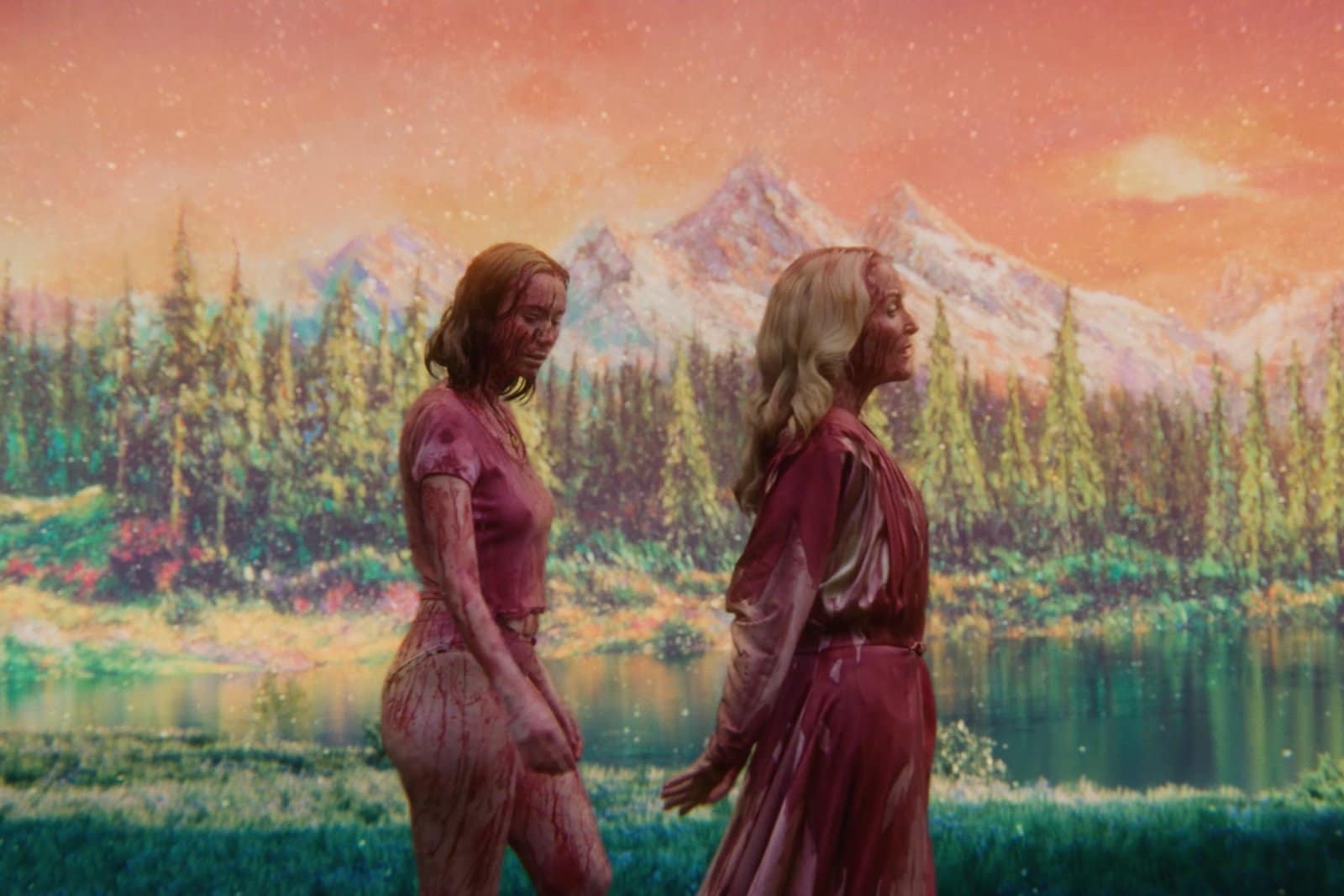
TONNER-CONNOLLY: That’s funny. The matte paintings were a major part, and the landscapes are such a major part of the visual concept from the jump, and it’s supposed to draw you into the idea of the character’s emotional landscape. It’s not just a forest landscape. It’s like we’re doing the paintings because we want to bring you into the emotional landscape of the characters and the emotional world of them.
It’s supposed to be a portal that Kris steps through to get into Billy’s world of play that she’s constructed, almost this fantasy world. So, when you see the final scene, and they’re up against that painted backdrop and really walking through the landscape and seeing like they’re a part of it, and the lighting is a part of that. Everything else is a part of that; it shows that she’s fully integrated into this world of fantasy play that Billy has created for herself at the camp.
The first matte painting that we see is outside of Kris’s hotel room. There’s a city in the distance, and it feels very much like a beacon on the remote horizon. And then she gets progressively more and more into it. The next one is the cinema building, and she’s actually almost stepping into the painted landscape at that point and stepping through the portal into Billy’s world and into this storybook romance world where you can be a little bit less tethered to the reality that we’ve established in the first 15 minutes of the movie.
All of this is easy for me to say, but it was a difficult journey to get there for the glass matte painting, especially the cinematic one, which Matt can attest to [laughs].
DEADLINE: OK, now, I don’t know why this spoke to me. But I love all the snacks. The candies, the chips. I guess it reminded me of being a teenager, being with my friends and having a movie night. And a lot of this film also plays on the nostalgia of the horror genre.
HYLAND: Yeah. You go and rent the movie, and you come home, and you rip into every snack.
TONNER-CONNOLLY: Exactly.

DEADLINE: Right. Then there’s the snack drawers at Billy’s cabin. The KFC scene with the dipping sauces. What went into the staging of these items since they are so prominent in the film? And it must have been tricky too with the Canadian labels vs the American ones.
TONNER-CONNOLLY: The candy was such a big part of those opening conversations with Jane. And we tried to keep the Canadian version out of the movie for the most part. We actually had people drive across the border to the U.S. to buy candy and then come back so that we didn’t have so much infiltration by the Canadian candy [laughs].
We had a chat about gummy candies and Nerds and all these different things. But again, it was supposed to be a progression. The first time you see Kris, she had some candy on the bed in the hotel, but the film keeps upping the ante until you get to that final layer of candy when Kris and Billy are on the rug in front of the fireplace. They’ve built this nest of candy wrappers around them while they’re having an intimate conversation.
Part of the candy is Billy getting at the idea that, like the movie, it’s about pleasure in some ways. The movie is about enjoyment. And Billy has different forms of enjoyment and pleasures, one of which is like candy – which I happen to share myself.
And it’s like Billy has different forms of enjoyment, has different forms of pleasure, one of which is like candy. One of which is, which I happen to share myself.
HYLAND: The movie’s so abstract in some ways that the fact that both Kris and Billy, that’s what they connect with first really is the silly thing about candy.
TONNER-CONNOLLY: And dipping sauce, don’t forget that.
HYLAND: Yes, and the dipping sauce [laughs]. This movie dares you to overthink this stuff. A lot of times with this, it’s like, we know candy is good, and we know that they’re going to connect on this. We get to have fun with it beyond just that purpose too. It’s super neat that we can dabble in pretty mundane stuff, but also something that can carry a lot of extra weight because of the movie it happens to be in.
TONNER-CONNOLLY: There’s nothing mundane about a candy drawer, my friend.
DEADLINE: It’s revealed that Little Death is living in a video rental store with some crazy looking walls. What’s up with that?
HYLAND: I think we called it the Flesh Palace.

DEADLINE: That makes sense.
TONNER-CONNOLLY: It was just one of those things when talking to Jane; we got into the specifics of everything. Like, oh, of course, Little Death he’s going to live in these flesh walls. But what kind of flesh are they? Would it be realistic? Or like meat? Or is it something like bubblegum, like the Disneyland version of flesh?
So, we went through a lot of different iterations of that and different concept art that showed the texture and different colors of it. We also looked at weird references like an illustration of an intestine in a doctor’s office…eventually we got the texture that we wanted. And then there were a couple of objects that Jane had called out, like, oh, there’s a neon sign that says open on it, and that’s in there. And then it’s got the video shelves and the videotapes. And beyond that, we just knew it was meant to be sort of a liminal space like that, but we wanted it to be different from what you’ve seen in other things.
The flooring was such a huge deal once we had the flesh walls figured out. We thought maybe a checkered tile. And then we were like, nah, it should be like a movie theater carpet, like a video store carpet. It should be exciting and get you back into this feeling of fun nostalgia that so many other things in the movie get at too. So once I saw that, I was like, man, we got to have this carpet.
We did have to have it flown from the U.S.; it was a crazy ordeal, but we did it. And everyone was like, “Are you sure you need to have this carpet?” And we’re like, “Yes, we’re sure we need to have this carpet.”
DEADLINE: What was the most challenging thing to put together?
HYLAND: What comes to mind is Billy’s [cinema cabin]. That exterior of the cinema where the one optical glass matte shot occurs, it took a lot of rigorousness and a lot of conversation and a lot of pre-planning to ultimately pull off something that we didn’t really get any chance to vet or to problem solve. We really only had one go. And essentially, this location pulls in snow and weather effects. It pulls in this painting technique – and those stakes got really high, basically.
And also people who do painted matte backdrops, especially optical glass mattes, don’t really work anymore, or they’re not alive anymore. It’s a little esoteric, strange, and technical.
DEADLINE: Lastly, was there anything hidden in your design that fans might not necessarily see but was important to you?
TONNER-CONNOLLY: I feel like the opening credits are a real treasure trove of small details and things like that. The whole idea was to really pull people into the Miasma franchise really quickly and get people excited and get this feeling that you had watching Halloween as a kid, that excitement at the video store as a kid, and the nostalgia. We had to tell the story of this franchise over the course of like 45 years and get people emotionally involved in the rise and fall of Camp Miasma.
And so through that, we did all of our research on different horror movie fan conventions, horror movie merchandise, which was so much fun to do. And then came up with the early Miasma, mid-Miasma, late-Miasma chronology. We charted the franchise with directors from the first one all the way down to Camp Miasma 14. And then locked ourselves in a room with Jane and the DP, and we’re like 12 Angry Men style, no phones. We’re going to map out this opening credit sequence beat by beat by beat, object by object by object, and do it.
We made all those things and the reviews that are in the opening credit sequence, the board game that’s in the opening credit sequence, all of these things are fully realized. The reviews are all 100%; you can read through them, and it tells you more about the Camp Miasma franchise and about each movie that it’s talking about. The board game is totally playable. The instructions work; you could get through that, and that tells you a little bit about the movie.
We were able to hide a lot of things in that opening credit sequence and all those fully realized objects, the trading cards, all that stuff that speak more to the Camp Miasma myth and legend and history. What was so important to us is that we weren’t going to let anything go on the set that’s not 100% real that Jane can’t pick up and turn around and look at or that an actor can’t walk up to and read and think that’s funny or insightful or in some way adds to their understanding of the world that we’re creating.
