When the board of the Kennedy Center met last week to decide on the future of the complex, they took up a resolution to restore Donald Trump‘s name to the front facade of the complex.
The vote by the Trump-controlled board was not just one designation for the president, but three.
According to a copy of the resolution filed in federal court late on Tuesday, Trump’s name would be returned to the front facade, just below its official name, “The John F. Kennedy Memorial Center for the Performing Arts.” Below that lettering, a new one would be added to read, “Restored and Renovated by President Donald J. Trump.”
That’s not all. The resolution also provides for another Trump designation, just below “Restored and Renovated by President Donald J. Trump.” Once a $100 million threshold is met for an endowment the board set up for the center, per the resolution, a line would be added to read, “Endowed by the Trump Kennedy Center Fund.”
Watch on Deadline
So the facade of the Kennedy Center would read:
The John F. Kennedy Memorial Center for the Performing Arts
Restored and Renovated by President Donald J. Trump
Endowed by the Trump Kennedy Center Fund
There’s more. The board resolution also designated “the physical site and grounds upon which the center sits” as the “President Donald J. Trump Plaza.”
The board is chaired by Trump and includes administration figures like Sergio Gor and Dan Scavino and Fox News personalities Maria Bartiromo and Laura Ingraham. In December, they voted to add Trump’s name to the center and, the next day, the facade was changed to read “The Donald J. Trump and The John F. Kennedy Memorial Center for the Performing Arts.”
Rep. Joyce Beatty (D-OH), an ex officio member of the board, sued, and in May U.S. District Judge Christopher Cooper ruled that only Congress could make such a change to the center’s name.
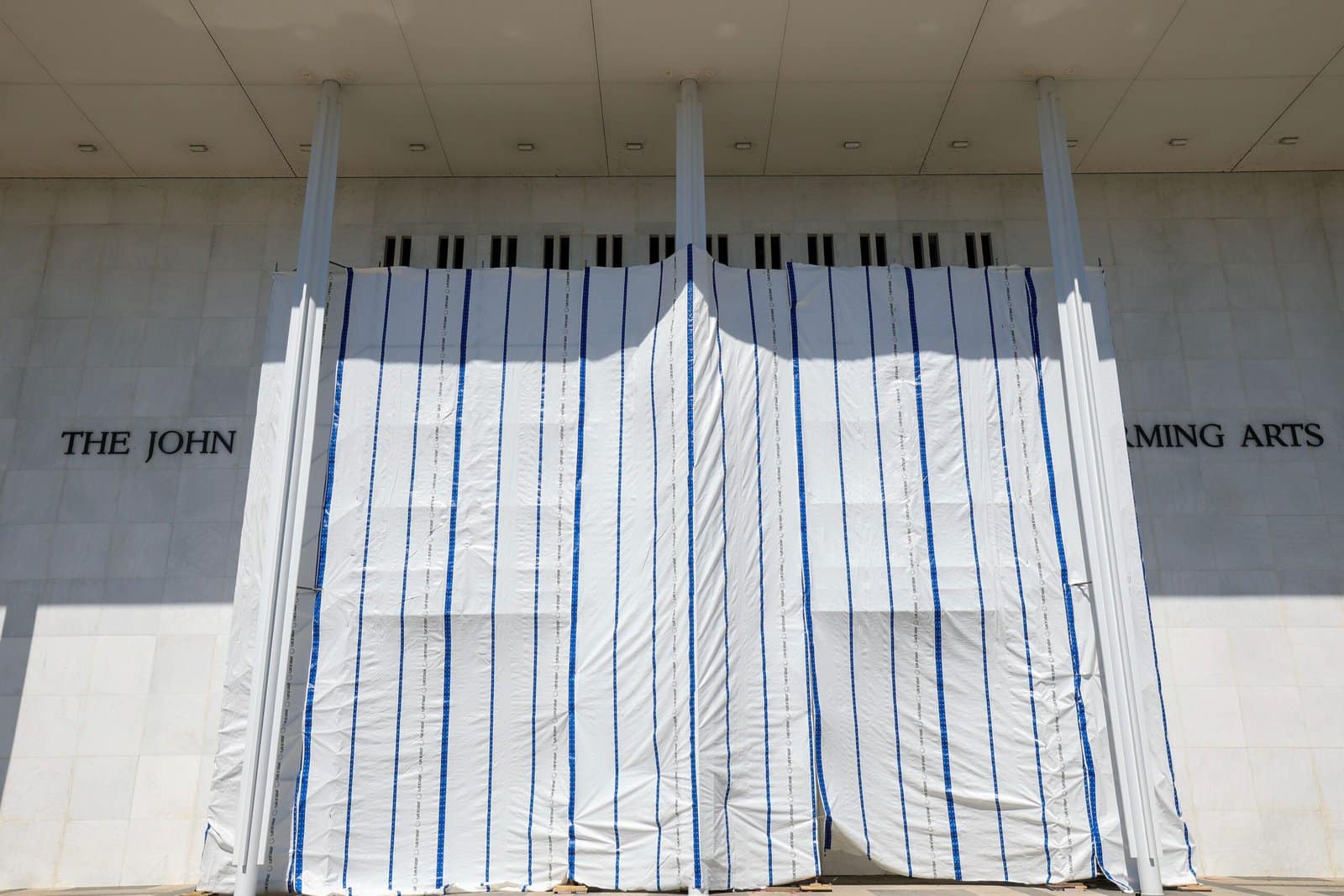
That forced the center to remove references of the “Trump Kennedy Center” from its website and other materials, and, most prominently, from the front facade. On the night of the deadline to remove Trump’s name from the facade, a crowd gathered and watched as workers installed scaffolding and, in the middle of the night, a tarp. That concealed the actual removal of the lettering for POTUS. The tarp has remained there ever since.
In response to the latest effort to return Trump’s name multiple times to the front of the building, Beatty’s attorneys argued that the board seems intent “on defying the court’s decision.”
Her attorneys, Nathaniel Zelinsky and Norm Eisen, wrote, “Adding the words ‘Restored and Renovated by,’ or ‘Endowed by,’ before President Trump’s name, and renaming the ground on which the building sits, provides no lawful basis to ignore this Court’s decision and impose Donald Trump’s name on a memorial dedicated by the Congress exclusively to a different President.”
They cited a statute that “no additional memorials or plaques in the nature of memorials shall be designated or installed in the public areas of the John F. Kennedy Center for the Performing Arts.” The board’s resolution seemed to suggest that renaming the plaza would fall outside of the statute.
The center has committed to forego attempts to install the Trump designations until September 8. Beatty’s attorneys want the judge to rule by then.
As for the tarp, the center’s attorneys cited a declaration from executive director Matthew Floca and wrote that the covering “was and is a necessary element of the ongoing construction activities at the Center—during the removal of the name, it served as a safety barrier for ongoing construction activities and helped safeguard the marble facade of the building in light of reported panel damage.” They added that the center will use the existing scaffolding to “assess, investigate and engineer structural repairs to the overhead soffit.”
“Final removal of the scaffolding and its barrier is contingent upon the scope of any repairs required at present to the marble facade, as well as any other necessary repairs,” the center’s attorneys wrote.
Beatty’s attorneys called the explanation a “pretextual justification.” “Defendants state they intend to use the scaffolding to examine the roof overhang,” the wrote. “But the soffits are some twenty feet or more above the scaffolding. Defendants imply that they will erect more scaffolding around the rest of the Center, presumably to examine other portions of the roof. But Defendants tellingly have not done so for months, leaving only the Center’s iconic name obscured—a strong indication that this structure has nothing to do with the roof and is, instead, meant to defy a return to the status quo.”
In his May ruling, the judge also halted plans to close the center for two years for renovations, concluding that the board had been “derelict” in moving to shutter the complex because they “neglected to consider the full range of its statutory obligations and potential adverse consequences of closure on programming and memorial functions.” He noted that the board could still move to close the complex, but only after there was a fuller consideration of impacts.
Last week, the board again voted for a two-year closure plan, while keeping limited programming at The Reach, an extension that opened in 2019.
In the latest filing, the center’s legal team argued that it had conducted an independent analysis, with Delta Consulting Group presenting two options: the closure plan that was ultimately approved, and another plan for a partial closure. The analysis concluded that the partial closure would take longer — four years — and would mean that the center “would suffer a reduction in both revenue and fundraising ability” and “reputational damage that would result from the proximity of construction activities to performance venues.”
Beatty’s team, though, argued that the board “fell short by a country mile” in its analysis.
“The only materials that purport to examine the costs and benefits of the closure was a 5-slide PowerPoint presentation prepared by the Delta Consulting Group, which was subsequently displayed at the Board meeting,” they wrote. “Excluding two cover slides and one slide describing the lead consultant’s biography, the substance of the presentation deck is just two slides long.”
Beatty’s team is calling for a discovery process rather than an expedited briefing on a motion to grant summary judgment, which the center wants. The center also is appealing Cooper’s May ruling.
