
After a year on the U.S. festival circuit, with buzzy stops at Mill Valley and Hot Springs, Diamond Diplomacy, the feature documentary from San Francisco-based filmmaker Yuriko Gamo Romer, receives its first international screening this week at the Tokyo Film Festival.
The screening will serve as a unique homecoming for Gamo Romer and the doc. Produced between the United States and Japan, Diamond Diplomacy traces more than 150 years of shared baseball history between the two nations.
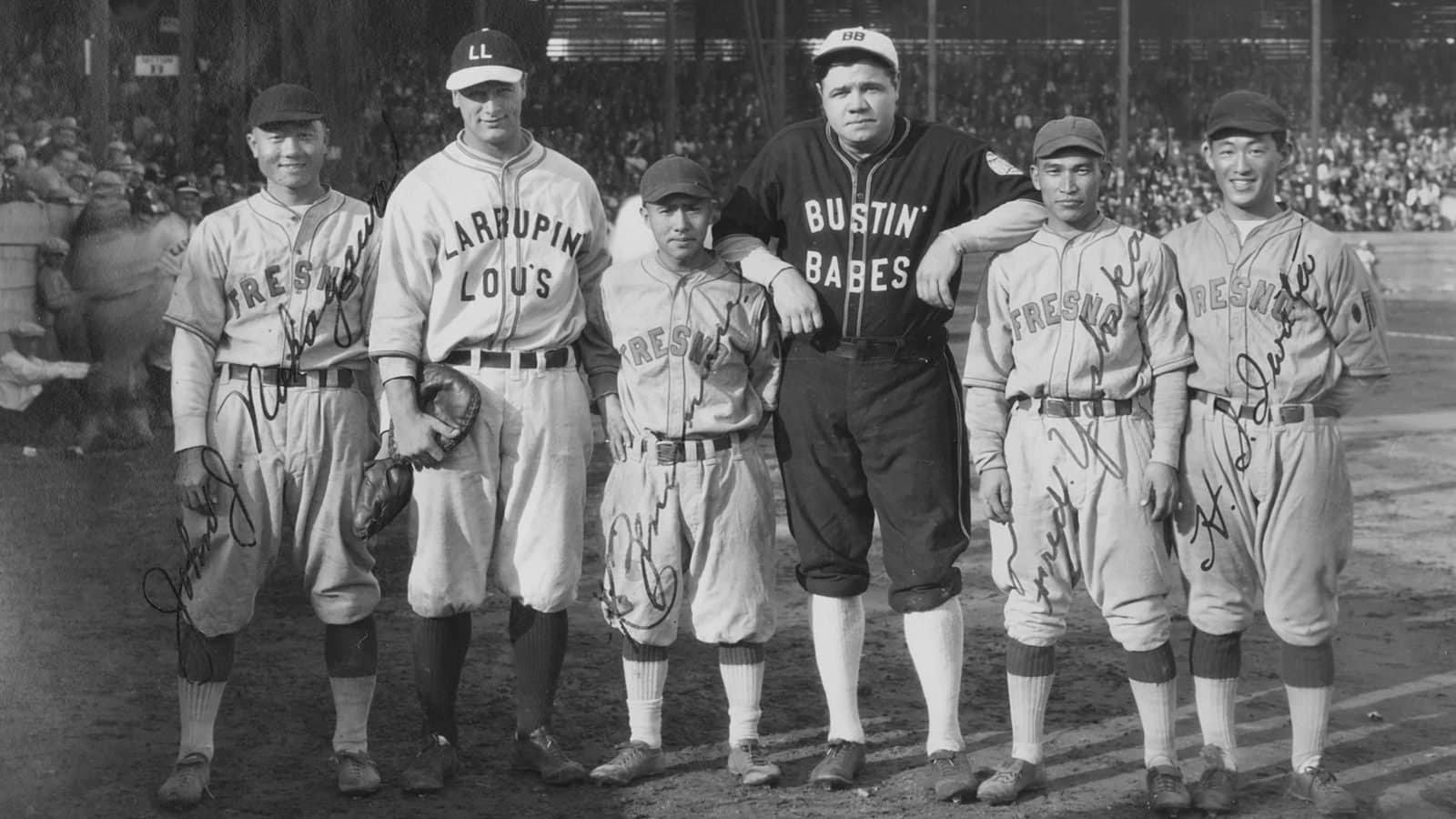
Using rare archival footage, the film explores baseball’s arrival in Meiji-era Japan through Babe Ruth’s 1934 tour and World War II to the modern era of Japanese stars such as Ichiro Suzuki and Shohei Ohtani. Using the sport, the doc examines the history of diplomacy, racism, war, reconciliation, and cultural exchange between the two countries. The story centers on Masanori “Mashi” Murakami, the first Japanese player in Major League Baseball, and Warren Cromartie, who starred for the Yomiuri Giants.
Gamo Romer previously directed and produced MRS JUDO: Be Strong, Be Gentle, Be Beautiful (2012), a feature documentary about Keiko Fukuda, the first woman to attain the 10th-degree black belt in judo. Her other credits include the shorts Baseball Behind Barbed Wire (2023) and My Immigrant Story (2018). Readers may also recognize her name from media reports about the Trump administration’s brutal cuts to the National Endowment for the Humanities. Gamo Romer was one of the few NEH recipients who spoke publicly about how the wide-scale cuts affected her work. Diamond Diplomacy had received substantial grants from the NEH. Overall, the Trump administration canceled more than 1,400 previously approved NEH grants. The cuts were later ruled unconstitutional by a U.S. court.
Watch on Deadline
Gamo Romer’s public advocacy attracted new funders and partners. U.S.-Japanese diplomat Glenn S. Fukushima boarded the project as an executive producer after hearing Gamo Romer on NPR. He was later joined by Steven Okazaki, Jacqueline Glover, and Mari Nakachi, who helped to fill gaps in the film’s funding. Strand acquired North American distribution rights in May, and the film heads to Tokyo with a freshly minted local distribution deal with Wondergenic. Producers on the doc are Gamo Romer, Marc Smolowitz, and Loi Ameera Almeron.
Below, Gamo Romer and Smolowitz speak with Deadline in depth ahead of their Tokyo screening about how they rebuilt their production after Trump’s NEH cuts and how they dug into the MLB archives to explore U.S.-Japanese history.
The Tokyo Film Festival runs until November 4.
DEADLINE: Yuriko, this film began as a short?
YURIKO GAMO ROMER: The initial spark was the 1949 San Francisco Seals coming to Japan during the postwar occupation. General MacArthur sent the baseball team to Japan as a goodwill gesture. That was the story I was drawn to. It turned out my friend’s father had been a pitcher on the Seals and had a movie camera with him when he went to Japan. That’s how the project started. I started opening history books and meeting people, and the project got longer and bigger. We did release a short focused more on the World War II Japanese American incarceration story. It came out a couple of years ago.
MARC SMOLOWITZ: The short, called Baseball Behind Barbed Wire, was a big festival success. It allowed Yuriko to talk about Diamond Diplomacy and gave us a way to keep communicating to funders and supporters that the feature was coming. The short helped the project pick up momentum, and the feature scaled up after that, around 2023. We got a grant that made the short possible. We were strategic about making clear that the short and feature were part of the same film enterprise, even though the short came out first.
DEADLINE: Yuriko, talk me through the research process. Was it easy to uncover this story? I only fairly recently learned about the internment camps in California. You don’t learn about that in the U.K., where I went to school.
GAMO ROMER: I’m old enough that when I went through the California school system, it wasn’t taught at all. I didn’t learn about it until the 1980s, when there was a movement to get reparations for people—especially American citizens—who were suddenly thrown into prison, basically. For the film’s research, I started coming across books. Historian Rob Fitts, who is in the film, has written several books on this area. I met him about a year into the research, and he had written a biography about Masanori “Mashi” Murakami, the first Japanese player to play in the major leagues. I went on a book tour with Rob, met a lot of people, and learned much more.
The history isn’t covered extensively, but the Babe Ruth tour comes up right away. Rob wrote a book about that; it’s a dramatic story. You bump into all these connected stories, but they aren’t covered in depth. Some are only in Japanese-language books. There are a few books around. I probably have most of them in my library now. I’ve been working on this film for more than 12 years. Through the research and meeting people, I kept discovering stories. It just kept getting bigger. One of the challenges was keeping the film short enough for people to sit down and watch it.
DEADLINE: Marc, there are a lot of great producers and executive producers on the film. We know how difficult it is to get documentaries off the ground. Could you talk about how you built this production?
SMOLOWITZ: I’ve been with Yuriko on this since the beginning, so we’ve built a long partnership. I always tell the story about the National Endowment for the Humanities funding because it’s important. We first received development funding, which was a big milestone. Later, we received a larger amount. Ultimately, that money was taken away during the DODGE controversy. We were on a trajectory to finish the film and had enough money at that point, with other funders who had stepped up. The cuts happened in the final year of making the film. We couldn’t have predicted that it would become one of the biggest gifts to the film’s story: it led us to our largest supporter. Yuriko was brave enough to speak out about the controversy. It became a case study in crisis PR—something terrible happens, and you communicate it publicly in a way that can turn into a win.
She went on NPR, and Glen Fukushima found us. Over several months, he became the perfect executive producer—not only filling the funding gap, but bringing a high-level diplomatic connection between the U.S. and Japan. He understood the film’s value as a cultural product that could encourage dialogue. Then we found Mari, Jackie, and Steven. These people became building blocks that gave the film credibility with funders. That’s how you do it: nurture the project for years.
DEADLINE: Trump’s NEH cuts have been so devastating. I did a panel recently with Rita Coburn. She directed a great film about W. E. B. Du Bois. She told me that during the production, she could sense that their NEH funding was about to be cut, so she told her crew to get their invoices in quickly.
SMOLOWITZ: We could report the same kind of thing. Rumors were coming down. When we were cut, about 14 people were working on the movie. It was a real hit to people’s livelihoods. We recovered pretty quickly—within about three months we were back at full pace. We shifted our delivery target by about one festival season. Many filmmakers weren’t able to solve their crisis that way. It has created a lot of discussion in the nonfiction field about how we value the humanities and how we’ll fund films if those kinds of funds aren’t available. There has been some recovery. California Humanities, for example, recently re-announced grants that had been on pause for about a year and a half. It’s looking up, but it’s tricky for filmmakers who have worked for years on important projects and then get cut off.
DEADLINE: Yuriko, where did you find all the great archival baseball footage? Does the MLB have a robust archive?
GAMO ROMER: Very early on, Marc helped a lot with negotiating a licensing agreement. It was a huge line item, and I wondered how I’d ever pay for it. Fortunately, they let us pay over several years. In retrospect, it was a wonderful deal. It was a blanket agreement, and they did all the research. The MLB asked me to send a list of what I wanted, along with a script, treatment, or rough cut. That helped them think beyond what I knew to ask for. They provided things that shocked me. A lot of footage in the film that you wouldn’t expect to come from MLB archives did come from there. The archive team knew where everything was and what the stories were. Ken, the editor, and I would receive material and ask, “What is this?” It was incredible.
DEADLINE: When you came to Japan to shoot, how were you and the project received? It’s not the easiest material for people involved in the story to relive.
GAMO ROMER: I shot twice at the Yokohama Country and Athletic Club, which is essentially an expatriate club filled with Americans and Brits. Some people knew bits and pieces of the story. But there’s a general interest. The story is less known among the broader population, especially younger people. We had a press screening last week. Mashi and I spoke and answered questions afterward. He gave a heartfelt speech about how grateful he was that I made the film. He feels people don’t know or appreciate baseball history, and that knowing more might help them appreciate it. The hope is that younger people will see the film, learn, and expand their horizons. Part of the problem is that there hasn’t been much access to this information and history.
DEADLINE: So how are you thinking about the release?
SMOLOWITZ: Strand is handling the U.S. release. Wondergenic Films is our Japanese distributor. They’re essentially a distribution startup. One partner is a Japanese distributor who has acquired individual films at Venice and released them in Japan when they otherwise wouldn’t have had a Japanese release. His young business partner, Michael, is binational and bilingual; he grew up in the U.S. and now lives here in Japan. They’re interesting young partners, and our film is their prototype—the first one they’re giving this kind of commercially oriented launch. They’re both huge baseball fans. Michael, the American-side CEO, is the grandson of Cappy Harada, which is a remarkable personal connection. For them, it will be about seeing which exhibitors come on board. They’re reasonably confident in predicting at least 60 screens, but it could be more. They haven’t officially announced the start date, but the plan is April.
