
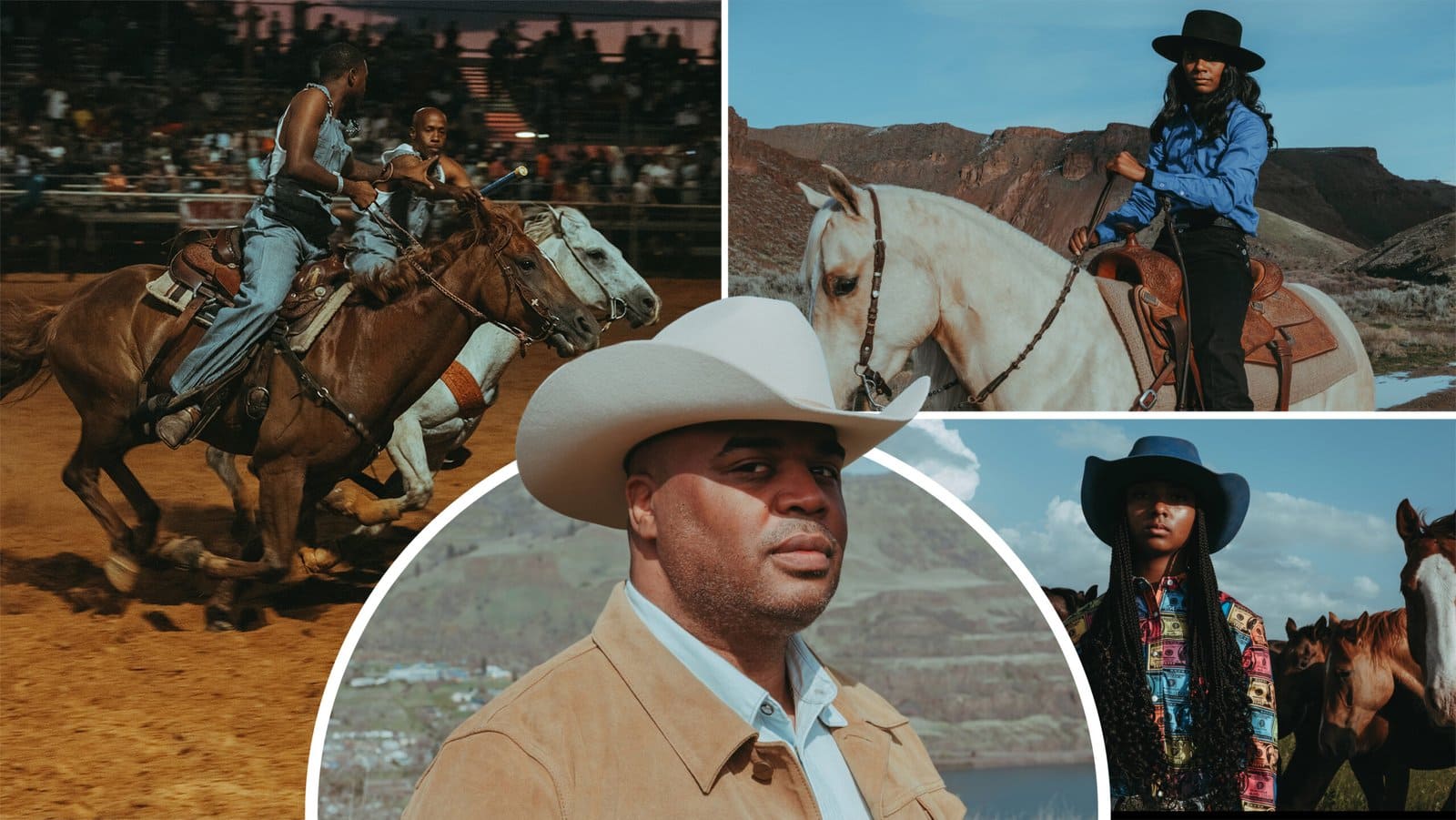
For generations, Hollywood has perpetuated an image of the American cowboy as a rugged, solitary white man riding across an unforgiving frontier. It is a mythology deeply embedded in American popular culture, one that has frequently overlooked the Black cowboys who helped shape the West and whose traditions continue to thrive today.
Photographer Ivan McClellan has spent more than a decade capturing a different American West, one populated by Black cowboys and cowgirls whose lives combine athleticism, family traditions, contemporary fashion, and an unwavering devotion to rodeo culture.
His new photography book, Eight Seconds: Legacy in Motion, published by Damiani, continues that exploration with 91 previously unpublished photographs celebrating a vibrant community that is not merely preserving its heritage but actively reinventing it.
Watch on Deadline
Scheduled for release in fall 2026, the 112-page hardcover follows McClellan’s acclaimed 2024 publication, Eight Seconds: Black Rodeo Culture.
For McClellan, however, the project has never been about reconstructing a forgotten chapter of American history. Instead, he is interested in celebrating the extraordinary individuals who inhabit this world today.

Ivan McClellan courtesy of and published by DAMIANI Books
“I grew up watching Westerns on TV obsessively as a latchkey kid,” McClellan recalls. “Everybody was white except for one time: there was an episode of The Rifleman with Sammy Davis Jr. and Sheriff Bart on Blazing Saddles. I thought a Black cowboy was more of a punchline than a reality.”
“But I’m not trying to correct Hollywood’s Western archetypes. I want to elevate these modern Black cowboys, who are compelling and essential, to icon status.”
His introduction to Black rodeo culture came in 2015, beginning what would become an extensive photographic journey across the United States. Over the following decade, McClellan immersed himself in the community, building relationships with competitors and their families while documenting the intensity of the sport and the lives that unfold beyond the arena.
“When I started photographing Black rodeos, I wasn’t looking for historical artifacts,” he explains. “I found an incredibly stylish, charismatic, competitive group of people with larger-than-life personalities. The kind of people Hollywood should have been making movies about all along.”
“And I think that’s the real power of photography. I don’t have to invent a Black cowboy superhero. I just have to show up with my camera. These people are already extraordinary.”

Ivan McClellan courtesy of and published by DAMIANI Books
The title Eight Seconds refers to the minimum amount of time a bull rider must remain mounted to earn a qualified ride. It is a brief, dangerous interval in which physical discipline, instinct, and extraordinary courage converge. Yet McClellan’s photographs extend far beyond the adrenaline of competition.
His portraits reveal an evolving Western aesthetic in which traditional cowboy hats and boots coexist with contemporary style. The resulting imagery challenges the familiar visual codes of the Hollywood Western without losing sight of the culture’s deep historical roots.
“There’s this expectation that a cowboy should look like he just walked off the set of a Spaghetti Western,” McClellan says. “But you go to a Black rodeo, and you’ll see guys riding in Jordans and a cowboy hat. You see women riding 50 miles per hour with box braids blowing behind them.”
“I love those contradictions. That’s where the magic is.” For McClellan, this distinctive fusion of tradition and modernity is an extension of Black America’s long history of cultural innovation.
“Black people have always had this incredible ability to take something, remix it, and create an entirely new visual language. We’ve done it with music, fashion, food, and just about every other part of American culture. Cowboy culture is no different.”
Rather than imposing a particular aesthetic on his subjects, McClellan allows their personalities and individual styles to shape the images.
“People I’m photographing aren’t trying to make some grand fashion statement. They’re just showing up as their authentic selves,” he adds. “They’re not thinking about redefining the American West. They’re living their lives.”

Ivan McClellan courtesy of and published by DAMIANI Books

Ivan McClellan courtesy of and published by DAMIANI Books
Among the most significant figures in McClellan’s latest book is 17-year-old cowgirl Kortnee Solomon, whose portrait appears on the cover of Eight Seconds: Legacy in Motion. A fourth-generation cowgirl, Solomon represents both the continuity of Black rodeo traditions and the confidence of a younger generation determined to define the culture on its own terms.
McClellan first encountered Solomon and her mother, Kanesha Jackson, in Hempstead, Texas, when the young rider was just nine years old. “I’ve watched Kortnee Solomon grow up doing this work,” he recalls. “She’s a 4th-generation cowgirl and walks around with the swagger of someone who knows exactly who she is.”
Solomon’s cover portrait shows her surrounded by horses, wearing a striking pink, blue, and yellow shirt covered in hundred-dollar bills.
“She’s on the cover of my new photobook Eight Seconds: Legacy in Motion, wearing a hot pink, blue, and yellow shirt covered in hundred-dollar bills. She’s surrounded by a herd of horses and dripping in confidence. This is the future of the culture, breaking free of expectations and showing up exactly as themselves.”

Ivan McClellan courtesy of and published by DAMIANI Books
But behind the colorful spectacle of rodeo life lies a demanding existence that requires significant personal and financial sacrifice. Many competitors balance full-time employment and family responsibilities with long-distance travel, training, and the considerable expenses associated with caring for horses and participating in rodeos.
“The Black Cowboy lifestyle is an inheritance that often doesn’t offer much financial security,” McClellan explains. “They’re working full-time jobs, raising children, and driving hundreds of miles on weekends for a chance to compete. Some of them are risking everything for a sport that pays pennies on the dollar.”
“When you see a family making those sacrifices together, you begin to understand that this culture is about much more than cowboy hats and horses.”

Ivan McClellan courtesy of and published by DAMIANI Books
Having spent more than ten years developing relationships within the Black rodeo community, McClellan is now preparing to bring those stories to the screen through an upcoming documentary. While his photographs capture moments of power, individuality, and almost mythological heroism, the documentary will offer an opportunity to explore the complicated realities behind those images.
“One of the greatest advantages I have is that I didn’t show up with a film crew and a list of questions, then bounce,” McClellan says. “I’ve been showing up for more than ten years. I’ve watched kids become adults, amateurs become champions, and champions struggle to stay on top.”
That familiarity, he believes, will provide a level of intimacy that cannot be achieved through a conventional documentary production.
“The cowboys know me. They’ve seen me standing in the dirt, sweating through my clothes, getting kicked out of places I wasn’t supposed to be, trying to get the perfect photograph. At this point, I’m practically furniture.”
McClellan is particularly interested in examining the contrast between the seemingly invincible figures photographed in the arena and their often precarious lives outside it.
“Photography allows me to create these heroic, almost mythological images of people. But filmmaking gives us an opportunity to explore what happens after the photograph.”
“What happens when the cowboy who looks invincible in the arena goes home and has to pay his child support? What happens when an athlete has to choose between paying rodeo entry fees and their cellphone bill?”
The filmmaker hopes that audiences will connect with the individuals themselves, rather than simply viewing the documentary as an educational examination of an underrepresented culture.
“And I think audiences are going to fall in love with these people,” he says. “They’re hilarious, stubborn, ambitious, occasionally delusional, and extraordinarily brave.”

Ivan McClellan courtesy of and published by DAMIANI Books
McClellan’s new book and documentary arrive amid renewed mainstream interest in Black Western culture, particularly following the success of Beyoncé’s country-inspired Cowboy Carter era and a broader embrace of Western aesthetics across music, fashion, and cinema.
Yet McClellan is keen to distinguish between the visibility popular culture generates and the enduring traditions of the communities he photographs.
“I love what Beyoncé has done for Western culture,” he says. “She helped introduce millions of people to a world they might never have considered. But trends eventually fade, and people move on to something else. The cowboys don’t move on. They’ve got horses to feed on Sunday morning.”
McClellan has also helped create a platform for contemporary Black rodeo culture through his 8 Seconds Rodeo events, where audiences embrace Western fashion in increasingly varied forms.
“I see fans at the 8 Seconds Rodeo investing in quality cowboy boots and hats, upgrading their Temu glitter hat to something more permanent. I also see folks showing up in Tims and hoodies.”
“Our whole thing is: Come as you are, and you’ll experience something physically powerful and spiritually moving.”
He believes the lasting appeal of rodeo lies not only in its cultural significance but also in the powerful human drama that unfolds in competition.
“At the end of the day, it’s entertainment, not homework. If you come through the doors, you’ll get thrilling competition and rivalries, heartbreak, disappointment, and romance. It’s everything you could possibly want from great storytelling.”
“I don’t want people to watch the documentary or come to the rodeo because they feel obligated to learn something about Black history. I want them to watch because they can’t look away.”

Ivan McClellan courtesy of and published by DAMIANI Books

Ivan McClellan courtesy of and published by DAMIANI Books
McClellan’s move into documentary filmmaking also places him within a growing tradition of filmmakers challenging the predominantly white narratives of the American Western. Among his personal influences is the 1972 documentary Black Rodeo, which featured Muhammad Ali and actor Willie Strode and captured a remarkable celebration of Black cowboy culture in Harlem.
“There’s something incredible about watching Ali ride a horse through Harlem and seeing the whole neighborhood excited about cowboy culture,” McClellan says. “It reminds you that none of this is new and that we’re just part of a longer narrative.”
He also praises the ambitious visual approach of Jeymes Samuel’s 2021 Western The Harder They Fall, which placed Black characters at the center of a stylized genre film.
“Jeymes Samuel didn’t ask for permission to put Black people at the center of a Western. He made a big, stylish, swaggering film and dared people not to enjoy it.”
McClellan also appears in High Horse: The Black Cowboy, the 2025 documentary series associated with Jordan Peele that examines the history and contemporary lives of Black cowboys. But while such productions are expanding the representation of Black Western culture, McClellan’s own documentary promises something particularly personal: a portrait of a community he has grown alongside for more than a decade.
Through Eight Seconds: Legacy in Motion and his transition to filmmaking, McClellan is not simply revisiting the history of the American West. He is documenting a living tradition in which identity, community, and self-expression continue to evolve from one generation to the next.
“Ultimately, I want a little Black kid watching these stories to recognize a culture they already belong to,” McClellan says. “And I want everybody else to wonder why they’ve never seen it before.”
Eight Seconds: Legacy in Motion is published by Damiani and scheduled for release in fall 2026.

Ivan McClellan courtesy of and published by DAMIANI Books

Ivan McClellan courtesy of and published by DAMIANI Books

Ivan McClellan courtesy of and published by DAMIANI Books

Ivan McClellan courtesy of and published by DAMIANI Books
